
Magmatic activity at the Carlsberg Ridge in the Indian Ocean triggered by glacial sea-level variation
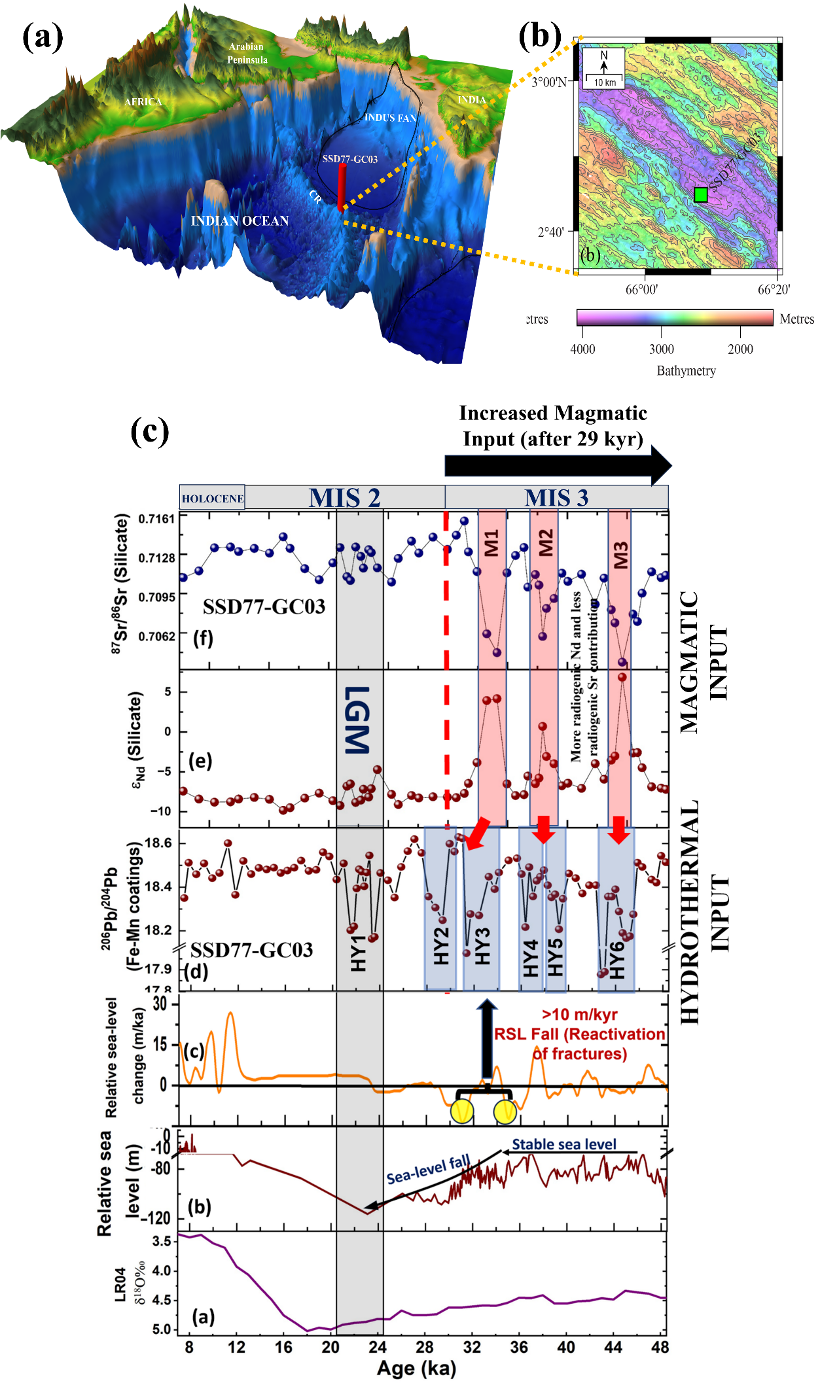
De and colleagues (2026, see reference below) provide a high-resolution record of magmatic input and associated hydrothermal activity over the past 49 kyr from a core recovered from a magmatic segment of the slow-spreading Carlsberg Ridge in the Indian Ocean. They show that during MIS 3, basalt-fragment mass accumulation rates (BF-MAR) and magnetic susceptibility exhibit coherent increases, accompanied by shifts toward less radiogenic 87Sr/86Sr and more radiogenic neodymium isotope composition (εNd) values, indicating an enhanced contribution of locally derived MORB-type material to the sediment. They demonstrate that variations in basaltic input are attributable to differences in melt extraction and delivery to the ridge axis rather than to large changes in mantle melt productivity. By relating their data to tectonic events, but primarily to sea-level changes, they reveal that glacio-eustatic sea-level variability influenced the timing and efficiency of melt delivery, eruption, and hydrothermal circulation at the slow-spreading Carlsberg Ridge.
The millennial-scale magmatic phases observed in this study at the Carlsberg Ridge align with the hydrothermal episodes identified in the preceding authors’ study (De et al., 2025, read GEOTRACES science highlight about this paper), indicating a common magmatic heat source. Altogether, De and his co-workers propose the first isotopic framework that resolves magmatic and hydrothermal variability and links both to glacio-eustatic forcing.
References:
De, S., Singh, S. K., & Yatheesh, V. (2026). Glacial sea-level drop triggers magmatic activity at the Carlsberg ridge during marine isotope stage 3. Chemical Geology, 714, 123451. Access the paper:10.1016/j.chemgeo.2026.123451
De, S., Singh, S.K., John, R. (2025). Millennial-scale hydrothermal variability at the Carlsberg Ridge driven by sea-level change and transient magmatism. Geochem. Geophys. Geosyst. 26, e2025GC012552. Access the paper: 10.1029/2025GC012552