Benaltabet and coworkers (2026, see reference below) analysed suspended particles collected in the upper 500 m during the GEOTRACES GP21 cruise from Chile to New Caledonia. They determined the zinc (Zn) concentrations and isotopic composition of these particles as well as those in the aerosols. To better establish anthropogenic sources, the authors coupled their measurement to those of lead (Pb) isotopes. The results speak for themselves: in this remote area, as far from the nearest civilisation as the International Space Station, significant Zn and Pb enrichment factors, light Zn isotope signatures, and Pb isotope compositions clearly trace industrial emissions, while Zn from natural sources was nearly undetectable. Given that Zn is a critical coenzyme for phytoplankton development, these findings once again confront humanity with the consequences of its excesses.
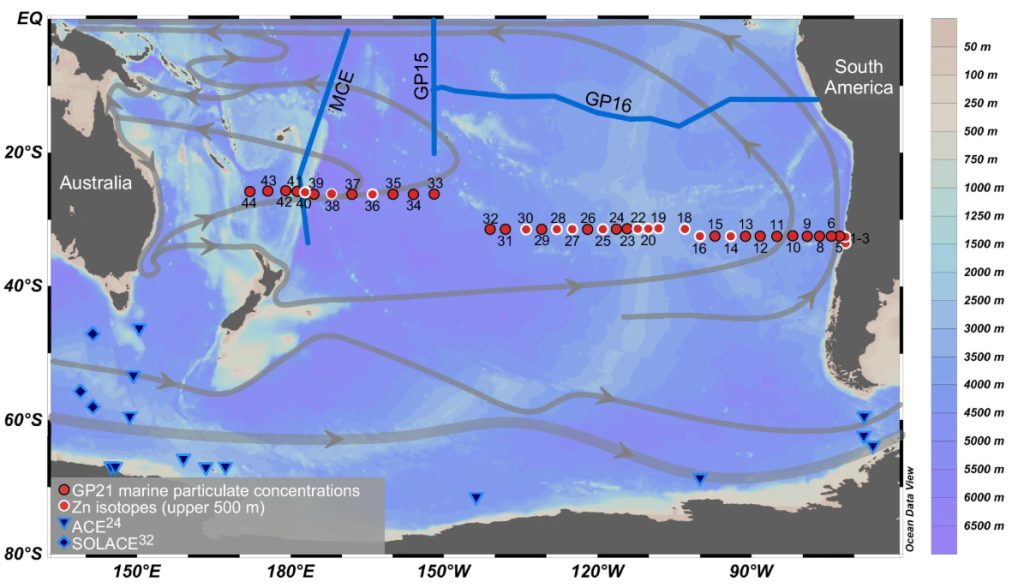
Figure 1: GEOTRACES GP21 sampling stations in the South Pacific Ocean.All stations were sampled for water column particulate profiles and atmospheric aerosols (red circles). The stations for which we present marine particulate Zn (and Pb) isotope data are outlined in white. Blue lines and symbols depict the cruise tracks and sampling stations of previous studies. General flow-path of surface currents is depicted by grey arrows. Figure generated using Ocean Data View.
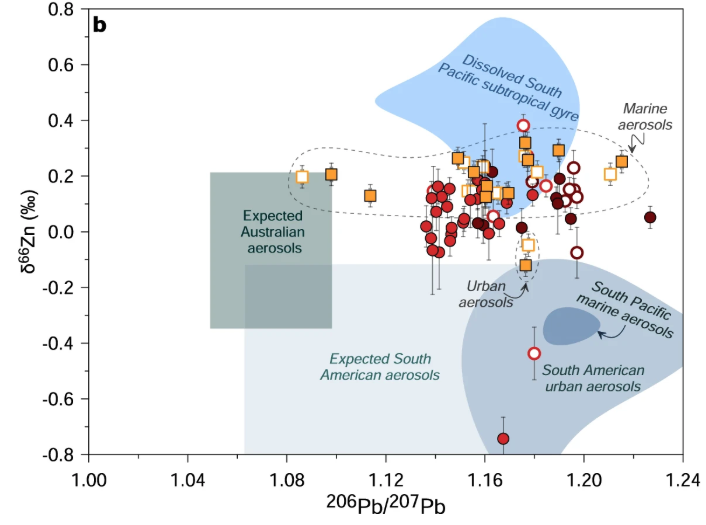
Figure 2: Isotope compositions of Zn and Pb in marine particles and aerosols along with potential sources. δ66Zn vs 206Pb/207Pb. The expected long-term isotope composition of Australian- and South American-sourced aerosols (green and grey squares, respectively) is estimated using the upper and lower boundaries of δ66Zn and 206Pb/207Pb measured in aerosols from South America and (offshore) Australia. Also presented are the ranges of dissolved South Pacific subtropical gyre data as well as urban and South Pacific marine aerosols.
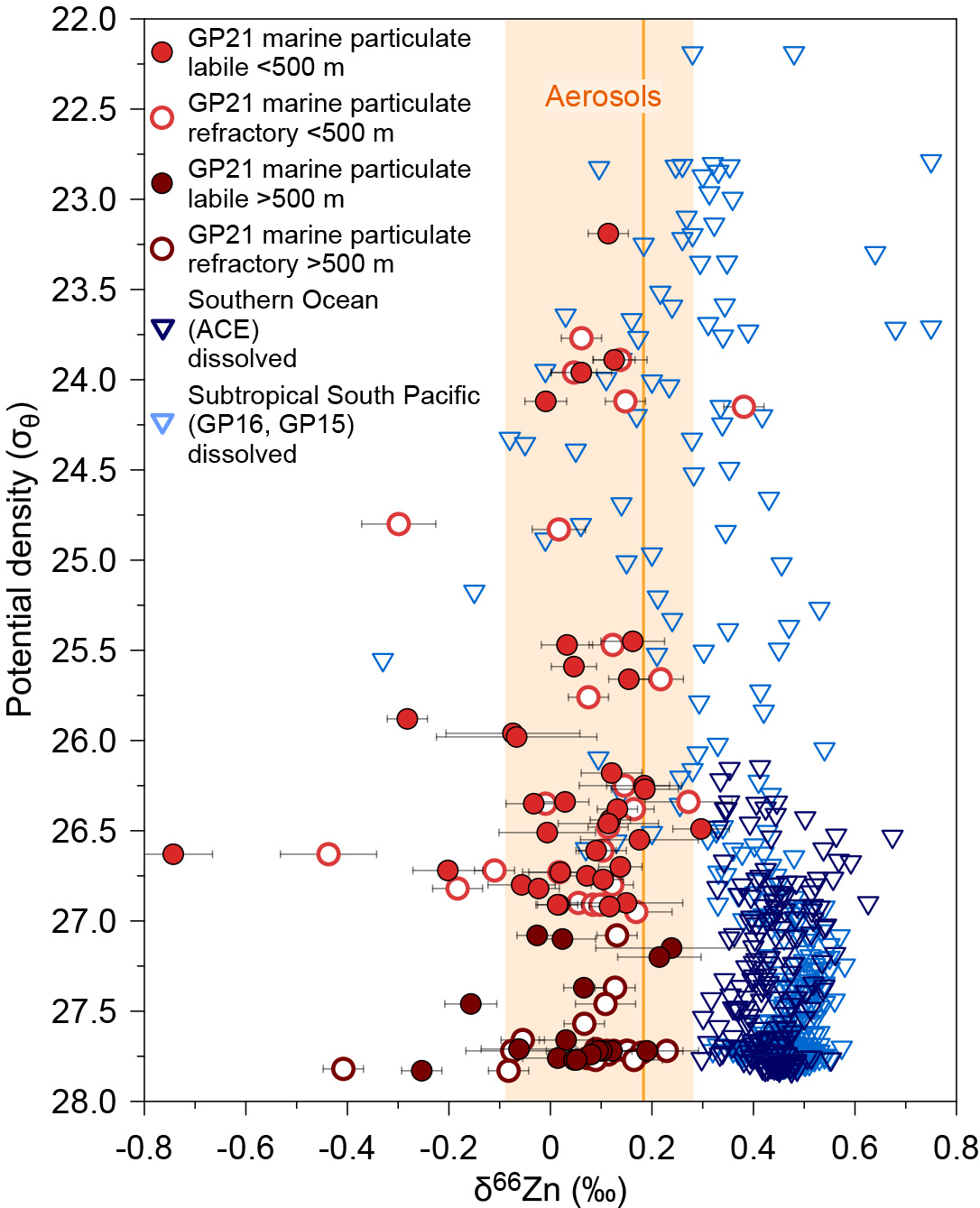
Figure 3: GP21 labile and refractory marine particulate phases (full and empty red circles, respectively) are presented against seawater potential density (σθ). Upper water column marine particles are isotopically lighter (lower δ66Zn) than, or similar to, dissolved Zn (inverted blue triangles) advected from the Southern Ocean (ACE: Antarctic Circumnavigation Expedition) and dissolved Zn within the South Pacific subtropical gyre (GP16 and GP15). The range of bulk (labile + refractory) aerosol δ66Zn from GP21 (orange bar; average depicted by an orange line) overlaps with the range of δ66Zn in marine particles. Error bars represent either propagated errors or uncertainties derived from the replicate analyses of certified reference materials.
Reference:
Benaltabet, T., Gosnell, K. J., de Souza, G. F., Jasinski, D., Rickli, J., O’Sullivan, E. M., Steiner, Z., Achterberg, E. P., & Vance, D. (2026). Pervasive contamination of the remote open ocean with anthropogenic zinc. Communications Earth Environment, 7. doi:10.1038/s43247-026-03425-y
Rechercher
We use cookies to guarantee you the best experience on our site, and to make statistics of attendance (Google Analytics). If you continue to use this site we will assume that you are happy with it.