
Continuous record of the Antarctic Circumpolar Current latitude over the last glacial-interglacial cycles
The meridional positions of the oceanic fronts separating subtropical and Antarctic waters are key to constraining the mechanisms that drive the degassing of deeply-stored CO2 at the end of the glacial periods. A central unresolved question concerns the positions of these fronts and the relation to the strong upwelling occurring at these latitudes and to the Southern Westerly Winds (SWW).
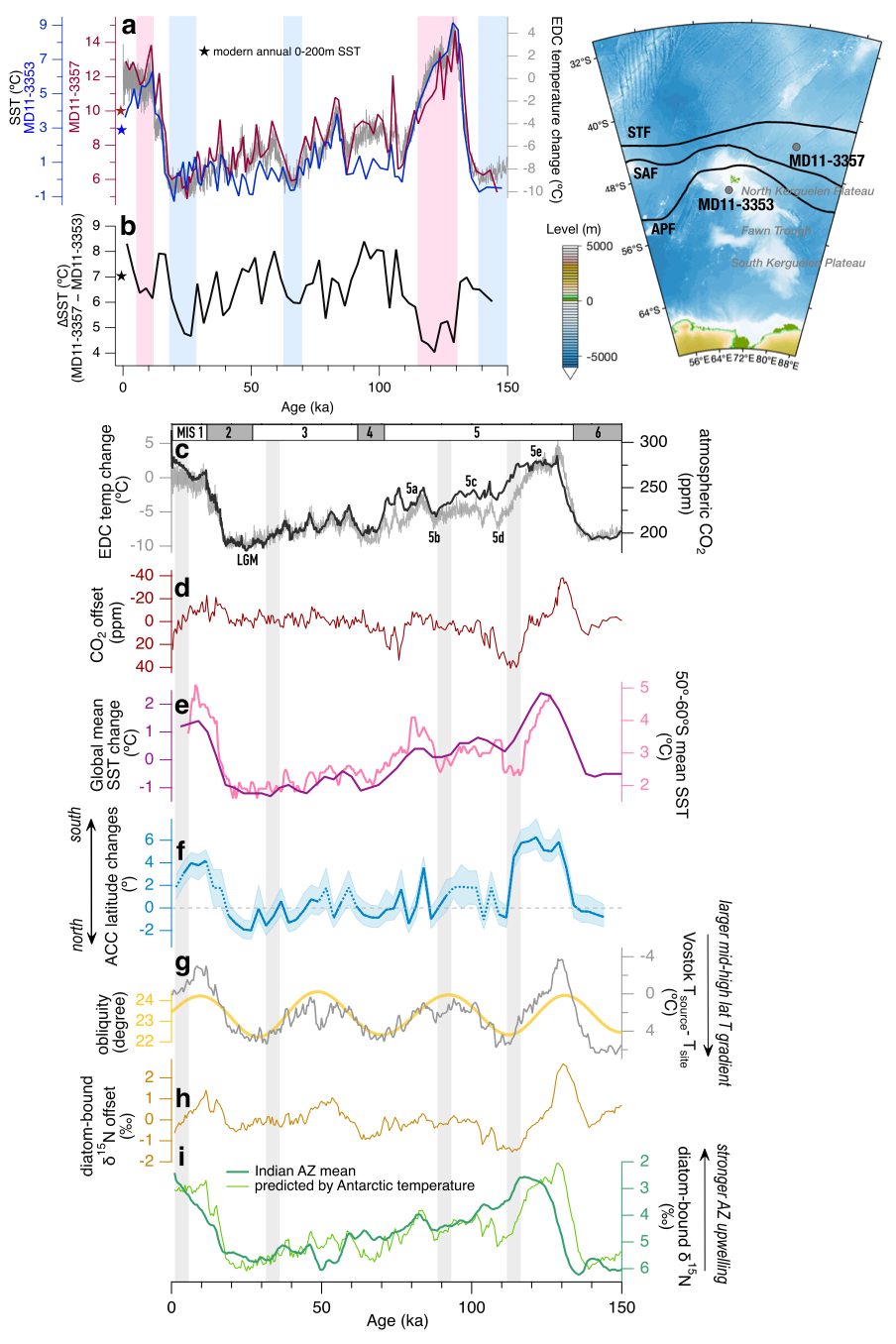
Ai and colleagues (2024, see reference below) addressed this challenge with the following toolbox: 1) the TEXL86 paleo-thermometer, which can be applied to across a broad latitudinal range in the Southern Ocean, 2) high resolution upper ocean temperature records reconstructed from two sediment cores located at 44.7°S (3349 m water depth) and 50.6 °S (1568m water depth) respectively, 3) a prognostic framework that quantitively estimates the latitude of the steep temperature gradient characterizing the Antarctic Circumpolar Current (ACC), the boundary between subtropical and Antarctic waters, based on temperature at two sites situated on either side of this boundary.
The resulting temporally continuous reconstruction of the ACC latitude revealed generally a more equatorward position during cold periods and a more poleward location during warm intervals. The authors further suggest that Earth’s obliquity has a strong influence on SWW intensity and Antarctic upwelling.
Reference:
Ai, X. E., Thöle, L. M., Auderset, A., Schmitt, M., Moretti, S., Studer, A. S., Michel, E., Wegmann, M., Mazaud, A., Bijl, P. K., Sigman, D. M., Martínez-García, A., & Jaccard, S. L. (2024). The southward migration of the Antarctic Circumpolar Current enhanced oceanic degassing of carbon dioxide during the last two deglaciations. Communications Earth & Environment, 5. Access the paper:10.1038/s43247-024-01216-x