
Neodymium budget in the Arabian Sea is governed by a combination of water mass advection and dominant boundary exchange processes
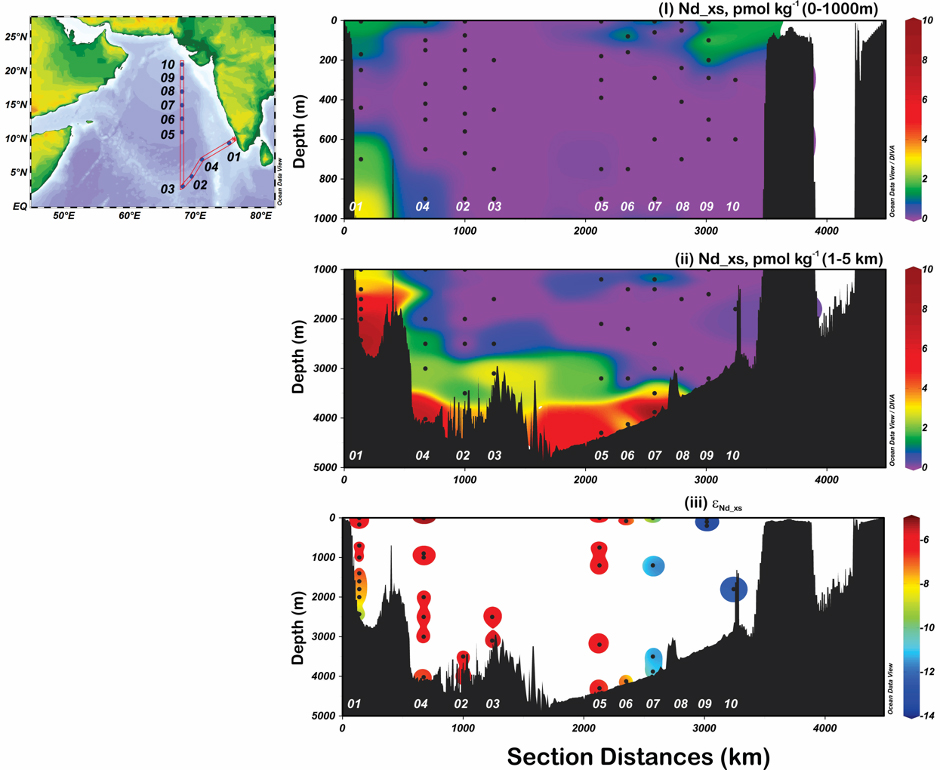
Karri and Singh (2026, see reference below) established the neodymium (Nd) concentrations and isotopic compositions -expressed as εNd- along a North-South section in the eastern Arabian Sea. The horizontal and vertical distributions of both dissolved Nd parameters underscore the influence of multiple sources and water masses, reflecting the complexity of the local hydrographic setting. Non-radiogenic Nd reflects the release of Nd from particles delivered by the Indus River in the northern Arabian Sea, and by the Ganga-Brahmaputra and peninsular rivers in the south-eastern region. In contrast, atmospheric mineral dust deposition from adjacent landmasses imprints radiogenic Nd signatures in the surface waters of the central Arabian Sea. Using an inverse model-derived excess Nd in surface waters, the authors estimate a dust flux of 1.8 ±1.4 g m−2 y−1 over the Arabian Sea.
Reference:
Karri, D., & Singh, S. K. (2026). Control of the water masses, aeolian and fluvial particulates and deoxygenation on the dissolved neodymium and its isotope composition in the Arabian Sea. Chemical Geology, 719, 123571. doi:10.1016/j.chemgeo.2026.123571