
23 Million Years of iron sources reconstructed in the Northwest Pacific Ocean using iron isotopes in a ferromanganese crust
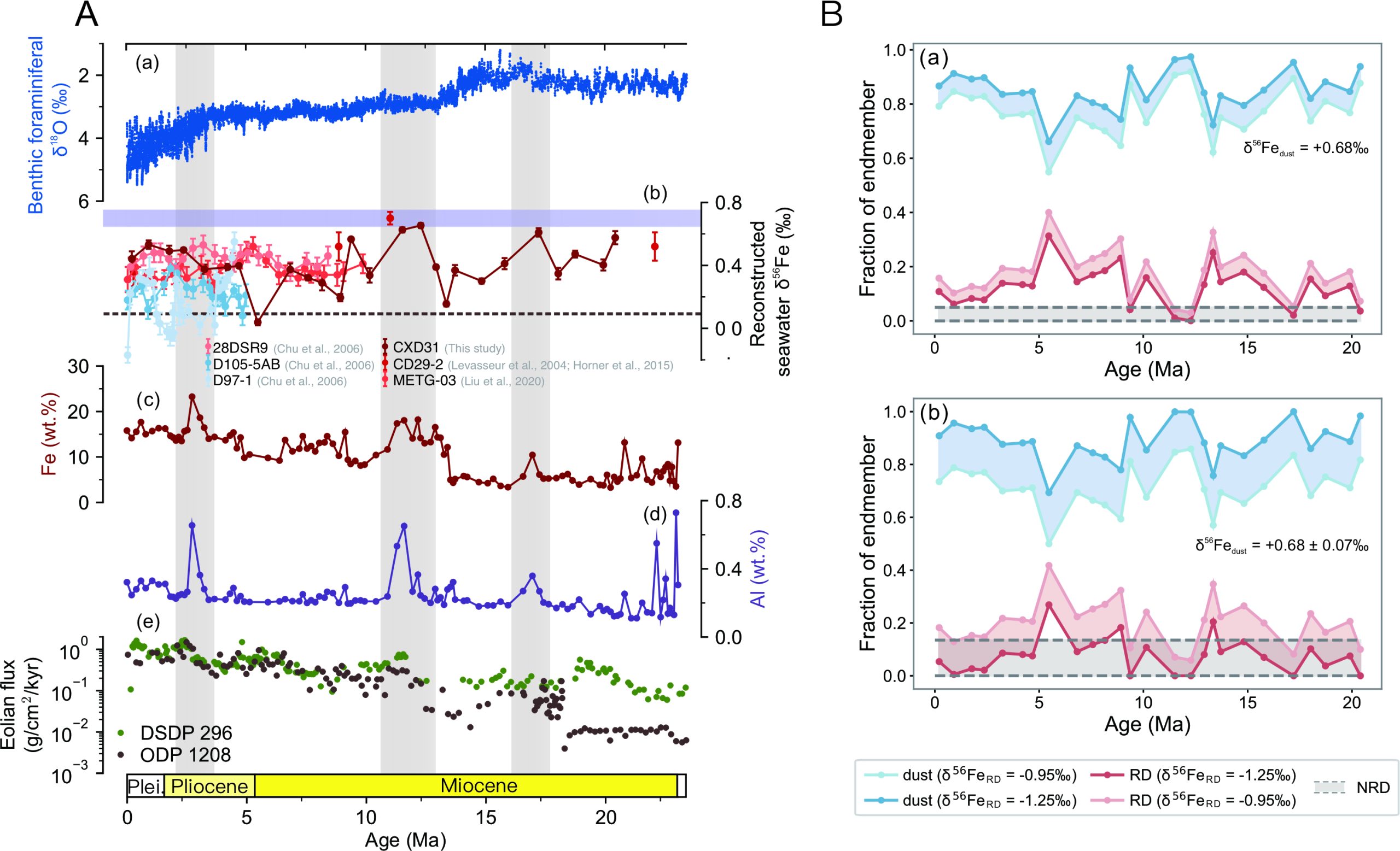
Using iron (Fe) isotopes and elemental records, Chu and co-workers (2026, see reference below) analysed an iron-manganese (Fe-Mn) crust (CXD31; 173.2°E, 19.9°N, 1,357 m depth) recovered from the Hongyan Seamount, and reconstructed the sources of dissolved Fe to the Northwest Pacific Ocean over the past 23 Myr. Building on the age model of the same crust (magnetic scanning, beryllium isotopes and cobalt flux), the authors measured Fe concentrations and Fe isotopic compositions (δ56Fe) along the crust profile, together with aluminium (Al) as a lithogenic tracer. Reconstructed seawater δ56Fe was then interpreted with a three-endmember mixing model – atmospheric dust, reductive dissolution (RD) of margin sediments, and non-reductive dissolution (NRD) – whose endmember compositions are drawn from the GEOTRACES-era Fe isotope literature.
Fe concentrations in CXD31 range from 3.28 to 23.25 wt.% and δ56Fe from −0.73 to −0.12‰, with reconstructed seawater values falling within the range of modern oceanic Fe sources. Sensitivity tests constrain the dust contribution to 0.58–0.98, RD to 0.01–0.39 and NRD to 0–0.05, indicating that dust deposition has been the dominant control on dissolved δ56Fe at this site since the Miocene. Three intervals (~16.9, ~11.6 and ~2.7 Ma) show coupled increases in Fe, Al and δ56Fe that coincide with enhanced eolian flux at nearby drilling sites, and are attributed to the aridification of inland Asia associated with Tibetan Plateau uplift and global cooling. A marked regional contrast also emerges: sediment-derived Fe accounts for ~77% of the Fe budget recorded by a near-margin western Pacific crust over the last 5 Myr, but only ~19% at CXD31 in the subtropical gyre. Fe-Mn crusts therefore appear to record regional rather than basin-averaged Fe inputs, consistent with the GEOTRACES-informed view that sediment-derived Fe can be transported over long distances into the open ocean.
References:
Chu, Y., Li, X., Xie, R. C., Conway, T. M., Xu, A., Dong, Y., 2026. Tracing the persistence and role of deep-sea iron sources in the Pacific Ocean over the last 23 million years. Geophys. Res. Lett. 53, e2025GL121323. Access the paper: https://doi.org/10.1029/2025GL121323
Conway, T. M., John, S. G., 2014. Quantification of dissolved iron sources to the North Atlantic Ocean. Nature 511, 212-215. Access the paper: https://doi.org/10.1038/nature13482
Fitzsimmons, J. N., Conway, T. M., 2023. Novel insights into marine iron biogeochemistry from iron isotopes. Annu. Rev. Mar. Sci. 15, 383-406. Access the paper: https://doi.org/10.1146/annurev-marine-032822-103431
Sieber, M., Lanning, N. T., Steffen, J. M., Bian, X., Yang, S. C., Lee, J. M., et al., 2024. Long distance transport of subsurface sediment-derived iron from Asian to Alaskan margins in the North Pacific Ocean. Geophys. Res. Lett. 51, e2024GL110836. Access the paper: https://doi.org/10.1029/2024GL110836