The Atlantic’s trace element fingerprint is mainly shaped at high latitudes
The ocean’s vast circulation system transports water across thousands of kilometers, connecting polar regions with tropical seas and the surface ocean with the deep. Along these journeys, seawater carries trace elements (TE) such as iron, zinc, cobalt, and nickel that are essential for marine life. The current paradigm is that TE distribution result from local processes, including metal inputs from sediments and hydrothermal vents, biological recycling, and removal by sinking particles on shaping the distributions of trace elements in the Ocean. A new study by Chen and colleagues (2026, see reference below) reveals a surprisingly simple overarching picture: the trace metal stoichiometry of subsurface seawater is largely established in high-latitude oceans and subsequently carried across the Atlantic by the circulation dynamic.
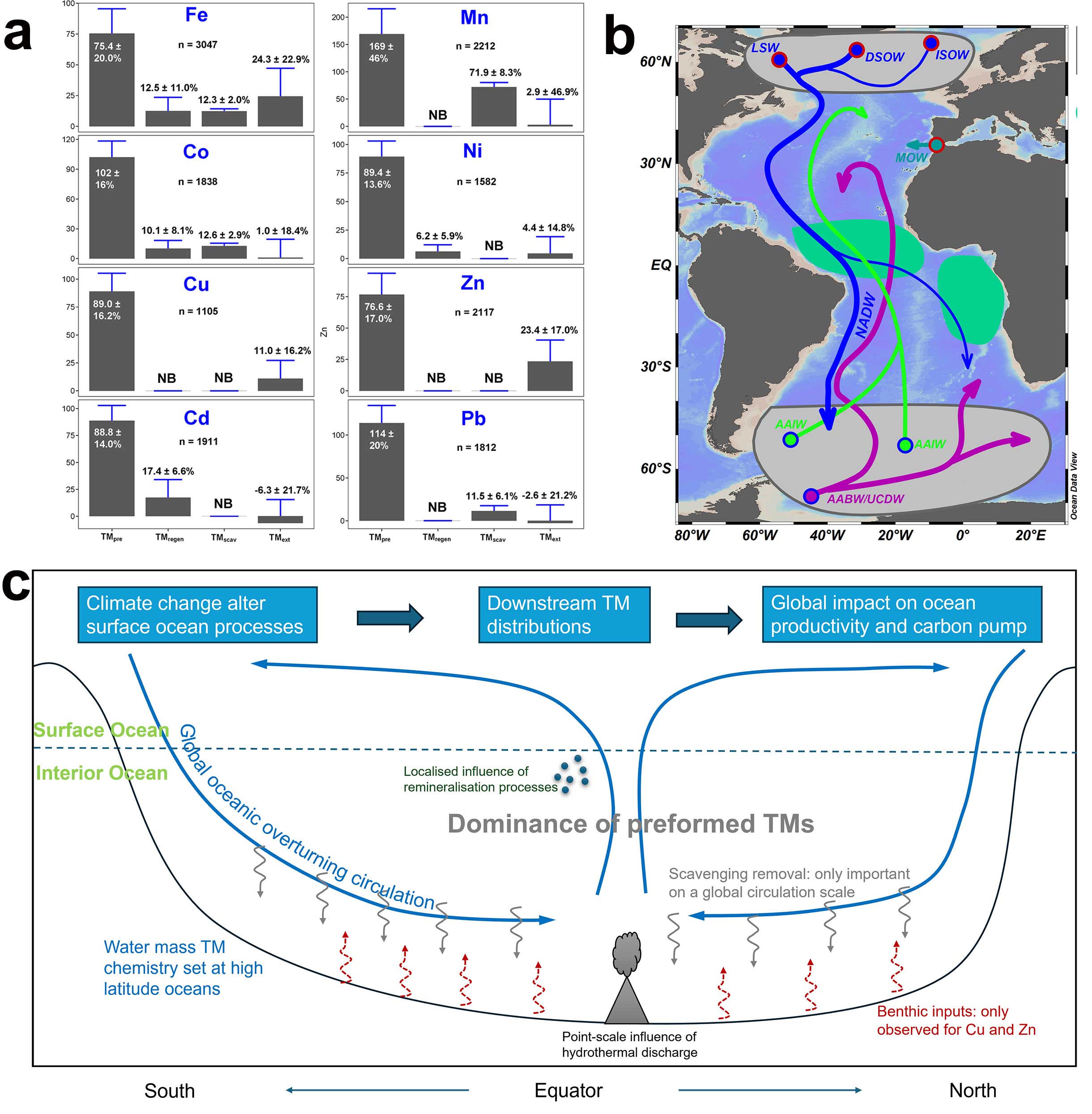
Using extensive datasets from the GEOTRACES Intermediate Data Product (IDP2021) and GLODAP to which they apply an eOMPA approach, the researchers traced the origins and mixing of water masses throughout the Atlantic Ocean and the Atlantic sector of the Southern Ocean. They examined eight trace metals (Fe, Mn, Co, Ni, Cu, Zn, Cd, and Pb) with very different chemical behaviors and found that water mass transport alone could explain approximately 60–90% of their observed distributions and more than 75% of their inventories in the Atlantic Ocean interior. This common pattern is particularly striking because some metals are rapidly recycled by marine organisms, whereas others readily attach to particles and are removed from seawater.
The study does not suggest that local processes are unimportant. The breakdown of sinking organic matter replenishes some metals, particularly in biologically active regions for Fe, Co, Ni, and Cd, while particles remove Fe, Mn, Co, and Pb from seawater. Hydrothermal vents and seafloor sediments can also create point-scale sources for trace elements. However, these processes generally modify a broader chemical pattern already established when deep and intermediate waters form in high latitude oceans.
With these findings, the authors predicted the baseline trace metal distributions through the Atlantic at high spatial resolution. In addition, these findings have important implications for understanding how the ocean may respond to climate change. Warming, melting ice, and changes in ocean circulation could alter both the trace metal composition of newly formed water masses and the pathways through which they spread. Such changes may propagate far beyond polar regions, potentially affecting the availability of essential micronutrients, marine productivity, and the ocean’s ability to absorb carbon dioxide.
Reference:
Chen, XG., Tagliabue, A. & Achterberg, E.P. Distinct drivers control trace metal distributions through the Atlantic Ocean. Commun Earth Environ (2026). https://doi.org/10.1038/s43247-026-04145-z
GEOTRACES Intermediate Data Product Group. The GEOTRACES Intermediate Data Product 2021 (IDP2021). NERC EDS British Oceanographic Data Centre NOC https://www.bodc.ac.uk/data/published_data_library/catalogue/10.5285/cf2d9ba9-d51d-3b7c-e053-8486abc0f5fd/