
Arctic outflows to Davis Strait and the Labrador Sea traced by radionuclide distributions

This study demonstrates that Arctic outflows through the Canadian Arctic Archipelago play a much more significant role than previously recognised. Leist and co-authors (2026, see reference below) reached this conclusion based on observations of two artificial radionuclides, iodine-129 (129I) and uranium-236 (236U), collected in 2022 and 2024 from Baffin Bay, Nares and Davis Straits and the Labrador Sea. Their main findings are:

  • West Greenland Shelf Water (WGWW) contributes substantially (approximately 75%) to the surface water (known as Arctic Water) of central Baffin Bay.
  • Arctic-Atlantic-derived water entering Baffin Bay through Lancaster Sound makes major contribution (40 – 60%) to the formation of Transition Waters (TrW) in Baffin Bay.
  • Arctic Water in Baffin Bay appears to originate predominantly from Nares Strait and is derived primarily (up to 70 %) from Arctic-Atlantic Water.
  • Finally, Baffin Bay Transition Water contributes more than 20% to the formation of Labrador Sea Water (LSW).

Overall, this study represents an important advance in our understanding of the complex circulation and water mass exchanges between the Arctic and subarctic regions.
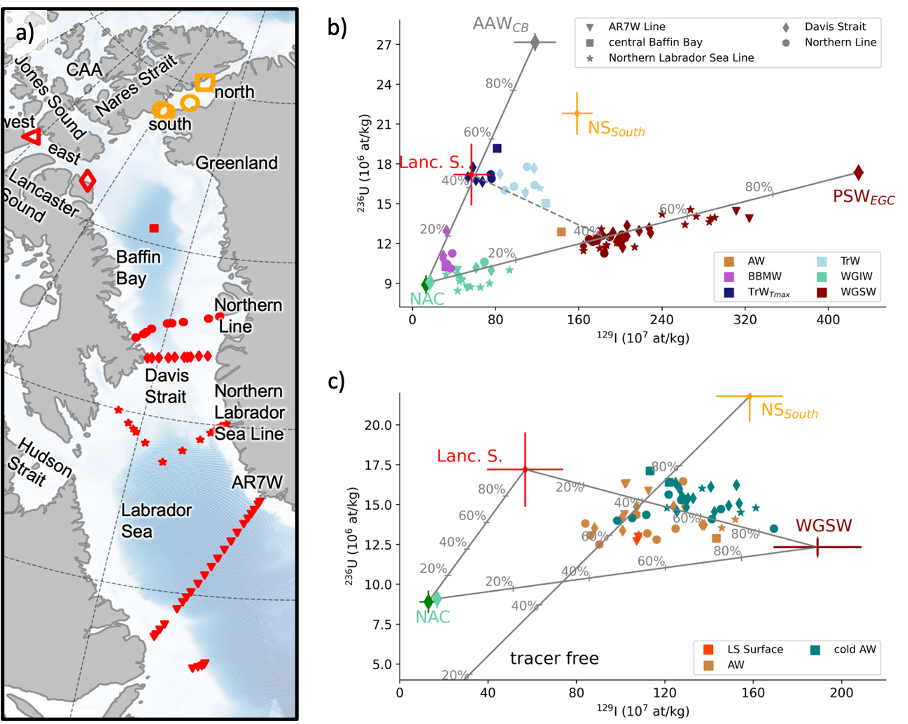
Figure: a) Map of the Baffin Bay showing the different oceanographic transects included in this study. Filled red symbols indicate sampling locations surrounding Davis Strait and along AR7W in 2022: central Baffin Bay (square), Northern Line (dots), Davis Strait (diamonds), Northern Labrador Sea Line (stars), and AR7W (triangles). Unfilled red symbols represent samples collected during the Amundsen cruise in 2024: Lancaster Sound (west: triangle, east: diamond) and Nares Strait (unfilled orange symbols). Panels b) and c) represent the binary mixing model based on artificial radionuclides 129I and 236U to infer mixing and water mass provenance. b) Mixing between Arctic Water (AW) and cold Arctic Water (cold AW) in Baffin Bay. C) Mixing in the Labrador Sea, including: Labrador Sea Water (LSW), Labrador Sea Surface Water, and North East Atlantic Deep Water (NEADW). Other acronyms in the legend are: Baffin Bay Mode Water (BBMW); Transition Water at Temperature Max (TrWTmax); West Greenland Irminger Water (WGIW) and West Greenland Shelf Water (WGSW).

Reference:

Leist, L. G. T., Castrillejo, M., Azetsu-Scott, K., Lee, C., Lenetsky, J., Ringuette, M., Vockenhuber, C., Pérez-Tribouillier, H., Jeandel, C., Tremblay, J.-É., & Casacuberta, N. (2026). Radionuclides as tracers of Arctic outflows: pathways, water mass mixing, and freshwater input to Davis Strait and the Labrador Sea. Ocean Science, 22, 1835–1860 Access the paper:10.5194/os-22-1835-2026

Latest highlights

Zinc and lead isotopes reveal human footprint on the most remote oceanic regions

Benaltabet and co-workers analysed suspended particles collected on GEOTRACES GP21 cruise tracked from Chile to New Caledonia.

Organic binding site heterogeneity controls amorphous ferric oxy-hydroxides oceanic sink

In oxygenated seawater iron binds to hydroxide ions, which results in authigenic Fe precipitation as amorphous ferric oxy-hydroxide…

Microbial trace metal transport in distinct water masses of the Southern Indian Ocean

Zhang and colleagues used genes coding for membrane transporters as proxies to map the distribution of the uptake and efflux of the trace metals…

Contraction of North Atlantic Deep Water during glacial times: a paradigm called into question

Blaser and co-authors propose a new distribution of deep-water masses in the Atlantic Ocean during the Last Glacial Maximum and the Heinrich Stadial 1…

Rechercher