
Authigenic radiogenic neodymium isotope composition traces millennial-scale overturning circulation variability in the Arabian Sea

The neodymium (Nd) isotopic signature of the sediment authigenic fraction is, a priori, a valuable proxy for reconstructing deep-water mass trajectories. However, several processes, including boundary exchange, particulate inputs, benthic fluxes, and hydrothermal processes, can perturb such reconstructions by modifying the radiogenic neodymium isotope composition of seawater (εNd). In this study, De and Singh (2026; see reference below) first conducted a thorough evaluation of these potential sources of contamination, demonstrating the reliability of εNd as a tracer of paleo-circulation and abyssal deep water-mass provenance.

Subsequently, high-resolution analyses of authigenic εNd along a gravity core collected from the axial valley of the Carlsberg Ridge (3,984 m water depth) enabled the authors to document the presence of North Atlantic Deep Water (NADW) in the Arabian Sea over the past 50 kyr (i.e., during MIS 3, MIS 2, and MIS 1). They propose a millennial scale re-organization of the Atlantic Meridional Overturning Circulation (AMOC). During MIS 1 and MIS 3, εNd values shift toward less radiogenic values, consistent with a stronger contribution from NADW. In contrast, during MIS 2, more radiogenic signatures trace a South Atlantic origin. Comparison of their record with previously established εNd records from the North, Equatorial, and South Atlantic Ocean enables a compelling reconstruction of past NADW dynamics.
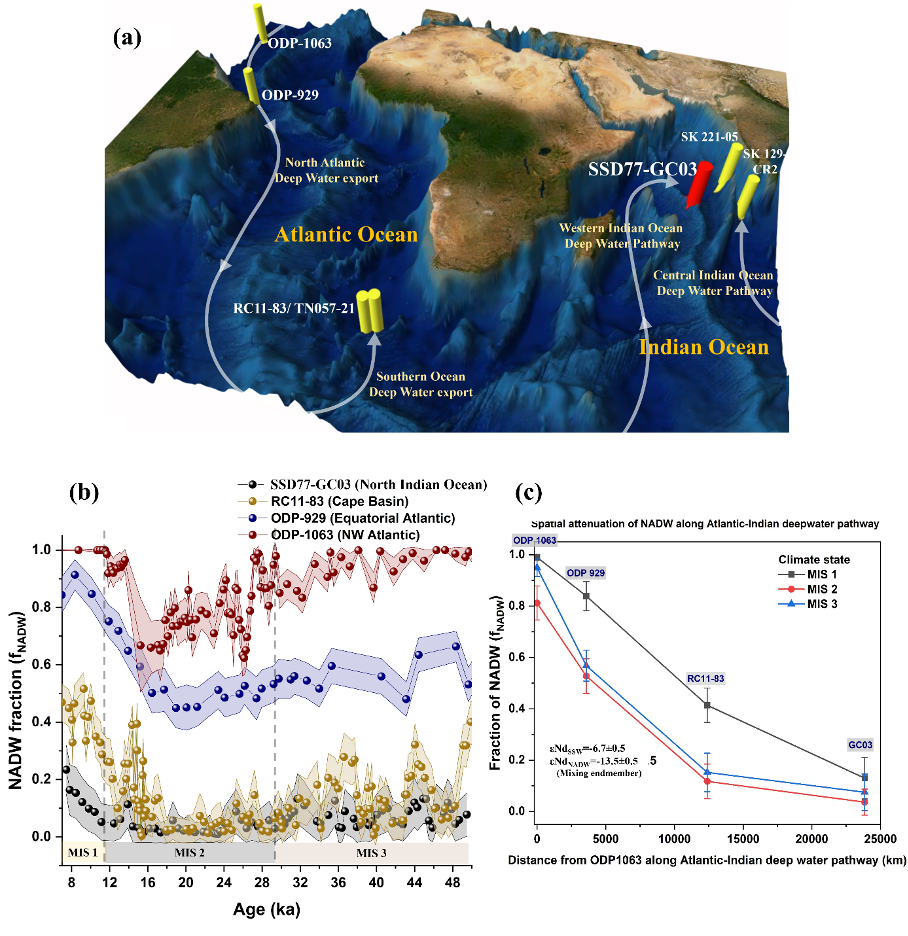
Figure: Core SSD77-GC03 from the Carlsberg Ridge provides a 50,000-year record of deep-water circulation along the Atlantic–Indian Ocean overturning pathway. Using authigenic neodymium isotopes preserved in marine sediments, we reconstructed changes in the contribution of North Atlantic Deep Water (NADW) reaching the Arabian Sea. The results show enhanced northern-sourced deep-water influence during MIS 1 and MIS 3, but a greater contribution from southern-sourced waters during MIS 2. Comparison with records from the North and South Atlantic reveals progressive downstream weakening of the NADW signal, with NADW contributing less than 20% of the deep-water mixture at abyssal depths in the western Arabian Sea. These findings establish the western Arabian Sea as a sensitive downstream recorder of Atlantic Meridional Overturning Circulation (AMOC) variability over glacial–interglacial and millennial timescales.

Reference:

De, S., & Singh, S. K. (2026). NADW attenuation and millennial-scale overturning circulation variability in the Arabian Sea constrained through authigenic εNd at the Carlsberg Ridge. Geochimica et Cosmochimica Acta423, 176–194. Access the paper:10.1016/j.gca.2026.04.048

Latest highlights

Magmatic activity at the Carlsberg Ridge in the Indian Ocean triggered by glacial sea-level variation

De and colleagues provide a high-resolution record of magmatic input and associated hydrothermal activity over the past 49 kyr from a core recovered from a magmatic segment of the slow-spreading Carlsberg Ridge in the Indian Ocean.

Zinc and lead isotopes reveal human footprint on the most remote oceanic regions

Benaltabet and co-workers analysed suspended particles collected on GEOTRACES GP21 cruise tracked from Chile to New Caledonia.

Organic binding site heterogeneity controls amorphous ferric oxy-hydroxides oceanic sink

In oxygenated seawater iron binds to hydroxide ions, which results in authigenic Fe precipitation as amorphous ferric oxy-hydroxide…

Microbial trace metal transport in distinct water masses of the Southern Indian Ocean

Zhang and colleagues used genes coding for membrane transporters as proxies to map the distribution of the uptake and efflux of the trace metals…

Rechercher