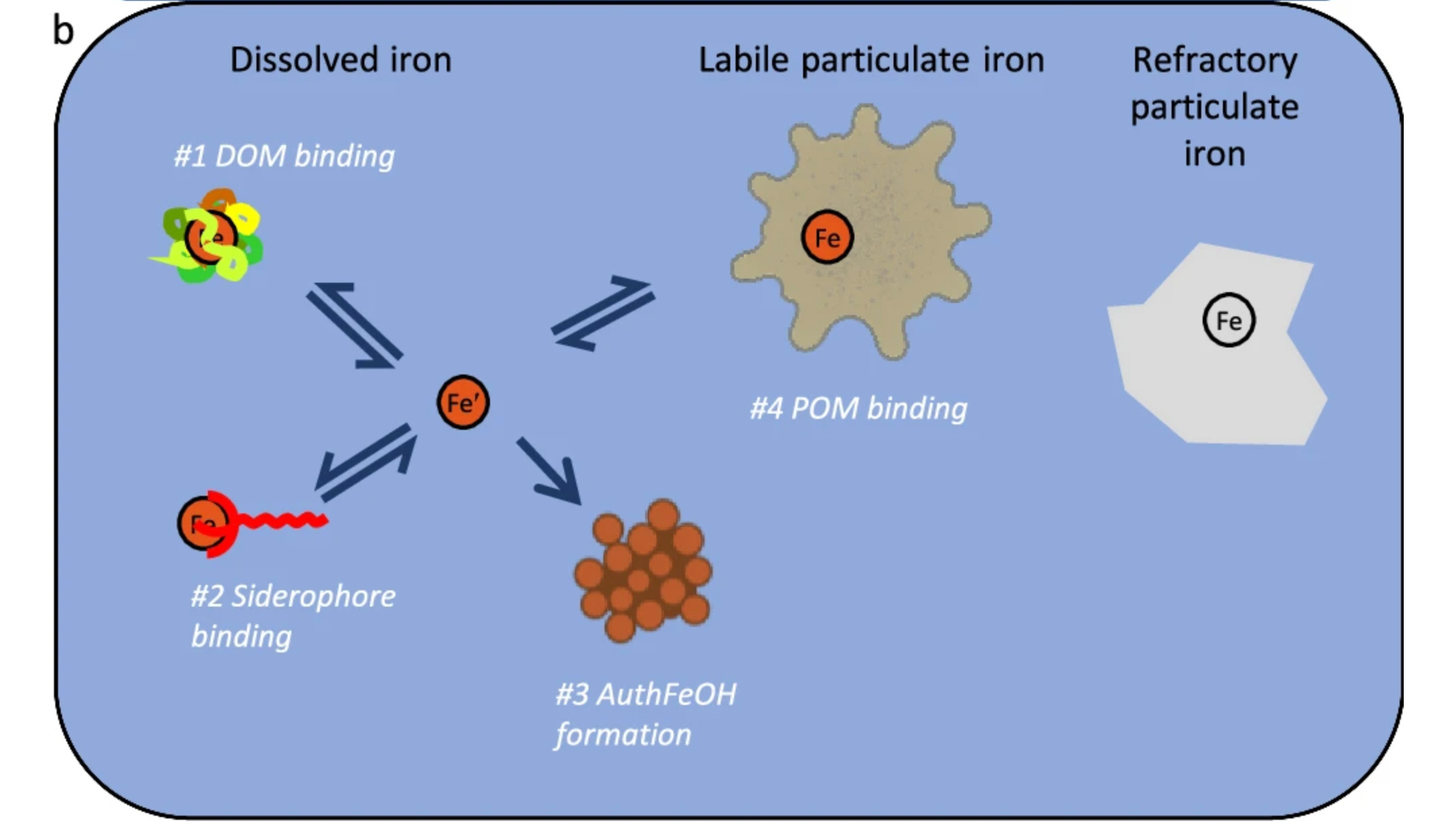
In oxygenated seawater iron (Fe) binds to hydroxide ions, which results in authigenic Fe precipitation as amorphous ferric oxy-hydroxides (authFeOH). Gledhill and colleagues (2026, see reference below) examine if authFeOH formation and the mechanisms underpinning iron (Fe) losses from the ocean could be constrained within a thermodynamically consistent framework that accounts for organic matter binding site heterogeneity, under changing environmental parameters (pH, temperature). Prior to this study, precipitation of authFeOH and abiotic scavenging was typically empirically related to the concentrations of soluble inorganic Fe (Fe’). Fe′ abundance was directly linked to an Fe binding ligand concentration: the more ligands you have, the more Fe complexed, the less Fe’ available, which hampered authFeOH formation. The authors propose a mechanistic approach, establishing Fe partitioning between the dissolved and labile particulate Fe (refractory Fe was not considered), with four different thermodynamically defined pathways: #1 reversible Fe binding to dissolved organic matter, #2 reversible Fe binding to microbial siderophores, #3 Fe precipitation as authFeOH and, #4 reversible Fe binding to particulate organic matter. They demonstrate that below 250 m in the South Pacific Ocean, accounting for changes in the affinity of dissolved organic matter for Fe is critical for the predicting widespread authigenic iron formation. Furthermore their mechanistic approach indicated that authFeOH formation is concentration near Fe sources and hence likely limits the extent to which Fe can be transported from source regions to the open ocean.
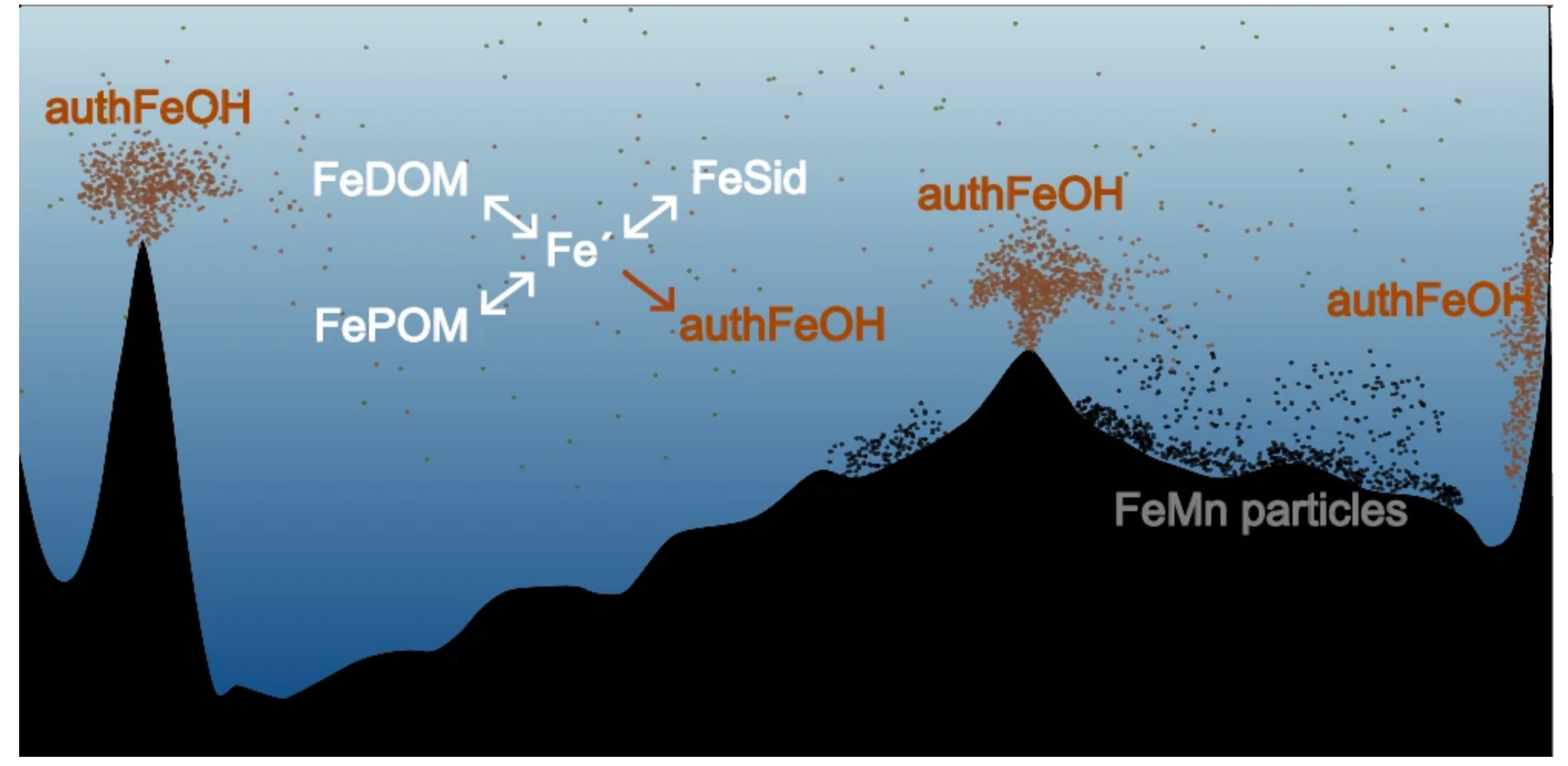
Figure 1: In this study Gledhill and colleagues, examine Fe partitioning between the dissolved and labile particulate phases, with refractory particulate Fe considered passive in the context of chemical interactions. They represent four different thermodynamically defined pathways comprised of #1 reversible Fe binding to dissolved organic matter (DOM), #2 reversible Fe binding to microbial siderophores, #3 Fe precipitation as authFeOH and #4 reversible Fe binding to particulate organic matter. They consider the organic phases to incorporate a wide range of Fe binding sites that reflect organic matter heterogeneity. Precipitated authFeOH could be present as colloids in the dissolved as well as in the particulate phase. All pathways operate at ambient pH and temperature. Further pathways, that would describe surface adsorption onto e.g., lithogenic particles are not included in this study.Figure 2: Equilibrium processes (white text) dominate in the oceans’ interior. At equilibrium, concentrations of inorganic Fe (Fe′) are buffered by Fe binding sites within dissolved (DOM) and particulate organic matter (POM) pools, with siderophores (Sid) contributing when they are present at high enough concentrations. When Fe′ becomes saturated, authigenic Fe hydroxides (authFeOH) form, which can be lost from the water column or, if present at low concentrations, remain within the water column, potentially as colloids and in association with organic matter. At the margins, equilibrium conditions are disturbed by Fe inputs. Inputs of labile and reduced Fe from e.g., hydrothermal, volcanic or reducing sediments give rise to supersaturated Fe′ that precipitates as authFeOH at rates likely controlled by a combination of pH, temperature and the form of Fe supplied by the source. The high abundance of Fe within this authFeOH phase means that rates of Fe loss will be intense near Fe sources. Our approach suggests inert sources of Fe, e.g., in the form of aged ferromanganese particles or refractory lithogenic material, do not result in detectable increases in dissolved forms of Fe in SPO.
Reference:
Gledhill, M., Gosnell, K., Humphreys, M. P., Delaigue, L., Helle, N., Zhu, K., Lodeiro, P., Rey-Castro, C., & Achterberg, E. P. (2026). Chemical controls on iron distributions across the subsurface South Pacific Ocean. Nature Communications, 17. doi:10.1038/s41467-026-72070-y
Rechercher
We use cookies to guarantee you the best experience on our site, and to make statistics of attendance (Google Analytics). If you continue to use this site we will assume that you are happy with it.