
Lead isotopes reveal that hydrothermal variability is driven by Sea‐Level change and transient magmatism

De and his colleagues’ study presents the first millennial-scale reconstruction of hydrothermal variability at a mid-ocean ridge using lead (Pb) isotopes from authigenic iron-manganese (Fe–Mn) coatings. Six hydrothermal events marked by unradiogenic Pb excursions and accompanying cobalt, nickel, and chromium (Co–Ni–Cr) enrichments over the Carlsberg Ridge are identified during the past 49 kyr. A key result during glaciation time (e.g., Marine Isotope Stage 4, MIS-4) sea-level low stand triggered enhanced magma production and increased hydrothermal activity, indicating that decreased hydrostatic pressure can initiate magmatic processes well before the Last Glacial Maximum, as suggested earlier. During the MIS 3–2 transition (i.e., entering the last glaciation), rapid sea-level drops generated additional pulses through increased fault-controlled permeability. These patterns reveal two forcing modes: melt-driven and fault-driven hydrothermal responses to sea-level fall. Fe–Mn coatings emerge as a powerful archive linking sea-level change to hydrothermal activity across glacial cycles, and Pb isotopes in these coatings are sensitive enough to track these subtle shifts in hydrothermal behaviour.
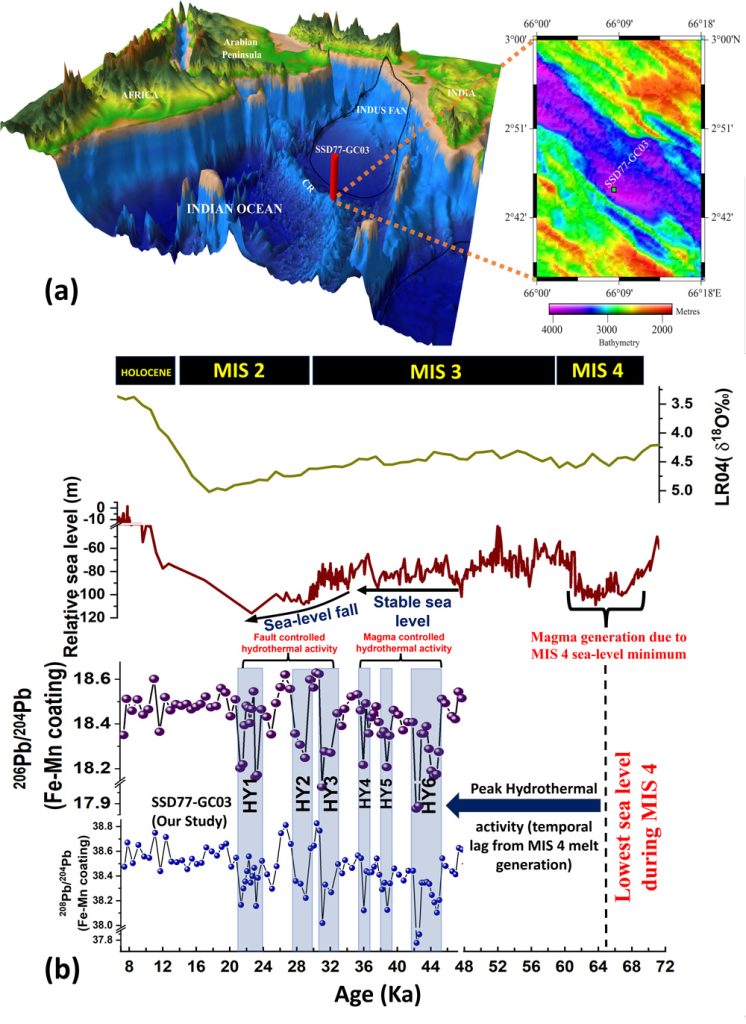
Figure: (a) Three-dimensional bathymetric view of the Carlsberg Ridge showing the symmetric, magmatically accreted ridge segment from which sediment core SSD77-GC03 was recovered. The inset map highlights the axial location of the core within the ridge valley. (b) Comparison of Fe–Mn coating Pb-isotope data  (²⁰⁸Pb/²⁰⁶Pb and ²⁰⁶Pb/²⁰⁴Pb)   from core SSD77-GC03 with the Red Sea relative sea-level curve (Grant et al., 2012) and LR04 benthic  δ¹⁸O stack. Vertical blue shaded bands (HY1–HY6) mark identified hydrothermal events inferred from unradiogenic Pb excursions. Periods of rapid sea-level fall (MIS 3-2 transition period) correspond to fault-controlled hydrothermal pulses, whereas stable sea-level intervals (MIS 3) coincide with magma-driven hydrothermal activity. The timing of peak hydrothermal intensity (HY5–HY6) lags the MIS 4 sea-level minimum, consistent with delayed magmatic response and melt generation beneath the Carlsberg Ridge.

Reference:

De, S., Singh, S. K., & John, R. (2025). Millennial‐Scale Hydrothermal Variability at the Carlsberg Ridge Driven by Sea‐Level Change and Transient Magmatism. Geochemistry, Geophysics, Geosystems, 26. Access the paper: 10.1029/2025gc012552

Latest highlights

Authigenic radiogenic neodymium isotope composition traces millennial-scale overturning circulation variability in the Arabian Sea

The neodymium isotopic signature of the sediment authigenic fraction is, a priori, a valuable proxy for reconstructing deep-water mass trajectories…

Magmatic activity at the Carlsberg Ridge in the Indian Ocean triggered by glacial sea-level variation

De and colleagues provide a high-resolution record of magmatic input and associated hydrothermal activity over the past 49 kyr from a core recovered from a magmatic segment of the slow-spreading Carlsberg Ridge in the Indian Ocean.

Zinc and lead isotopes reveal human footprint on the most remote oceanic regions

Benaltabet and co-workers analysed suspended particles collected on GEOTRACES GP21 cruise tracked from Chile to New Caledonia.

Organic binding site heterogeneity controls amorphous ferric oxy-hydroxides oceanic sink

In oxygenated seawater iron binds to hydroxide ions, which results in authigenic Fe precipitation as amorphous ferric oxy-hydroxide…

Rechercher