
Microbial trace metal transport in distinct water masses of the Southern Indian Ocean

Bioactive trace metals are vital co-factors for microbial enzymes, driving essential metabolic processes and element cycling. Microbes regulate intracellular metal levels via membrane transporters, which mediate uptake and efflux. These processes may create feedback loops between microbes and their environment. Whether these processes vary among trace metals and across habitats is presently not known. Zhang and colleagues (2026, see reference below) used genes coding for membrane transporters as proxies to map the distribution of the uptake and efflux of the trace metals iron (Fe), manganese (Mn), nickel (Ni) and copper (Cu) in surface waters across a latitudinal transect and in distinct water masses of the Southern Indian Ocean during the SWINGS (South West Indian Ocean GEOTRACES GS02 Section) cruise. They observed an enrichment of efflux genes in North Atlantic Deep Water and Lower Circumpolar Deep Water suggesting that microbes could shape trace metal speciation and distribution. Concurrently, the distinct gene repertoire of key bacterial taxa in these old water masses may reflect adaptation to the unique chemical conditions, with trace metals acting as selective drivers. This study highlights the role of microbial-metal homeostasis in deep ocean biogeochemistry, with potential implications for understanding trace metal cycling and microbial adaptation in distinct marine habitats.
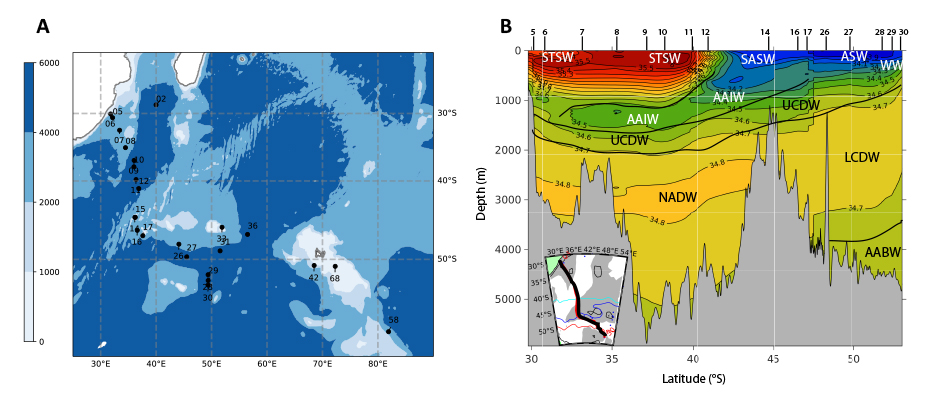
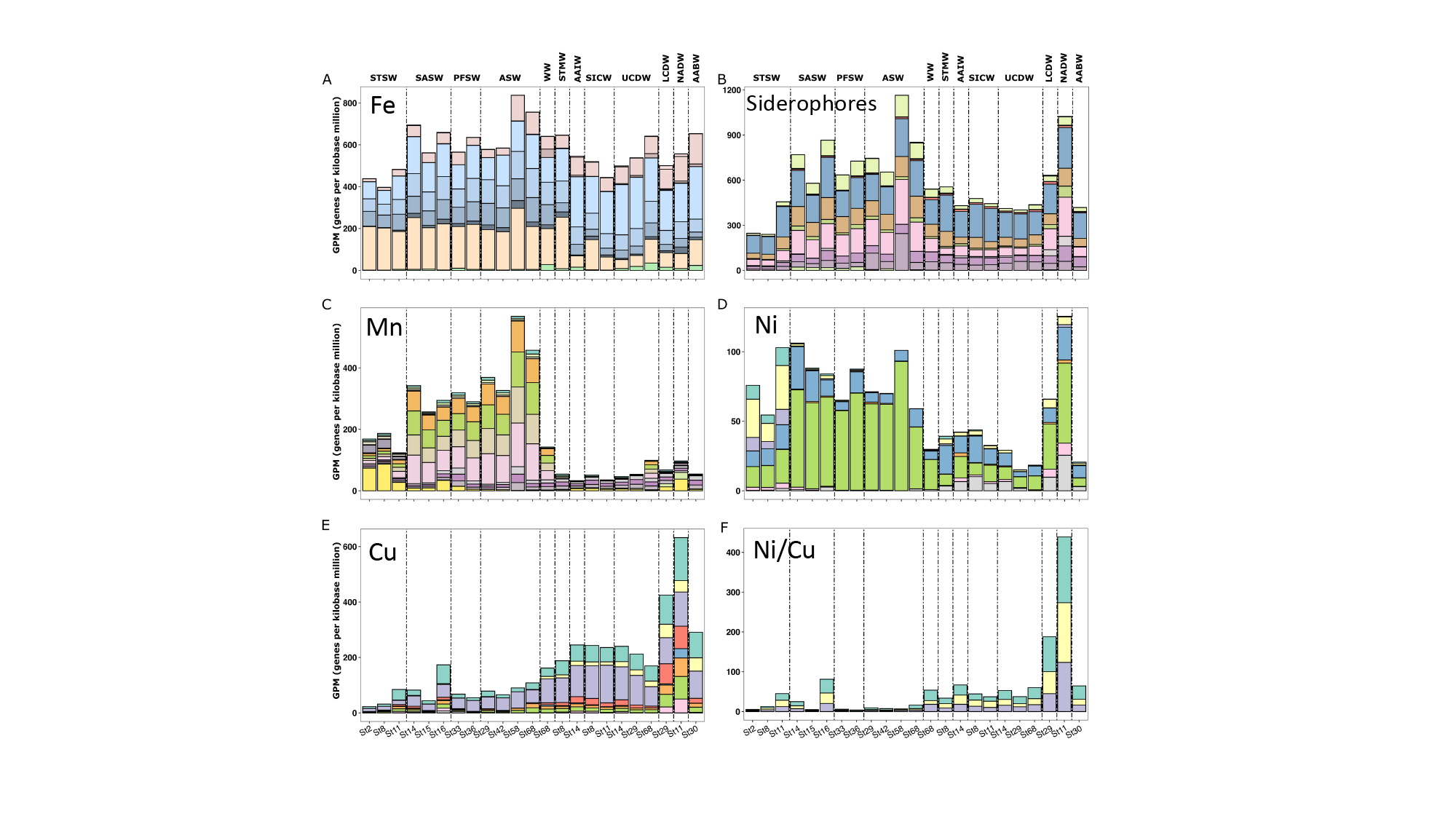
Figure 1. A. Map of stations from the SWINGS cruise in the Indian Sector of the Southern Ocean. Shown are stations that were used to produce the map of water masses as illustrated in panel B, and the stations where samples were collected for the present study. Color shading represents bathymetry and the grey line contours South Africa (25°- 35° E) and Madagascar (45°-50°E). B. A cross-section (inserted map) showing the vertical distribution of some water masses at the stations indicated on the upper x-axis. Lines indicate salinity. STSW, Subtropical Surface Water; SASW, Subantarctic Surface Water; ASW, Antarctic Surface Water; WW, Winter water; AAIW, Antarctic Intermediate Water; UCDW, Upper Circumpolar Deep Water; LCDW, Lower Circumpolar Deep Water; NADW, North Atlantic Deep Water; AABW, Antarctic Bottom Water.
Figure 2: Normalized abundance of genes related to the transport of Fe (Fe3+, Fe 2+) (A), heme and siderophores (B), Mn (C), Ni (D), Cu (E), and Ni/Cu (F) in free-living microbial communities in surface waters (STSW- Subtropical Surface Water; SASW- Subantarctic Surface Water; ASW-Antarctic Surface Water) and water masses (WW- Winter Water; AAIW- Antarctic Intermediate Water; UCDW- Upper Circumpolar Deep Water; LCDW- Lower Circumpolar Deep Water; NADW-North Atlantic Deep Water; AABW- Antarctic Bottom Water). The color codes in each panel refer to different genes within a category.

Reference:

Zhang, R., Debeljak, P., Gadegaonkar, S. S., Baudet, C., Ringard, A., Blain, S., & Obernosterer, I. (2026). Microbial membrane transporters reveal trace metal niche adaptation in distinct water masses of the Southern Ocean. Microbiome, 14. Access the paper: 10.1186/s40168-025-02293-6

Latest highlights

Mercury content and isotopes in bird’s guano: a window to reconstruct past climates

By analysing peat cores, Chuxian Li and her colleagues have shown how populations of nesting seabirds have fluctuated on a sub-Antarctic Island over the last 8,000 years.

Contraction of North Atlantic Deep Water during glacial times: a paradigm called into question

Blaser and co-authors propose a new distribution of deep-water masses in the Atlantic Ocean during the Last Glacial Maximum and the Heinrich Stadial..

Authigenic radiogenic neodymium isotope composition traces millennial-scale overturning circulation variability in the Arabian Sea

The neodymium isotopic signature of the sediment authigenic fraction is, a priori, a valuable proxy for reconstructing deep-water mass trajectories…

Magmatic activity at the Carlsberg Ridge in the Indian Ocean triggered by glacial sea-level variation

De and colleagues provide a high-resolution record of magmatic input and associated hydrothermal activity over the past 49 kyr from a core recovered from a magmatic segment of the slow-spreading Carlsberg Ridge in the Indian Ocean.

Rechercher