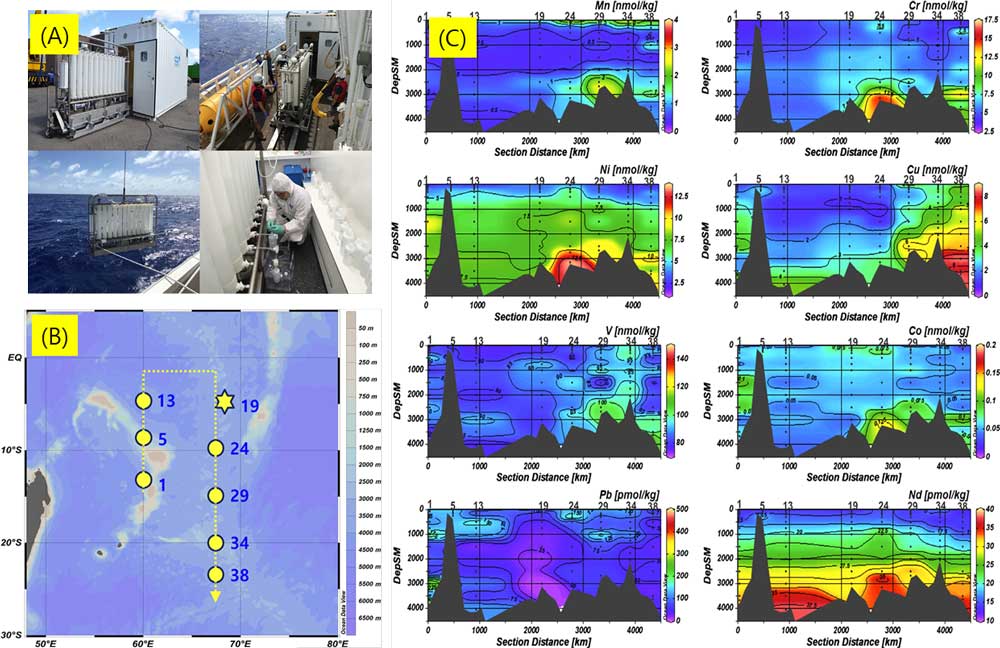
About the decoupled fates of aluminium, manganese, cobalt and lead in the North Pacific Ocean
Did you know that each of these tracers could follow its own marine story, quite decoupled from the others?
Some recent GEOTRACES science findings are reported below.
Did you know that each of these tracers could follow its own marine story, quite decoupled from the others?
Do you wish to improve your recoveries, blanks or any other parameter of your seawater preconcentration system (seaFAST)? Or are you simply curious about it? Wuttig and co-workers (2019, see reference […]
This treasure is made of approximately 60,000 valid tritium measurements, 63,000 valid helium isotope determinations, 57,000 dissolved helium concentrations, and 34,000 dissolved neon concentrations, including their metadata (geographic location, date […]
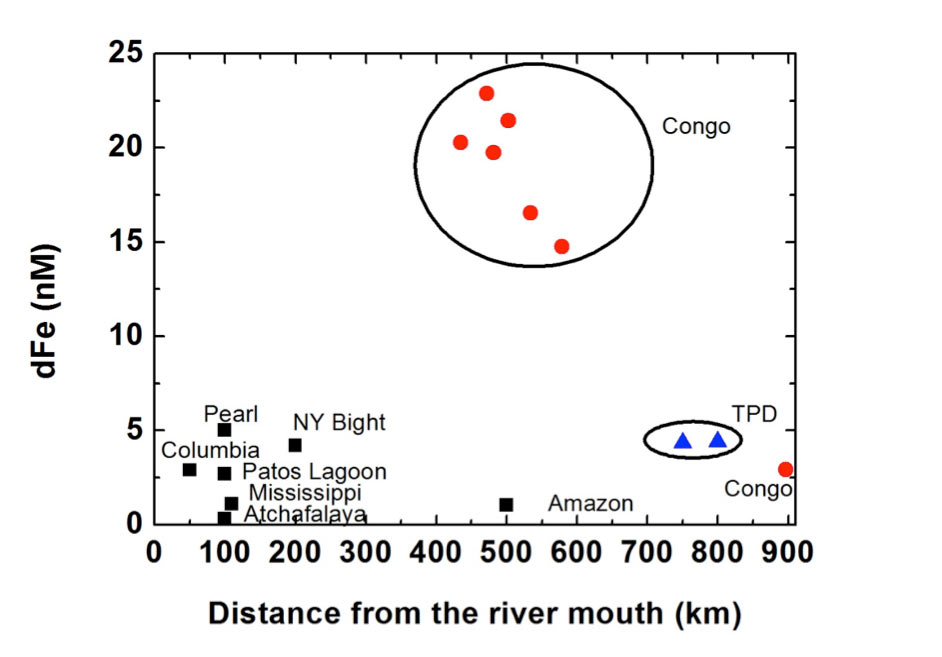
Separation of the particulate (> 0:22 μm), colloidal (0.22 μm–1 kDa), and truly dissolved (< 1 kDa) fractions of iron (Fe) was carried out along the 600 km mixing between […]
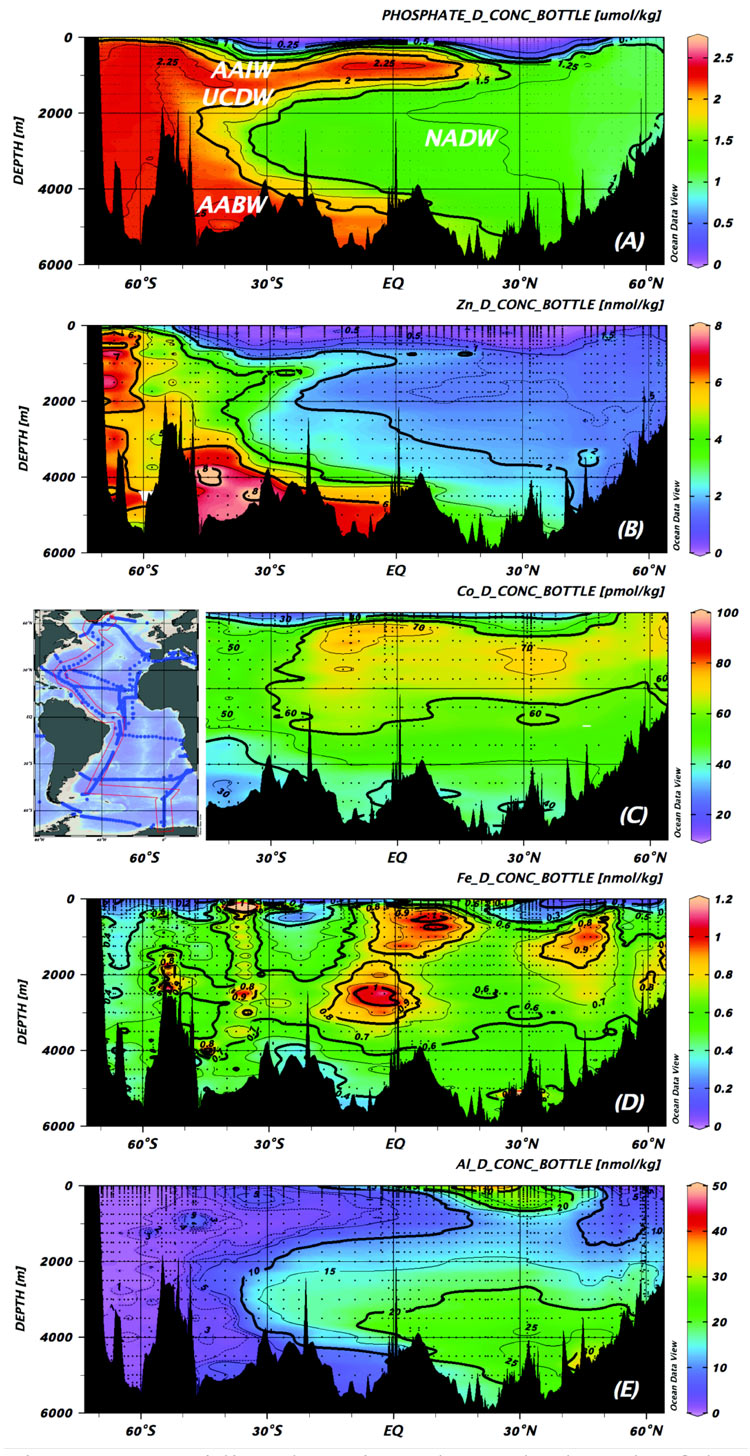
Middag and co-workers (2019, see reference below) established the distributions of dissolved zinc (Zn), silicate (Si) and phosphate (PO4) at high resolution along the GEOTRACES transect GA02, in other words, […]
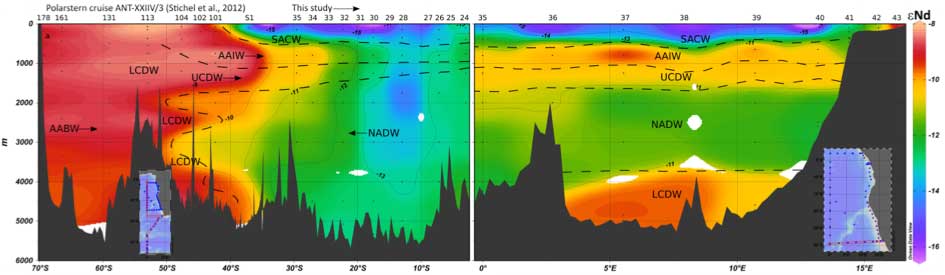
Rare earth elements (REE) patterns and neodymium (Nd) isotopic signatures of filtered and unfiltered waters collected as part of KEOPS GEOTRACES process study (mostly KEOPS 2, data compared to KEOPS […]
Dissolved chromium (Cr) in the ocean is present under two oxidation states: The oxidized and soluble Cr (VI) and the reduced more reactive Cr (III). Reduction of Cr (VI) to […]
A high resolution survey of the distribution of dissolved iron (dFe) over the Hebridean (Scottish) shelf break was conducted as part of the U.K. Shelf Sea Biogeochemistry programme, a GEOTRACES […]
Atmospheric dust is considered an important source of trace elements to the ocean. As part of the Eastern Pacific Zonal Transect GEOTRACES cruise (EPZT GP16), Buck and co-workers collected 17 […]