A review constituting the half-way mark of GEOTRACES
After a brief reminder on the motivation and foundation processes of the international and ambitious programme GEOTRACES, Bob Anderson (2020, see reference below) proposes an overview of many results of GEOTRACES activities related to the three guiding themes of the programme: (1) fluxes and processes at ocean interfaces (2) internal cycling of TEIs, and 3) the development of proxies for past change. It is beyond the scope of a highlight to summarise the main results obtained with the programme so far, knowing that most of them are already covered as highlights in this website!
Thus your favourite International Project Office (IPO) encourages colleagues, teachers and students who wish to discover how fruitful is the modern marine geochemistry to open this review. As a produit d’appel we propose the illustration below: the contrasting distributions of phosphate (PO4), aluminium (Al), iron (Fe), cobalt (Co) and zinc (Zn) along a meridional Atlantic section illustrates how the acquisition of clean and reliable data at high resolution questions established paradigms… Although all micronutrients, Fe, Zn and Co fates are readily different; although both of lithogenic origin, Al and Fe distributions are quite contrasting… so many exciting research fields opened!
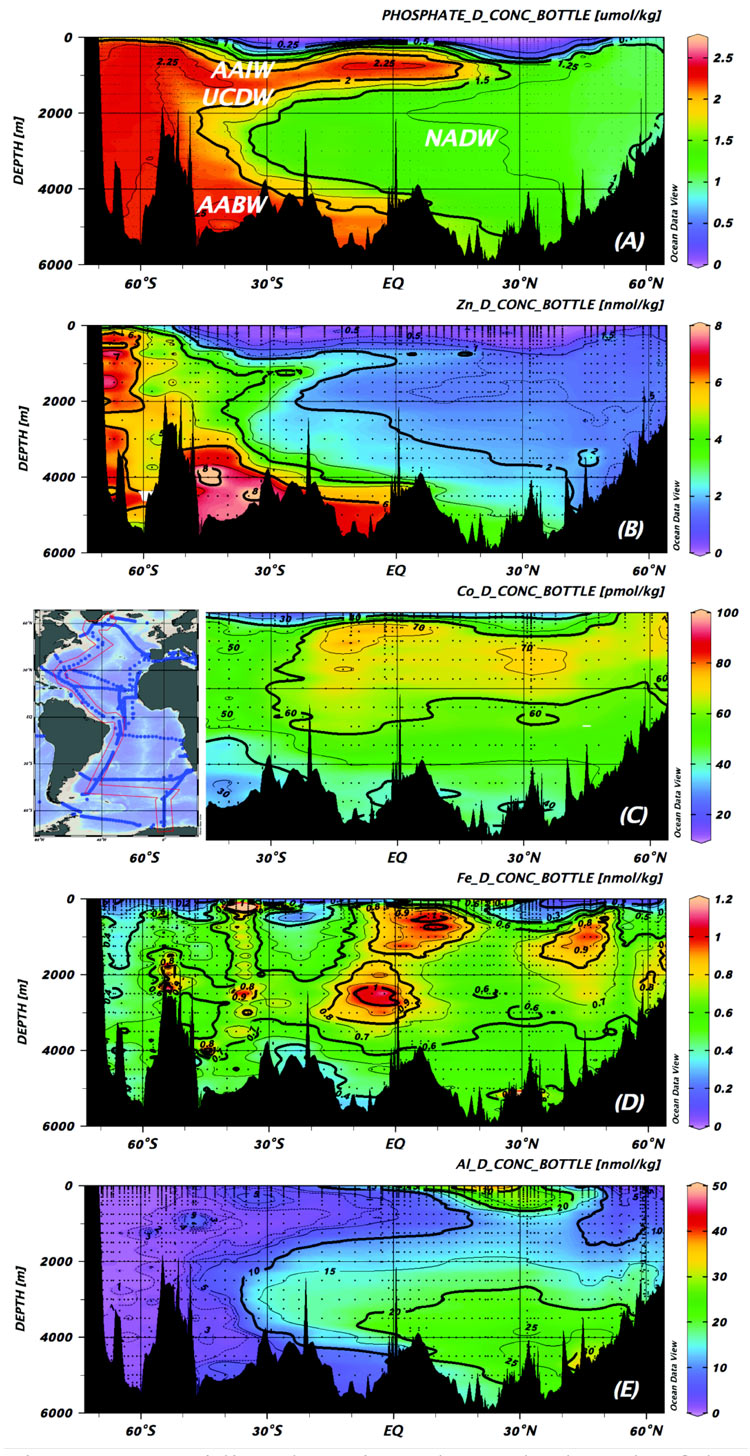
Figure: Meridional sections down the length of the Atlantic Ocean created by splicing data from multiple GEOTRACES sections (see inset in panel C). Data are available in the GEOTRACES Intermediate Data Product IDP2017. A) Phosphate data from IDP2017. B) Dissolved Zn (Middag et al 2019) and unpublished data from P. Croot, available in IDP2017. C) Dissolved Co (Dulaquais et al 2014a, Dulaquais et al 2014b) and unpublished data from M. Boye available in IDP2017. D) Dissolved Fe (Klunder et al 2011, Rijkenberg et al 2014). E) Dissolved Al (Middag et al 2015, Middag et al 2011) and unpublished data from Peter Croot available in IDP2017. Figure produced using Ocean Data View <http://odv.awi.de>.
References:
Anderson, R. F. (2020). GEOTRACES: Accelerating Research on the Marine Biogeochemical Cycles of Trace Elements and Their Isotopes. Annual Review of Marine Science, 12(1), DOI: https://doi.org/10.1146/annurev-marine-010318-095123
Dulaquais G, Boye M, Middag R, Owens S, Puigcorbe V, et al. (2014a). Contrasting biogeochemical cycles of cobalt in the surface western Atlantic Ocean. Glob. Biogeochem. Cycles 28:2014GB004903
Dulaquais G, Boye M, Rijkenberg MJA, Carton X. (2014b). Physical and remineralization processes govern the cobalt distribution in the deep western Atlantic Ocean. Biogeosciences 11:1561–80
Klunder MB, Laan P, Middag R, de Baar HJW, Ooijen JV. (2011). Dissolved iron in the Southern Ocean (Atlantic sector). Deep-Sea Res. II 58:2678–94
Middag R, van Hulten MMP, Van Aken HM, Rijkenberg MJA, Gerringa LJA, et al. (2015). Dissolved aluminium in the ocean conveyor of the West Atlantic Ocean: effects of the biological cycle, scavenging, sediment resuspension and hydrography. Mar. Chem. 177:69–86
Middag R, van Slooten C, de Baar HJW, Laan P. (2011). Dissolved aluminium in the Southern Ocean. Deep-Sea Res. II 58:2647–60
Rijkenberg MJA, Middag R, Laan P, Gerringa LJA, van Aken HM, et al. (2014). The distribution of dissolved iron in the West Atlantic Ocean. PLOS ONE 9:e101323