
When cadmium faces the Black Sea contrasting environment
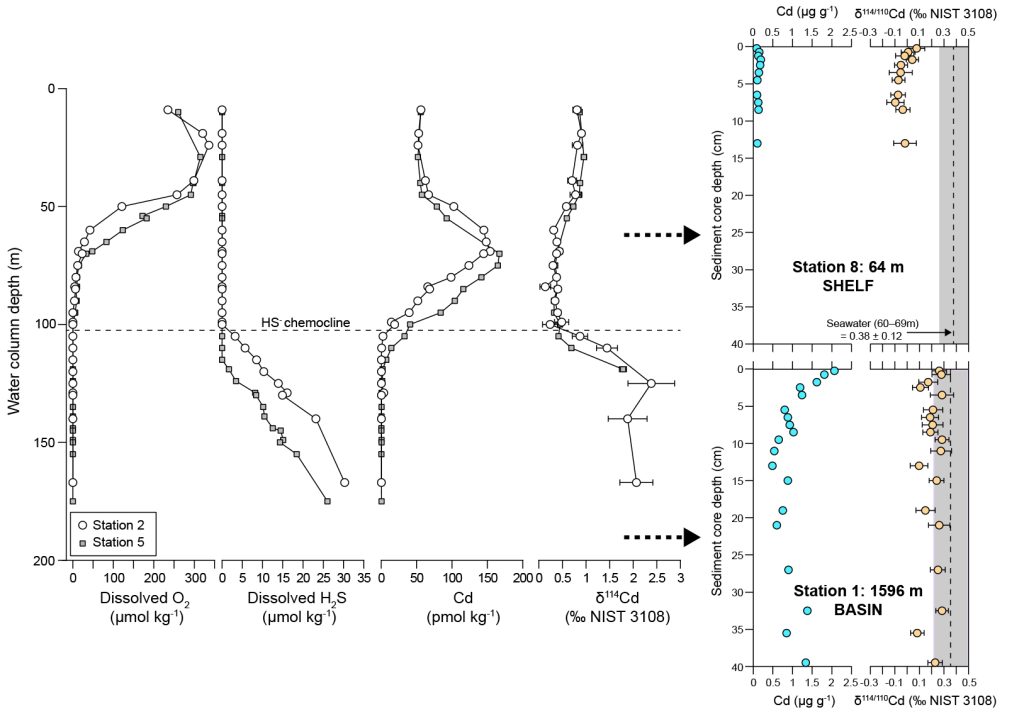
The Black Sea is known for its very specific redox properties: oxygenated in the surface waters, permanently anoxic and sulfidic below 150 m, and a chemocline between 50 m and 150m. Reactive trace metals might thus experience speciation changes under such contrasting conditions. Based on the analysis of two vertical water profiles and seven sediment cores, Dickson and his colleagues (2025, see reference below) investigated the fate of cadmium (Cd) in the Black Sea using its concentration and isotopic composition. Their results showed that several processes influence the isotope composition (δ114Cd) of these parameters in Black Sea waters:
- Isotopic variations in near-surface waters reflect biological assimilation and regeneration, with characteristic deviations to heavier δ114Cd in the photic zone.
- Below ~100 m, Cd concentration and isotopic composition confirm fractionation trends predicted from previous experimental CdS precipitation experiments.
- Removal of dissolved Cd begins above the sulfide chemocline, likely reflecting diffusion of dissolved Cd to the depth of CdS precipitation.
- Sediments that accumulate below the sulfide chemocline have δ114Cd that mimic the composition of near-surface Black Sea waters. This similarity is consistent with the high fraction of dissolved Cd that precipitates as isotopically light sulfide (CdS) and is presumably then buried into sediments.
- Sediments above the chemocline display δ114Cd offset toward lighter values than seawater at the same depth. These offsets are likely due to mixtures of isotopically light organic-bound Cd with other sedimentary phases such as oxyhydroxides.
Reference:
Dickson, A. J., Bryan, A. L., George, E., Henderson, G. M., Porcelli, D., Rolison, J., Slomp, C. P., Middag, R., & Stirling, C. H. (2025). Behaviour of cadmium isotopes in sulfidic waters and sediments of the Black Sea: Implications for global cadmium cycling and the application of cadmium isotopes as a paleo-oceanographic proxy. Earth and Planetary Science Letters, 662, 119408. Acces the paper: 10.1016/j.epsl.2025.119408