
North-South section of bioactive cadmium, nickel, zinc, copper and iron along GEOTRACES transect GP19 in the Pacific Ocean

Zheng and his colleagues (2024, see reference below) propose the first full sections of the simultaneous dissolved distributions of five nutrient-type trace metals cadmium (dCd), nickel (dNi), zinc (dZn), copper (dCu) and iron (dFe) in the western South Pacific Ocean along the GEOTRACES transect GP19 (∼170°W) and discuss the key factors influencing their distributions.

Interestingly, these trace elements present different behaviors, that are highlighted by the comparison of their distribution with that of PO4.

Dissolved cadmium exhibited a robust correlation with PO4 within a high PO4 range with a slope that aligns with the Cd/P ratio observed in phytoplankton. In the surface waters north of 50°S when PO4 drops below 0.8 μmol/kg, the Cd/P slope is lower, the exact cause of this kink remaining a subject of debate.

At high PO4 concentrations, dNi, dCu, and dZn increased independently of PO4 while dNi and dCu are linearly correlated with PO4 when phosphate concentrations are low.

The slope of the dFe vs. PO4 relationship was considerably lower than the Fe/P ratio observed in phytoplankton and strong scavenging of dFe is observed throughout the water column in the western South Pacific.

Since part of the section is very close to active hydrothermal sites in the Fiji basin, the authors established a significant impact of hydrothermal activity on the distribution of manganese (Mn), Fe, and Cu. They suggest that dFe is scavenged from deep water in a manner akin to dMn. Notably, no significant anomalies were detected for Cd, Ni, and Zn in regions influenced by hydrothermal plume.
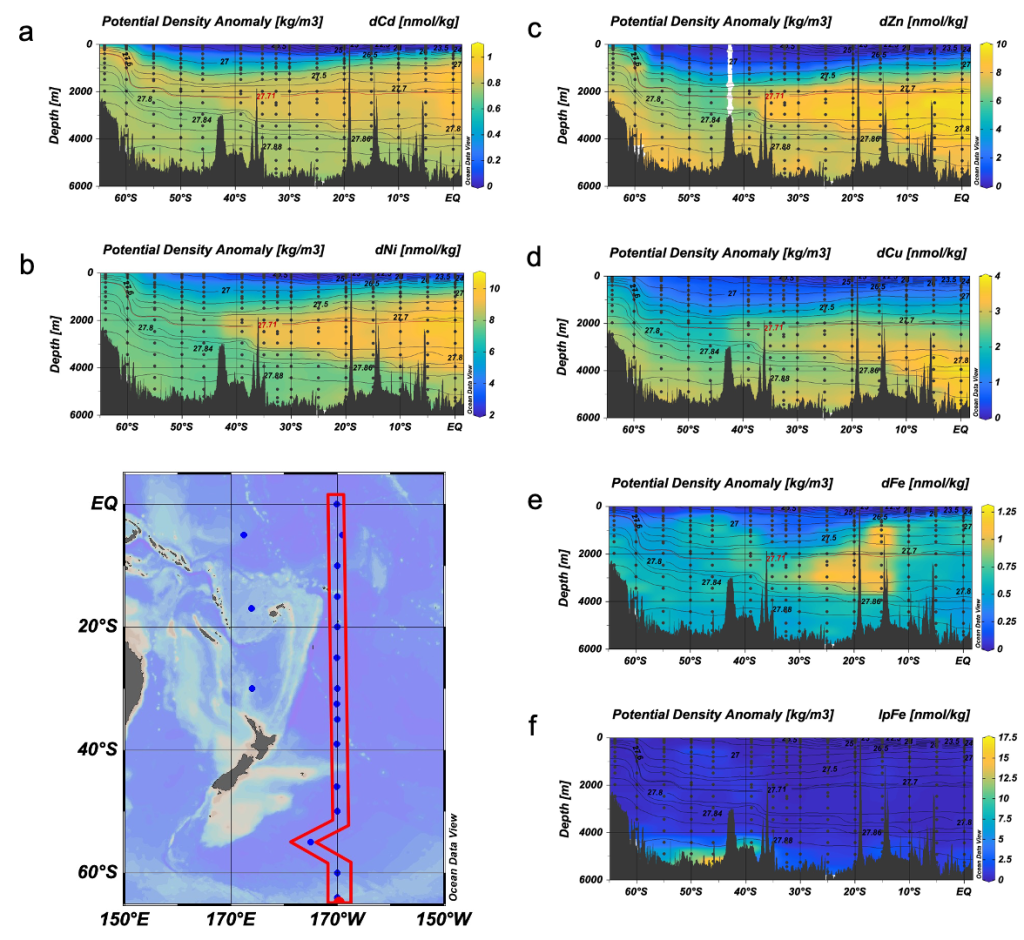
Figure 1. Full-depth sectional distributions of (a) dCd, (b) dNi, (c) dZn, (d) dCu, (e) dFe, and (f) lpFe along GP19 (170°W, 65°S–0°N). The black line contours show potential density anomalies (σθ), and the black dots indicate sampling points. The map shows the locations of sampling stations in this study, and the red line represents the section definition. EqPIW: Equatorial Pacific Intermediate Water; PDW: Pacific Deep Water; LCDW: Lower Circumpolar Deep Water. The σθ value of 27.71 kg/m³ is shown in red, where dissolved metals (dMs) were high. While ocean circulation and biogeochemical cycling are major controls, scavenging and local sources shape the different distributions of these metals.
Figure 2. Horizontal distributions of dNi/PO4 on an isopycnal surface with σθ = 27.71 kg/m³, at a depth of approximately 2000 meters in the western South Pacific Ocean. The dark brown lines show geostrophic circulation at this depth, exhibiting an anticyclonic pattern east of the Tonga–Kermadec Ridge. This circulation transports the elevated dNi/PO4 ratios from the South Fiji Basin to the Southwest Pacific Basin.

Reference:

Zheng, L., Minami, T., Takano, S., & Sohrin, Y. (2024). Distributions of cadmium, nickel, zinc, copper, and iron in the western South Pacific Ocean: Local sources of the nutrient-type trace metals. Marine Chemistry, 263–264, 104411. doi:10.1016/j.marchem.2024.104411

Latest highlights

Mercury content and isotopes in bird’s guano: a window to reconstruct past climates

By analysing peat cores, Chuxian Li and her colleagues have shown how populations of nesting seabirds have fluctuated on a sub-Antarctic Island over the last 8,000 years.

Contraction of North Atlantic Deep Water during glacial times: a paradigm called into question

Blaser and co-authors propose a new distribution of deep-water masses in the Atlantic Ocean during the Last Glacial Maximum and the Heinrich Stadial..

Authigenic radiogenic neodymium isotope composition traces millennial-scale overturning circulation variability in the Arabian Sea

The neodymium isotopic signature of the sediment authigenic fraction is, a priori, a valuable proxy for reconstructing deep-water mass trajectories…

Magmatic activity at the Carlsberg Ridge in the Indian Ocean triggered by glacial sea-level variation

De and colleagues provide a high-resolution record of magmatic input and associated hydrothermal activity over the past 49 kyr from a core recovered from a magmatic segment of the slow-spreading Carlsberg Ridge in the Indian Ocean.

Rechercher