
Major controls on the fate of dissolved manganese in the northeastern Indian Ocean
One of the particularities of the bioactive trace metal manganese (Mn) is that redox conditions determine its solubility: while the reduced form Mn(II) is soluble, the oxidized form Mn(IV) is insoluble and is rapidly scavenged by suspended particles in seawater.
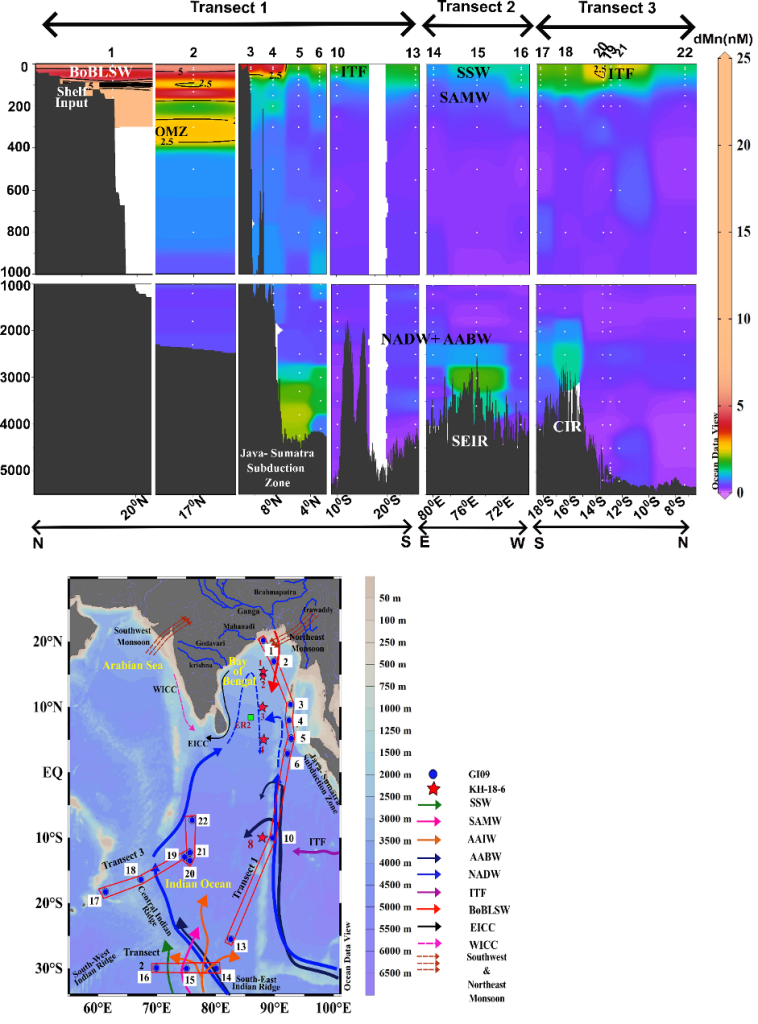
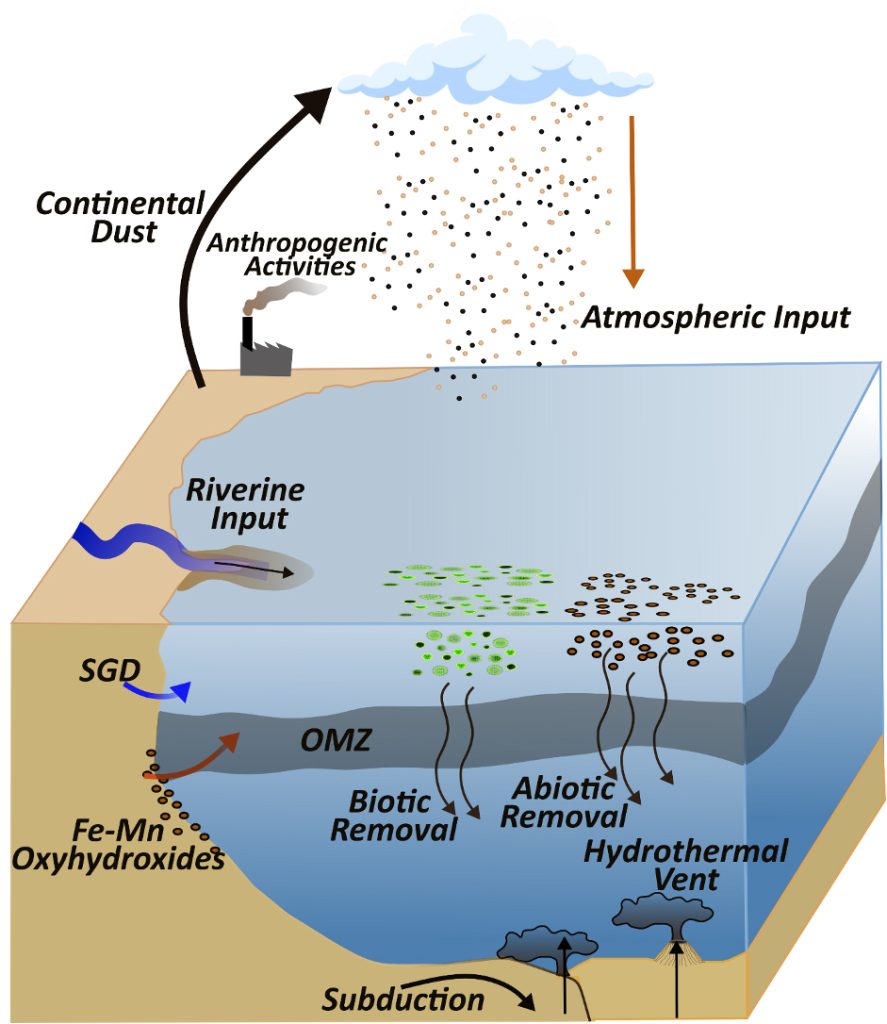
In addition, one of the exciting specificities of the northeastern Indian Ocean is that: i) it is subject to strong and diverse external inputs of trace metals from atmospheric dust (both anthropogenic and natural), solid and dissolved river discharges — including submarine groundwater —, shelf and margin sediments — including subduction zones —, and hydrothermal vents; ii) its water column displays highly contrasting redox conditions, with pronounced oxygen minimum zones (OMZs) off the Bay of Bengal; and iii) its circulation is influenced by the Indian-Pacific throughflow.
Thus, studying the fate of Mn in such an environment is particularly exciting. Malla et al. (2025, see reference below) undertook this comprehensive study and demonstrated that:
- Surface dissolved Mn (dMn) decreases southward in the Bay of Bengal, following the mixing of the enormous riverine influx with seawater.
- Reductive dissolution of Fe–Mn oxyhydroxide-rich sediments brought by the Ganga–Brahmaputra rivers enriches dMn in the bottom waters of the shelf regions, which is further advected to the open ocean through cross-shelf transport.
- Atmospheric input is the predominant source of dMn in the Bay of Bengal.
- Transport of the Indonesian Throughflow waters supplies high dMn concentrations to the surface waters of the Central Indian Ocean Basin.
- Water-column denitrification increases dMn in the OMZ waters of the Bay of Bengal through the reductive dissolution of sinking Mn oxide particles.
Reference:
Malla, N., & Singh, S. K. (2025). Atmospheric Deposition, Shelf Sediment Supply, Riverine Input, and Redox Conditions Control Dissolved Manganese in the Indian Ocean. Global Biogeochemical Cycles, 39. Access the paper: 10.1029/2025gb008660