
Intrigued by Rare Earth Elements and neodymium isotopes? A review for the curious
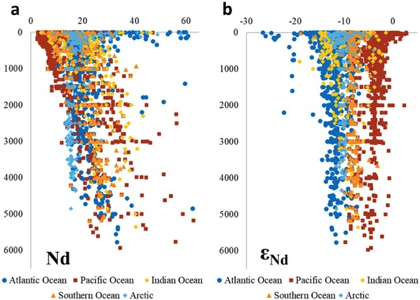
Vanessa Hatje and a group of Rare Earth Element (REE) specialists (2024, see reference below) propose an exhaustive review on the behaviour of REE, not forgetting the informative neodymium (Nd) isotopes, in the aquatic environment. The sources, sinks and transformations of these elements along the land-sea continuum are reviewed. The effects of increased use of REE in industry and medicine are also discussed, as are their bioavailability, bioaccumulation and transfer along trophic chains. Finally, the potential effects of climate change on the cycling, mobility and bioavailability of these elements are discussed. In other words, this paper is a comprehensive review of REE behavior in the environment, from their properties and roles to their distribution and anthropogenic impacts, offering valuable insights and pinpointing key knowledge gaps.
Reference:
Hatje, V., Schijf, J., Johannesson, K. H., Andrade, R., Caetano, M., Brito, P., Haley, B. A., Lagarde, M., & Jeandel, C. (2024). The Global Biogeochemical Cycle of the Rare Earth Elements. Global Biogeochemical Cycles, 38. Access the paper: 10.1029/2024gb008125
van de Flierdt, T., Grifths, A. M., Lambelet, M., Little, S. H., Stichel, T., & Wilson, D. J. (2016). Neodymium in the oceans: A global database, a regional comparison and implications for palaeoceanographic research. Philosophical Transactions of the Royal Society A: Mathematical, Physical & Engineering Sciences, 374(2081), 20150293. Access the paper: 10.1098/rsta.2015.0293
Filippova, A., Frank, M., Kienast, M., Rickli, J., Hathorne, E., Yashayaev, I. M., & Pahnke, K. (2017). Water mass circulation and weathering inputs in the Labrador Sea based on coupled Hf–Nd isotope compositions and rare earth element distributions. Geochimica et Cosmochimica Acta, 199, 164–184. Access the paper: 10.1016/j.gca.2016.11.024
Crocket, K. C., Hill, E., Abell, R. E., Johnson, C., Gary, S. F., Brand, T., & Hathorne, E. C. (2018). Rare earth element distribution in the NE Atlantic: Evidence for benthic sources, longevity of the seawater signal, and biogeochemical cycling. Frontiers in Marine Science, 5, 147. Access the paper: 10.3389/fmars.2018.00147
Paffrath, R., Pahnke, K., Böning, P., Rutgers van der Loeff, M., Valk, O., Gdaniec, S., & Planquette, H. (2021). Seawater-Particle Interactions of Rare Earth Elements and Neodymium Isotopes in the Deep Central Arctic Ocean. Journal of Geophysical Research: Oceans, 126(8), e2021JC017423. Access the paper: 10.1029/2021JC017423
Pham, V. Q., Jeandel, C., Grenier, M., Cravatte, S., Eldin, G., Belhadj, M., et al. (2022). Neodymium Isotopic Composition and Rare Earth Element Concentration Variations in the Coral and Solomon Seas. Frontiers in Environmental Chemistry, 3. Access the paper: 10.3389/fenvc.2022.803944