Trace Element Dynamics in the Oligotrophic Northwest Pacific: Insights from the China GEOTRACES GP09 Cruise
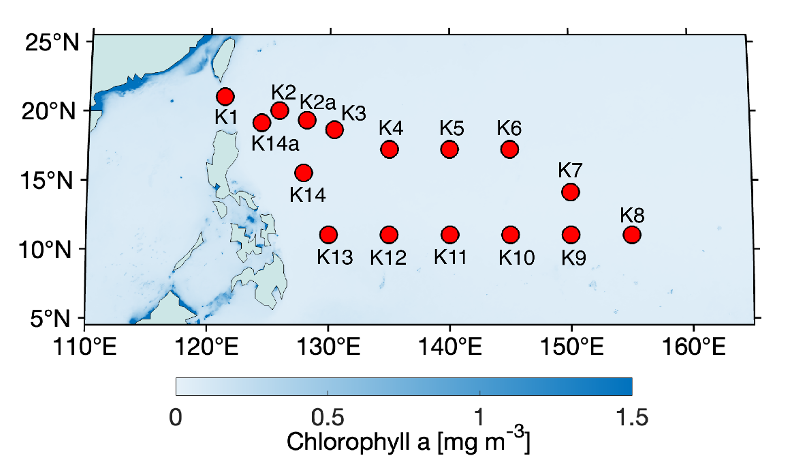
Following the completion of the China GEOTRACES GP09 cruise (25 April–13 June, 2019) in the Northwest Pacific Ocean (see Figure below) aboard R/V Tan Kah Kee (Xiamen University, China), an extensive suite of GEOTRACES key parameters, including dissolved and particulate trace metal concentrations, was submitted to the GEOTRACES International Data Assembly Centre and released as part of GEOTRACES Intermediate Data Product 2025 (IDP2025). Building on these observations, a series of peer-reviewed studies has now been published, providing new insights into the biogeochemical cycling of trace elements in the oligotrophic North Pacific Subtropical Gyre.
Wang, X., et al. (2025) provided constraints on dust-borne iron (Fe) deposition fluxes by combining long-lived thorium (Th) isotope (230Th and 232Th) measurements in seawater with aerosol data on Th and Fe concentration and solubility. Their results revealed a close connection between dust deposition, surface dissolved Fe concentrations, and iron to nitrogen (Fe:N) supply ratios, highlighting the role of atmospheric inputs in modulating surface nutrient availability in the Northwest Pacific Ocean.
Browning, T. J., et al. (2021) conducted 14 factorial nitrogen – phosphorus – iron (N–P–Fe) addition experiments across the study region, demonstrating a gradient from N limitation of surface phytoplankton productivity in the north to N–Fe co-limitation in the south. Wen, Z., et al. (2022) examined the abundance and activity of N2-fixing diazotrophs in the euphotic zone, showing higher N2 fixation rates in N-limited areas and identifying the Fe:N supply ratio as the primary control on their spatial distribution. Zhu, S. J., et al. (2025) further quantified horizontal and vertical nutrient supplies in the upper water column using modified Optimum Multiparameter analysis with rare earth elements (REEs) as quasi-conservative tracers, and found that vertical fluxes of dissolved inorganic nitrogen to the base of the euphotic zone were 1–100 times the supply from N2 fixation.
Yuan, Y., et al. (2025) applied the particulate excess Ba approach to quantify organic carbon remineralization in the twilight zone of the Northwest Pacific Ocean, and revealed a strong link between carbon cycling in the upper and mesopelagic layers. Zhang, K., et al. (2024) presented depth profiles of size-fractionated particulate cadmium (Cd) and P concentrations, which illustrated their decoupled cycling and underscored uncertainties in the use of Cd as a palaeo-phosphate proxy.
Cao, A., et al. (2024) demonstrated that REE concentrations and Ytterbium/Neodymium (Yb/Nd) ratios can distinguish North Pacific Intermediate Water (NPIW), Antarctic Intermediate Water (AAIW), and modified Antarctic Intermediate Water (AAIW), and that heavy REEs can serve as quasi-conservative tracers to quantify the mixing of NPIW and modified AAIW at a potential density of 27.2 kg/m3.
Li, Y., et al. (2025) identified a previously overlooked, particle-mediated sink for dissolved arsenic (As) removal from seawater across multiple deep-sea systems in the Northwest Pacific Ocean, including hydrothermal vents, seamounts, and island sediments, thereby contributing to balancing the global oceanic As budget. For further details, readers are referred to the publications listed below. Additional findings from this cruise are forthcoming.
References:
Browning, T. J., Liu, X., Zhang, R., Wen, Z., Liu, J., Zhou, Y., Xu, F., Cai, Y., Zhou, K., Cao, Z., Zhu, Y., Shi, D., Achterberg. E. P., & Dai, M. (2021). Nutrient co‐limitation in the subtropical Northwest Pacific. Limnology and Oceanography Letters, 7: 52-61. Access the paper: 10.1002/lol2.10205
Cao, A., Liu, Q., Zhang, J., Shiller, A. M., Cai, Y., Zhang, R., Gilbert, M., Guo, X., & Liu, Z. (2024). Dissolved rare earth elements in the North Pacific Subtropical Gyre: Lithogenic sources and water mass mixing control. Geochimica et Cosmochimica Acta, 372: 42–61. Access the paper: 10.1016/j.gca.2024.02.018
Li, Y., Bo, G., Cai, Y., Zhang, K., Zhou, K., Zhang, P., Yang, C., Chen, T., Dai, M., Ma, J., & Cao, Z. (2025). Removal of dissolved arsenic from deep seawater around hydrothermal vents and seamounts. Earth and Planetary Science Letters, 660, 119351. Access the paper: 10.1016/j.epsl.2025.119351
Wang, X., Zhang, X., Yang, W., Shi, D., Chen, M., Cheng, H., Lin, Q., Cai, P., & Cai, Y. (2025). Dust deposition and iron cycling in the tropical western North Pacific based on thorium supply. Global and Planetary Change, 247, 104740. Access the paper: 10.1016/j.gloplacha.2025.104740
Wen, Z., Browning, T. J., Cai, Y., Dai, R., Zhang, R., Du, C., Jiang, R., Lin, W., Liu, X., Cao, Z., Hong, H., Dai, M., & Shi, D. (2022). Nutrient regulation of biological nitrogen fixation across the tropical western North Pacific. Science Advances, 8, eabl7564. Access the paper: 10.1126/sciadv.abl7564
Yuan, Y., Zhao, S., Lin, W., Li, Y., Yu, J., Huang, Y., Zhang, Z., Frank, M., Dai, M., & Cao, Z. (2025). Quantifying organic carbon remineralization in the twilight zone of the Western North Pacific using particulate excess barium. Global Biogeochemical Cycles, 39, e2025GB008755. Access the paper: 10.1029/2025GB008755
Zhang, K., Zhou, K., Cai, Y., Yuan, Z., Chen, Y., Xu, F., Liu, X., Cao, Z., & Dai, M. (2024). Decoupled cycling of particulate cadmium and phosphorus in the subtropical Northwest Pacific. Limnology and Oceanography, 69, 1941–1954. Access the paper: 10.1002/lno.12635
Zhu, S. J., Zhang, J., Liu, Q., Shiller, A. M., Du, C., Cao, Z., Guo, X., Cai, Y., & Liu X. (2025). Quantifying nutrient supply to the eddy‐influenced subtropical North Pacific upper ocean: Modified optimum multiparameter analysis using rare earth elements from three GEOTRACES cruises. Limonology and Oceanography, 7: 3696–3710. Access the paper: 10.1002/lno.70226