
Hydrothermal activity detected above the ultra-slow South West Indian Ridge, using a multi-proxy approach
The Southwest Indian Ridge (SWIR) is among the world’s slowest ultra-slow-spreading ridges, which for many years led scientists to suspect that it was not a site of hydrothermal activity. However, two subsequent studies, including data acquired during the GEOTRACES GS02 Section (SWINGS cruise), are changing this paradigm.
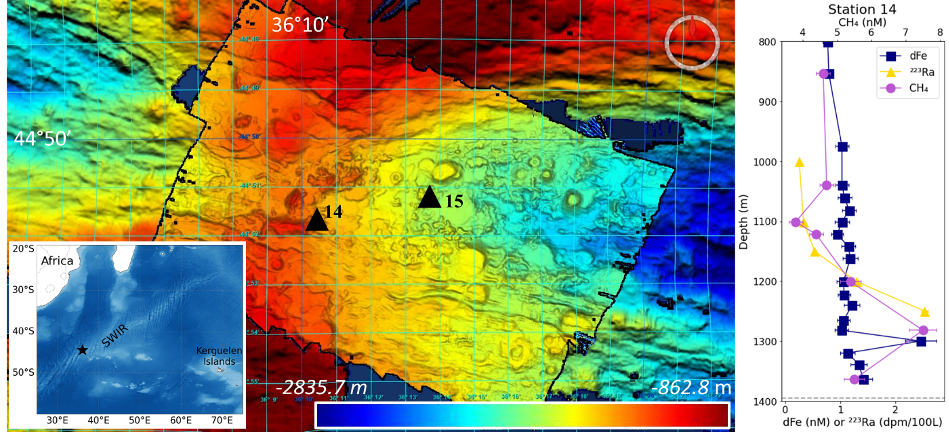
Baudet and colleagues (2024, see reference below) demonstrate the occurrence of hydrothermal venting on the SWIR in the vicinity of the location 44°51.690′ S, 36°10.460′ E, which is likely to be a low or moderately high temperature fluid. Above the SWIR, dissolved Fe (dFe) and dissolved Mn (dMn) concentrations were enriched by factors of approximately 3 and 7, respectively, and particulate Fe (pFe) and particulate Mn (pMn) by factors of 2 and 1.5, respectively, compared to a reference station located outside the SWIR. These trace metals are likely maintained in dissolved form through complexation with organic ligands. In addition, high values of dissolved methane to manganese ratios are observed.
Radium isotope data, published by León and co-workers (2024, see reference below) and associated with this study, clearly trace the hydrothermal origin of these enrichments. However, low current velocities and the bathymetry likely limit the fertilization of surface waters by dFe and dMn along this section of the SWIR.
This work illustrates the power of multi-proxy approaches, led by a collective, coordinated group of researchers.
References:
Baudet, C., Bucciarelli, E., Sarthou, G., Boulart, C., Pelleter, E., Goddard-Dwyer, M., Whitby, H., Zhang, R., Obernosterer, I., Gonzalez-Santana, D., Léon, M., van Beek, P., Sanial, V., Jeandel, C., Vivier, F., Vorrath, M.-E., Liao, W.-H., Germain, Y., & Planquette, H. (2024). A hydrothermal plume on the Southwest Indian Ridge revealed by a multi-proxy approach: Impact on iron and manganese distributions (GEOTRACES GS02). Marine Chemistry, 265–266, 104401. Access the paper: 10.1016/j.marchem.2024.104401
Léon, M., van Beek, P., Sanial, V., Baudet, C., Charette, M. A., Souhaut, M., Vivier, F., Kestenare, E., Jeandel, C., & Planquette, H. (2024). Investigation of hydrothermal activity in the South West Indian ridge region using Ra isotopes and 227Ac as tracers. Progress in Oceanography, 221, 103191. Access the paper: 10.1016/j.pocean.2023.103191