
Coupling copper and neodymium data highlights the importance of the margin sources for the copper oceanic cycle

Among the bioactive metals, copper’s marine cycle (Cu) is far from being understood yet. Lemaitre and co-workers (2025, see reference below) analysed the dissolved (dCu) concentrations and isotopes along the GEOVIDE (GA01) section. Their data reveal that i) in the surface waters, microorganisms take up dCu along with carbon, leaving “heavy” dCu in the surrounding waters and ii) at depth, particle remineralization and (reversible) scavenging onto particles, are also influencing dCu distributions.

The authors also established the relative importance of the external dCu sources to the North Atlantic (atmospheric, hydrothermal, benthic…). A fruitful strategy was to compare the dCu data to neodymium concentration (Lagarde et al., 2024) allowing them to highlight the Iberian margin as a source of Cu to the ocean. Overall, the margin inputs could contribute significantly to the missing source of Cu in the ocean.
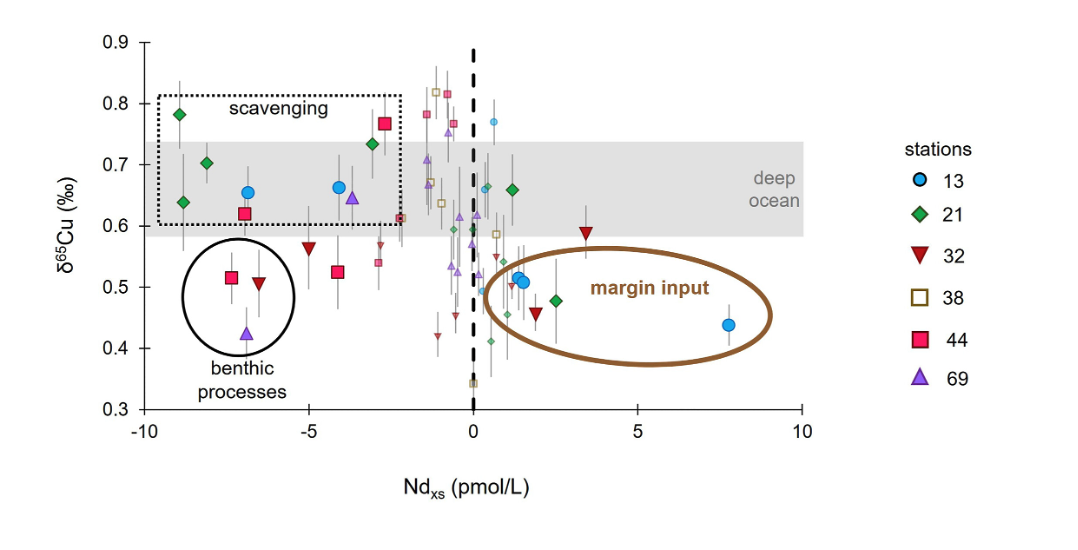
Figure: Copper isotope compositions (δ65Cu) are compared to non-conservative neodymium concentrations (Ndxs; data from Lagarde et al., 2024). High δ65Cu values are co‐located with Ndxs < 0, suggesting a removal of both elements by scavenging (as shown by the black dotted rectangle). Conversely, significant Nd inputs (Ndxs > 0) coincide with low δ65Cu values (as shown by the brown oval). Neodymium being a lithogenic tracer, this comparison highlights the importance of lithogenic particle dissolution as a source of light Cu. This lithogenic input originates from the Iberian Margin.

References:

Lemaitre, N., Lagarde, M., & Vance, D. (2025). Controls on Dissolved Cu Concentrations and Isotopes in the North Atlantic: The Importance of Continental Margins. Global Biogeochemical Cycles, 39. Access the paper: 10.1029/2024gb008453

Lagarde, M., Pham, V. Q., Lherminier, P., Belhadj, M., & Jeandel, C. (2024). Rare Earth elements in the North Atlantic, part I: Non-conservative behavior reveals margin inputs and deep waters scavenging. Chemical Geology, 664, 122230. Access the paper: 10.1016/j.chemgeo.2024.122230

Latest highlights

Authigenic radiogenic neodymium isotope composition traces millennial-scale overturning circulation variability in the Arabian Sea

The neodymium isotopic signature of the sediment authigenic fraction is, a priori, a valuable proxy for reconstructing deep-water mass trajectories…

Magmatic activity at the Carlsberg Ridge in the Indian Ocean triggered by glacial sea-level variation

De and colleagues provide a high-resolution record of magmatic input and associated hydrothermal activity over the past 49 kyr from a core recovered from a magmatic segment of the slow-spreading Carlsberg Ridge in the Indian Ocean.

Zinc and lead isotopes reveal human footprint on the most remote oceanic regions

Benaltabet and co-workers analysed suspended particles collected on GEOTRACES GP21 cruise tracked from Chile to New Caledonia.

Organic binding site heterogeneity controls amorphous ferric oxy-hydroxides oceanic sink

In oxygenated seawater iron binds to hydroxide ions, which results in authigenic Fe precipitation as amorphous ferric oxy-hydroxide…

Rechercher