
Estimating particulate organic carbon export in seawater with polonium-210: problems with iron hydroxide co-precipitation
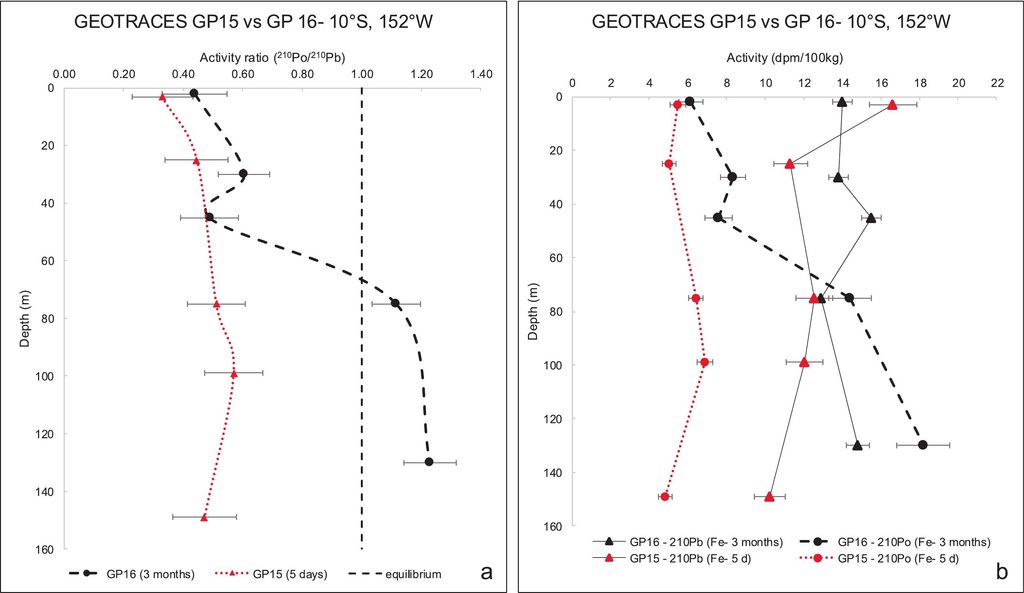
For years, two methods have been used to extract polonium-210 (210Po) from seawater and thus estimate the Particulate Organic Carbon (POC) export, a key value to quantify the oceanic Biological Carbon Pump (BCP): precipitation of iron hydroxide (Fe(OH)3) and coagulation of cobalt ammonium pyrrolidine dithiocarbamate (Co-APDC). However, Carrasco and co-workers (2026, see reference below) demonstrate that 210Po extracted from seawater with Fe(OH)3 shows lower values than with Co-APDC, although two months of storage of the seawater reduces the difference. This could be related to the production of dissolved 210Po complexed with organic ligands by diatoms, a fraction not efficiently precipitated by Fe(OH)3 (as seen in laboratory phytoplankton incubation experiments). Note that this was not the case with coccolithophores. Direct comparison of the methods during a time of high productivity at the DYFAMED site (off the Riviera coast, France) and with Fe(OH)3 at two GEOTRACES stations (cruises GP16 and GP15; see figure) suggests that POC export fluxes based on the Fe(OH)3 method can be overestimated by ∼50% in the primary productivity zone and by much larger amounts in the mesopelagic zone.
Reference:
Carrasco, H., J. K. Cochran, B. Gasser, I. Sanz-Alvarez, M. Roca-Martí, C. Heilbrun, N. S. Fisher, J. Friedrich, and P. Masqué (2026), Comparing methods for measuring 210Po in seawater: Fe(OH)3 can extract less 210Po than Co-APDC and thus overestimate POC export fluxes, Marine Chemistry, 275, 104618, doi: https://doi.org/10.1016/j.marchem.2026.104618