Authigenic radiogenic neodymium isotope composition traces millennial-scale overturning circulation variability in the Arabian Sea
The neodymium (Nd) isotopic signature of the sediment authigenic fraction is, a priori, a valuable proxy for reconstructing deep-water mass trajectories. However, several processes, including boundary exchange, particulate inputs, benthic fluxes, and hydrothermal processes, can perturb such reconstructions by modifying the radiogenic neodymium isotope composition of seawater (εNd). In this study, De and Singh (2026; see reference below) first conducted a thorough evaluation of these potential sources of contamination, demonstrating the reliability of εNd as a tracer of paleo-circulation and abyssal deep water-mass provenance.
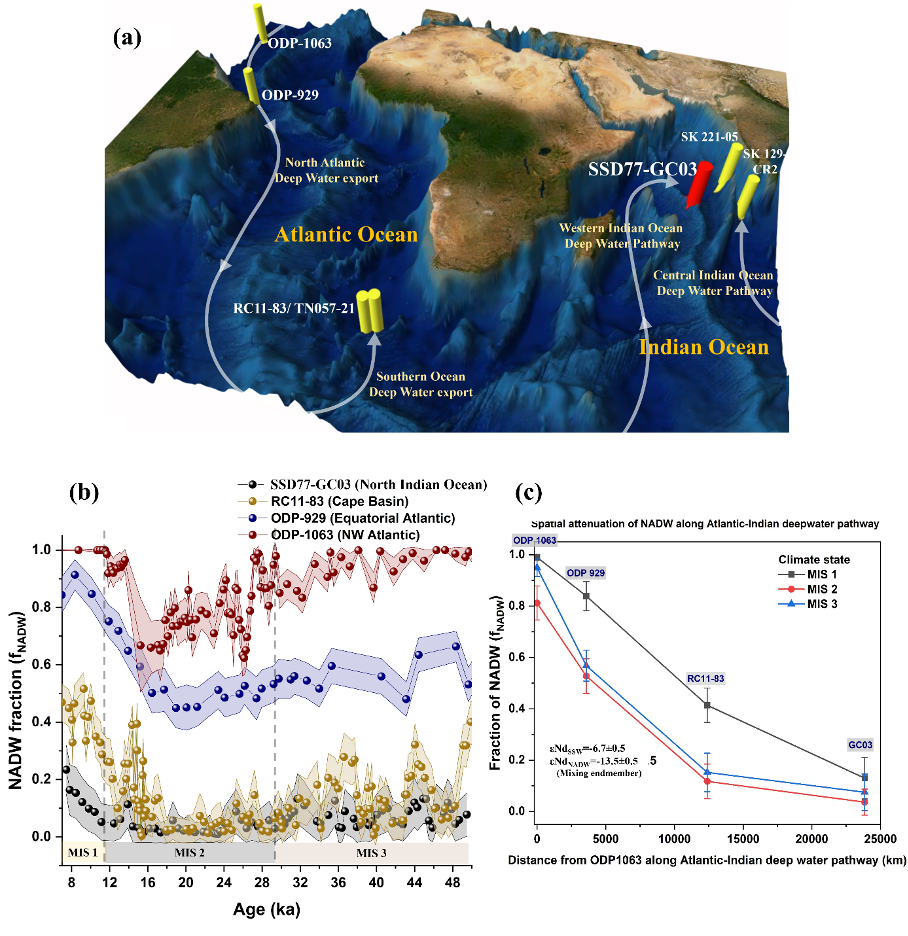
Subsequently, high-resolution analyses of authigenic εNd along a gravity core collected from the axial valley of the Carlsberg Ridge (3,984 m water depth) enabled the authors to document the presence of North Atlantic Deep Water (NADW) in the Arabian Sea over the past 50 kyr (i.e., during MIS 3, MIS 2, and MIS 1). They propose a millennial scale re-organization of the Atlantic Meridional Overturning Circulation (AMOC). During MIS 1 and MIS 3, εNd values shift toward less radiogenic values, consistent with a stronger contribution from NADW. In contrast, during MIS 2, more radiogenic signatures trace a South Atlantic origin. Comparison of their record with previously established εNd records from the North, Equatorial, and South Atlantic Ocean enables a compelling reconstruction of past NADW dynamics.
Reference:
De, S., & Singh, S. K. (2026). NADW attenuation and millennial-scale overturning circulation variability in the Arabian Sea constrained through authigenic εNd at the Carlsberg Ridge. Geochimica et Cosmochimica Acta, 423, 176–194. Access the paper:10.1016/j.gca.2026.04.048