
Do not mourn Nobias any longer: InertSep ME-2 is coming!

Thanks to the thorough development proposed by Alifia and co-workers (2026, see reference below), the community may have a solution to the shortage of Nobias Chelate PA-1. Using a bracketing standard approach, the authors achieved simultaneous analysis of medium- to heavy-mass trace elements using small sample volumes, with high analytical precision and repeatability in natural waters across a wide range of ionic strengths.

A few words on the solid-phase extraction (SPE): 50 mL of natural water, buffered at pH 5.5 (0.1 M NH4Ac), loading flow rate 2 mL/min, elution with 3 mL of 3 M HNO3 followed by 3 mL of MQW at a flow rate of 1.5 mL/min.

Analytical performance is good, with major ions (manganese, calcium, sodium and potassium) efficiently removed (~100%), repeatability and intermediate precision generally below 3–5% RSD, and recoveries close to quantitative (~95–105%), and ability to evaluate potential element fractionation during the analytical process. Let’s try it!
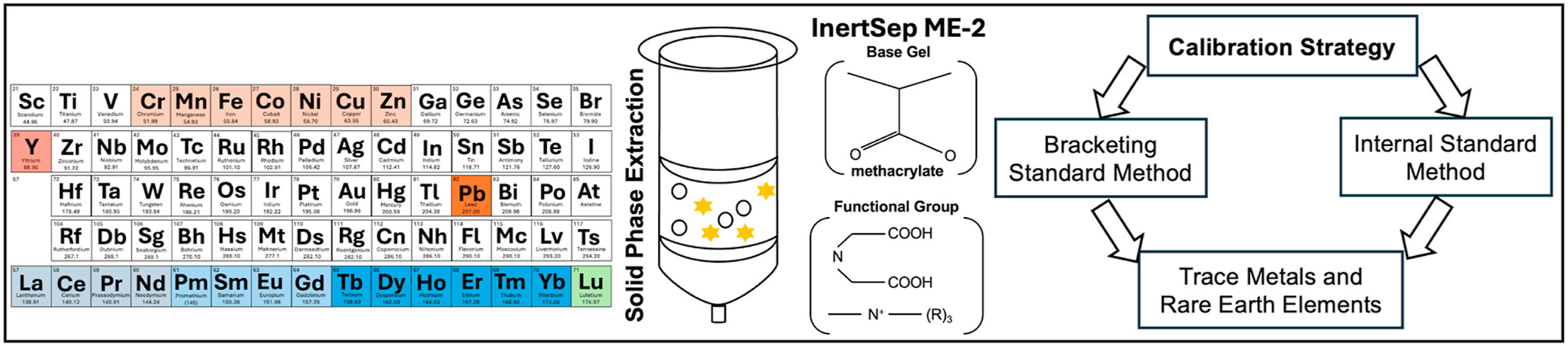
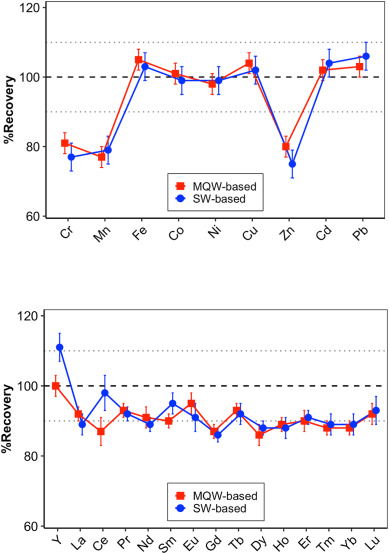
Figure: Simultaneous analysis of trace metals and rare earth elements was achieved within one running time of pre-concentration using solid-phase extraction with InertSep ME-2, combined with bracketing standard and internal standard calibration methods and ICP-MS detection.
Figure 2: Recovery of trace metals and rare earth elements (REEs) in MQW- and SW-based samples using the BS-method (n = 3). This figure highlights the recovery performance of the method for trace metals and rare earth elements (REEs) in both MQW and seawater (SW) matrices. The consistent recoveries across contrasting matrices indicate minimal matrix effects and demonstrate the suitability of the method for diverse natural water samples.

Reference:

Alifia, Z., Zhang, J., Haryanto, M. J., Nahar, Mst. S., & Kagaya, S. (2026). A versatile solid-phase extraction method using InertSep ME-2 for simultaneous analysis of covering medium to heavy mass trace elements in diverse water matrices. Talanta, 306, 129694. doi:10.1016/j.talanta.2026.129694

Latest highlights

Organic binding site heterogeneity controls amorphous ferric oxy-hydroxides oceanic sink

In oxygenated seawater iron binds to hydroxide ions, which results in authigenic Fe precipitation as amorphous ferric oxy-hydroxide…

Microbial trace metal transport in distinct water masses of the Southern Indian Ocean

Zhang and colleagues used genes coding for membrane transporters as proxies to map the distribution of the uptake and efflux of the trace metals…

Long-range transport of iron off the Antarctic Peninsula

Tian and co-authors investigate dissolved iron concentrations and isotope compositions in the western Weddell Sea…

Seasonal variation of the dissolved iron ligands in the South Atlantic sector of the Southern Ocean

In the ocean, up to 99% of the dissolved iron is strongly complexed with organic compounds known as iron-binding ligands…

Rechercher