
The Tonga arc, an iron boundary in the South West Pacific Ocean

As part of the TONGA GEOTRACES process study (GPpr14), Tilliette and colleagues (2022, see reference below) established that the dissolved iron concentrations were very low in the South Pacific gyre (∼0.2 nmol kg−1) while they could reach 50 nmol kg−1 in the west of the Tonga arc. As established by an eOMPA statistical analysis, this iron fertilization of the Lau basin results from active shallow hydrothermal inputs from the Tonga arc geological structures. It explains the rich development of Trichodesmium and other dinitrogen fixing organisms, making this area a hot spot for nitrogen fixation. However, shallow hydrothermal plumes are not transported over long distances, contrasting with the extent of deep plumes. Specific surface biogeochemical conditions might lead to dissolved iron precipitation and depletion.
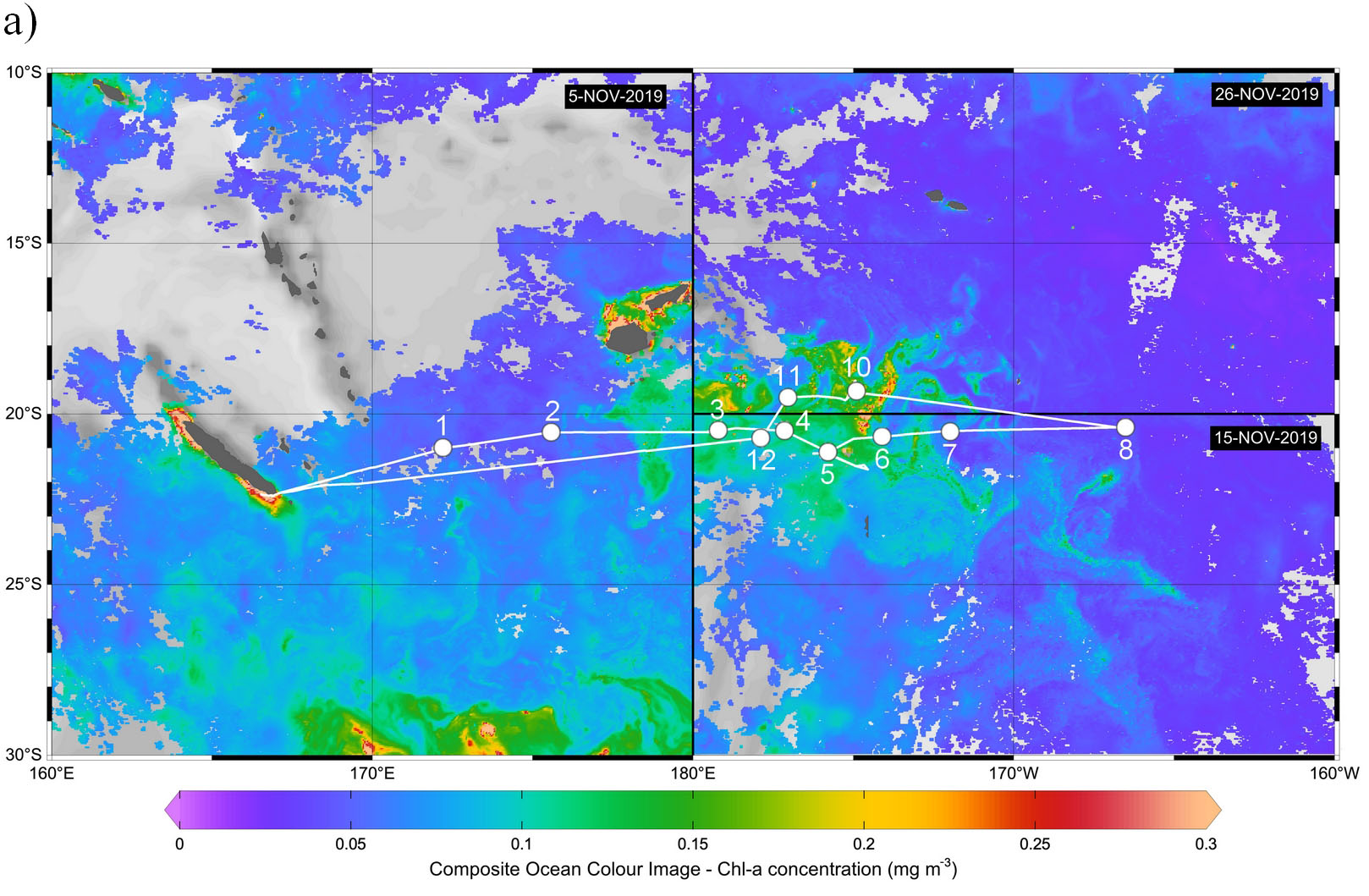
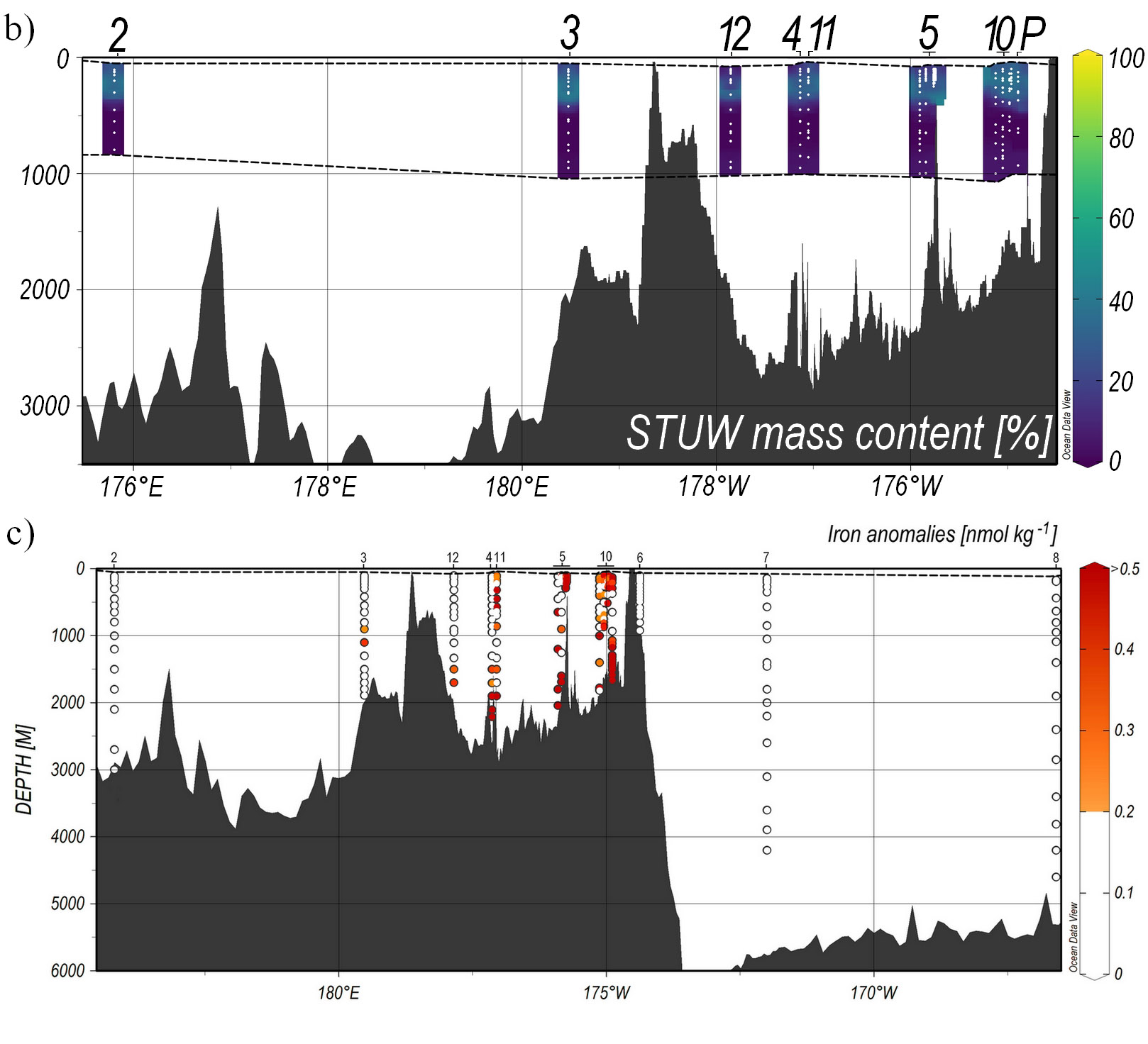
Figure: Transect of the cruise (a) superimposed on surface chlorophyll-a concentrations (mg m-3). Contribution (%) of the “Subtropical Underwater” water mass to the transect (STUW, b), reaching up to 40% between 100 and 300 m. Using the dissolved iron (DFe) concentrations (mainly from GEOTRACES database) and the contributions of each water mass to the transect, it was possible to estimate the DFe concentrations resulting solely from water mass transport. DFe anomalies along the transect could thus be determined as the difference between measured concentrations and estimated concentrations (c) and highlighting the hydrothermal origin of DFe in the Lau Basin.

Reference :

Tilliette, C., Taillandier, V., Bouruet‐Aubertot, P., Grima, N., Maes, C., Montanes, M., Sarthou, G., Vorrath, M. ‐E., Arnone, V., Bressac, M., González‐Santana, D., Gazeau, F., & Guieu, C. (2022). Dissolved Iron Patterns Impacted by Shallow Hydrothermal Sources Along a Transect Through the Tonga‐Kermadec Arc. Global Biogeochemical Cycles, 36(7). Access the paper: 10.1029/2022gb007363

Latest highlights

Organic binding site heterogeneity controls amorphous ferric oxy-hydroxides oceanic sink

In oxygenated seawater iron binds to hydroxide ions, which results in authigenic Fe precipitation as amorphous ferric oxy-hydroxide…

Microbial trace metal transport in distinct water masses of the Southern Indian Ocean

Zhang and colleagues used genes coding for membrane transporters as proxies to map the distribution of the uptake and efflux of the trace metals…

Do not mourn Nobias any longer: InertSep ME-2 is coming!

Thanks to the thorough development proposed by Alifia and co-workers, the community may have a solution to the shortage of Nobias Chelate PA-1…

Long-range transport of iron off the Antarctic Peninsula

Tian and co-authors investigate dissolved iron concentrations and isotope compositions in the western Weddell Sea…

Rechercher