
Are the dissolved iron distributions well represented by the global ocean biogeochemistry models?

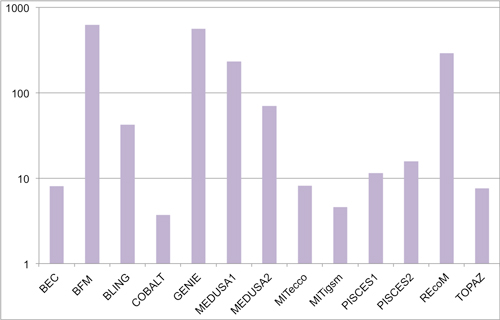
Alessandro Tagliabue and co-workers (2016, see reference below) have conducted the first intercomparison of 13 global ocean iron models against the latest datasets emerging from GEOTRACES.

A large disparity in the residence times for iron across the different models was found, which reflects a lack of agreement in how to represent the iron cycle in such models. Many models perform relatively poorly in their representation of the observed trends, but those who reflect the emerging insights into new sources and cycling pathways are better able to reproduce observed features.

A key challenge for the future is to reduce uncertainties in the iron sources and especially the magnitude of scavenging losses.
16 Tagliabue l
Figure: The range of iron residence times (in years) for the global ocean across the thirteen Iron Model Intercomparision Project (FeMIP) models.

Reference:

Tagliabue, A., Aumont, O., DeAth, R., Dunne, J. P., Dutkiewicz, S., Galbraith, E., Misumi, K., Moore, J. K., Ridgwell, A., Sherman, E., Stock, C., Vichi, M., Völker, C.,Yool, A. (2016). How well do global ocean biogeochemistry models simulate dissolved iron distributions? Global Biogeochemical Cycles, 30(2), 149–174. doi:10.1002/2015GB005289


Latest highlights

Continuous record of the Antarctic Circumpolar Current latitude over the last glacial-interglacial cycles

The meridional positions of the oceanic fronts separating subtropical and Antarctic waters are key to constraining the mechanisms that drive the degassing of deeply-stored CO2 at the end of the glacial periods…

23 Million Years of iron sources reconstructed in the Northwest Pacific Ocean using iron isotopes in a ferromanganese crust

Using iron isotopes and elemental records, Chu and co-workers analysed an iron-manganese crust recovered from the Hongyan Seamount, and reconstructed the sources of dissolved Fe to the Northwest Pacific Ocean…

Variability of the past deep-water masses in the Arabian Sea over the last 41ka

Shukla and colleagues propose a high-resolution authigenic ƐNd record measured from a sediment core located in the eastern Arabian Sea…

Arctic outflows to Davis Strait and the Labrador Sea traced by radionuclide distributions

This study demonstrates that Arctic outflows through the Canadian Arctic Archipelago play a much more significant role than previously recognised.

Rechercher