
An updated global ocean chromium biogeochemical cycle
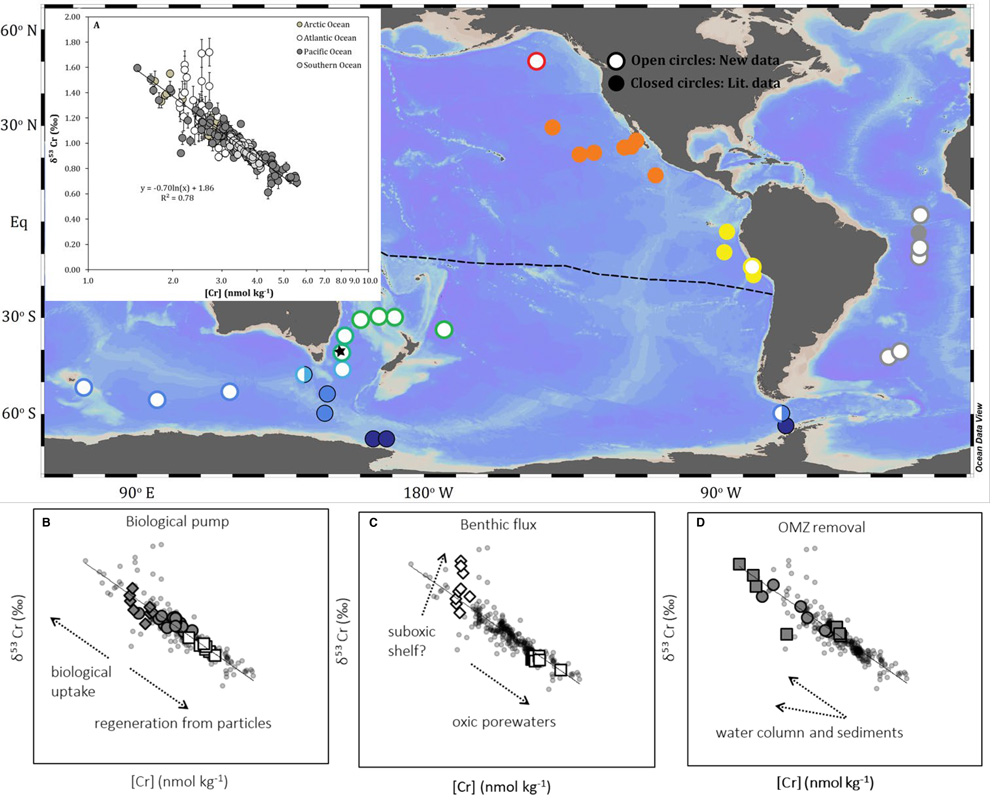
Based on i) new data from regeneration incubations and ii) an exhaustive compilation of total chromium (Cr) and stable isotope composition (δ53Cr) data, among them a significant number of new profiles collected as part of different oceanographic cruises, Janssen and co-authors (2021, see reference below) propose a comprehensive description of the different processes that might affect the Cr/δ53Cr distribution. Those are:
- Cr release from biogenic particles, which may be driven by Cr oxidation, is mechanistically independent from the regeneration of major elements in organic matter (e.g. C, N, P). This Cr release could occur either in the water column or oxic sediments, and can explain the [Cr]-rich side of the Cr/δ53Cr array (figure A below)
- In oxygen minimum zones, dissolved Cr can occur under its reduced form Cr(III), not soluble and thus easily scavenged in the water column or in the sediment, as illustrated in the figure D below,
- large benthic Cr fluxes can be locally important, and are possibly a globally-important component of the ocean’s Cr budget,
- hydrothermal inputs effects are not well constrained yet,
- as for all the oceanic tracers, mixing will generally lead to an homogenization of the variabilities due to the biogeochemical processes but also of the source effects (margins being locations where local inputs might be significant), and
- however, water masses that are mixing might also be imprinted by a specific signature, that could be superimposed on the other effects.
In the end, the authors warn us about the complexity and role of these biogeochemical processes shaping the Cr/δ53Cr array before using them as paleo-proxies.
Reference:
Janssen, D. J., Rickli, J., Abbott, A. N., Ellwood, M. J., Twining, B. S., Ohnemus, D. C., Nasemann, P., Gilliard, D., & Jaccard, S. L. (2021). Release from biogenic particles, benthic fluxes, and deep water circulation control Cr and δ53Cr distributions in the ocean interior. Earth and Planetary Science Letters, 574, 117163. Access the paper: 10.1016/j.epsl.2021.117163