
An original approach to assess the particulate trace metal concentrations in seawater

Measuring the particulate trace metal (pM) concentrations in seawater is challenging, even though this parameter is essential to understand the trace metal cycles, a GEOTRACES mission. Sohrin and co-workers (2025, see reference below) propose defining pM as the difference between total dissolvable and dissolved metals after a long storage (approximately two years) of filtered and unfiltered seawater acidified to pH 1.9. They observed that pM increased in two stages and reached equilibrium within ~ 1 y for relatively soluble elements as cobalt (Co) and lead (Pb), and took twice as long for aluminium (Al) and iron (Fe). They then compared their results with those obtained by a strong-acid leaching of filtered particles (total particulate metal; tpM) and established that pM determined by their protocol is a good proxy for tpM. Although they acknowledge some drawbacks for their approach -mostly related to the occurrence of refractory minerals in the samples- they consider that, if researchers are patient enough, they can assess a proper concentration of pM via the proposed protocol: pM result is related to the intercalibrated concentration of dM; approximately a hundred grams of filtered and unfiltered seawater subsampled from a sampling bottle are sufficient to determine pM; the risk of contamination is low because strong acids at high concentrations are unnecessary.
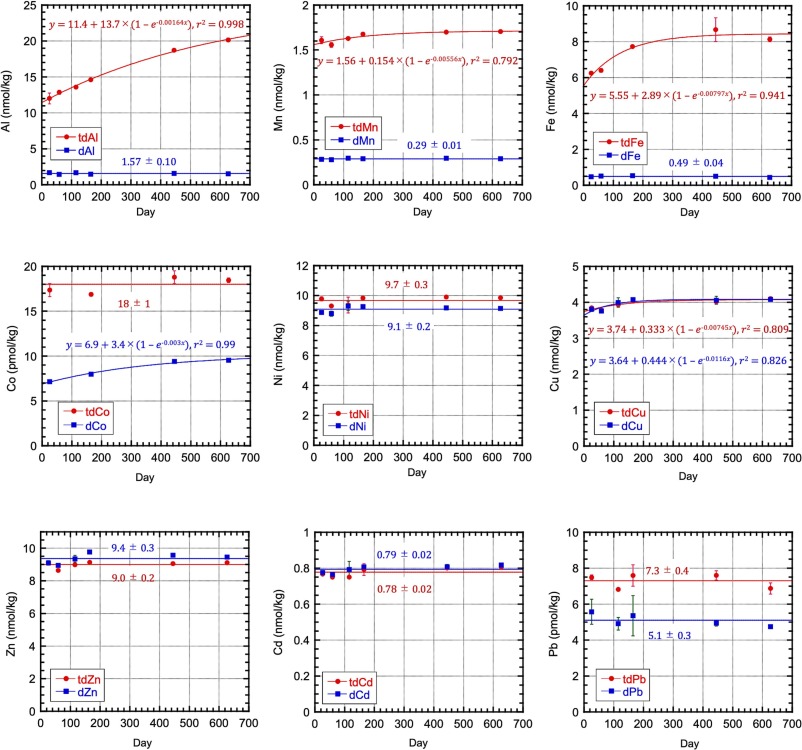
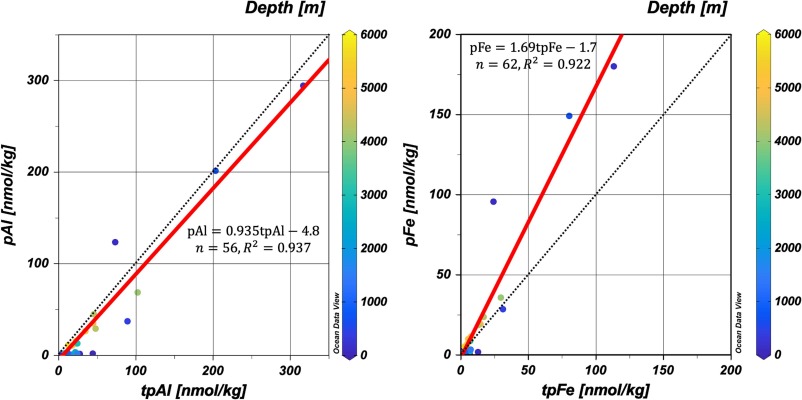
Figure 1: Time course of total dissolvable metal (tdM) and dissolved metal (dM) concentrations at pH 1.9 in bottom water collected from the western North Pacific. The error bars represent ±sd. The difference between tdM and dM represents the concentrations of particulate metal (pM). The time required for 90% dissolution is 1060 days for pAl and 281 days for pFe, suggesting that pM is more leachable than previously expected.
Figure 2: Correlation between pAl and tpAl, and between pFe and tpFe, in seawater samples that were collected from the subarctic Pacific during the R/V Hakuho Maru KH-17-3 cruise. The red lines represent linear regressions, and the doted lines indicate 1:1 relationships. The slope for pAl vs tpAl is close to 1. The slope for pFe vs tpFe is also close to 1 when the three data with pFe > 50 nmol/kg, which were affected by colloids, are excluded. These results suggest that pM is a good proxy for tpM.

Reference:

Sohrin, Y., Zheng, L., Chan, C.-Y., Nakaguchi, Y., Takano, S., Sohrin, R., Liao, W.-H., & Ho, T.-Y. (2025). Acid-leachability of metals from suspended particles in the Pacific Ocean. Marine Chemistry273, 104571. Access the paper:10.1016/j.marchem.2025.104571

Latest highlights

Do not mourn Nobias any longer: InertSep ME-2 is coming!

Thanks to the thorough development proposed by Alifia and co-workers, the community may have a solution to the shortage of Nobias Chelate PA-1.

Tracing the origin of iron in the equatorial Pacific: an isotopic study

The equatorial Pacific Ocean is a region of contrasts: in the west, rivers and sediments supply large amounts of iron, while in the east, iron deficiency limits the growth of phytoplankton…

Comprehensive inverse model constrains the application of beryllium-7 as a deposition tracer

Measurements of beryllium-7 activity in surface waters provide a promising approach for quantifying the deposition of aerosol-bound elements at the ocean surface…

Long-range transport of iron off the Antarctic Peninsula

Tian and co-authors investigate dissolved iron concentrations and isotope compositions in the western Weddell Sea…

Rechercher