First combined distributions of dissolved Neodymium (Nd) – Hafnium (Hf) concentrations and isotope compositions from the Baltic Sea
The central Baltic Sea is a marginal brackish basin, in which anoxic bottom waters prevail either seasonally or permanently and which is surrounded by continental landmasses comprising a large variety of compositions and ages of rocks. This allows the investigation of water mass mixing using radiogenic isotope compositions of Nd and Hf, as well as the geochemical cycling of these elements in the water column. Tianyu Chen and co-workers present the first combined distributions of dissolved Neodymium (Nd) and Hafnium (Hf) concentrations and their isotopic compositions from the Baltic Sea obtained during a cruise onboard the Polish RV Oceania in the frame of a process study of the GEOTRACES program.
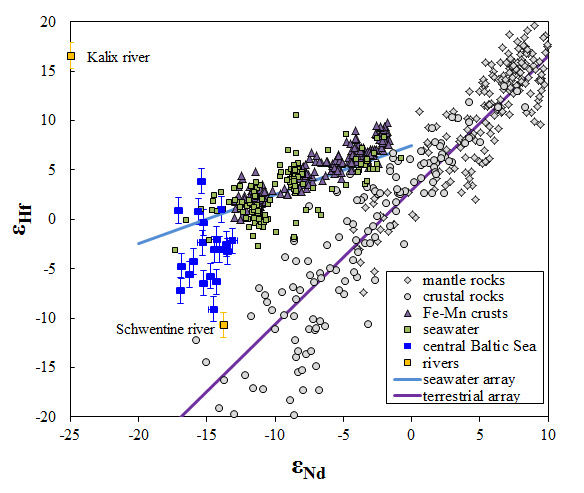 Figure: Neodymium-hafnium isotope systematics of the central Baltic Sea, in comparison with published Nd-Hf isotope data of terrestrial rocks, seawater (<0.45 μm), and Fe-Mn crusts (for sources of the data see publication).
The results document a pronouncedly different behavior of Nd and Hf. The Nd isotopes effectively trace the mixing between more radiogenic saline waters from the Atlantic and unradiogenic fresh waters from the northern Baltic Sea, which helps to understand Nd isotopes as water mass tracer in the open ocean. In contrast the dissolved Hf isotope signatures show a large variability but no consistent mixing trends, suggesting a shorter oceanic residence time of Hf than of Nd and thus a larger influence of local and highly variable weathering inputs. Nevertheless all data plot very close to the seawater array in Nd-Hf isotope space suggesting that continental incongruent weathering alone is most likely sufficient to explain the oceanic Hf isotope compositions without the involvement of hydrothermal contributions, which is also supported by the extreme Hf isotope composition of the Kalix river from northern Sweden.
Reference:
Chen, T.-Y., Stumpf, R., Frank, M., Beldowski J. and Staubwasser, M. (2013): Contrasting geochemical cycling of hafnium and neodymium in the central Baltic Sea. Geochimica et Cosmochimica Acta. 123, 166-180 DOI:10.1016/j.gca.2013.09.011