
Tracing dust deposition with aluminium and silicate at a resolution never reached before

Benaltabet and his colleagues (2022, see reference below) propose a study of the dissolved aluminium (Al) and silicate (Si) fate in the Gulf of Aqaba (Red Sea), with a temporal sampling resolution never achieved before. They focus on daily time scale dust storms, episodes of sediment resuspension and rain events, to quantitatively describe the in situ short- and long- term impact of such environmental perturbations on water column Al and Si inventories. Surprisingly, their data show that when the aerosol loads are intense the mixed layer Al (AlML) inventories decrease due to Al adsorption (scavenging) onto dust particles. This effect is intensified by dust storms, which cause scavenging rates to surpass dissolution rates resulting in the abrupt decrease in AlML. When the storm stops, Al scavenging rates increase linearly with increasing theoretical dissolution rates. The authors also presented important insights on the use of Al as a dust deposition tracer, by testing it in an extreme environment of atmospheric dust. Dissolved Al and Si concentrations ranged between 22 and 91 nmol kg-1 and 0.6 and 3.2 µmol kg-1, respectively. These two elements correlated at depth but decoupled in the upper water column.

The authors also show that a sediment resuspension event triggered a decrease of 34 % in the Al water column inventory, while the soluble Al flux from mineral dust is multiplied by a factor of 11 under wet deposition conditions.
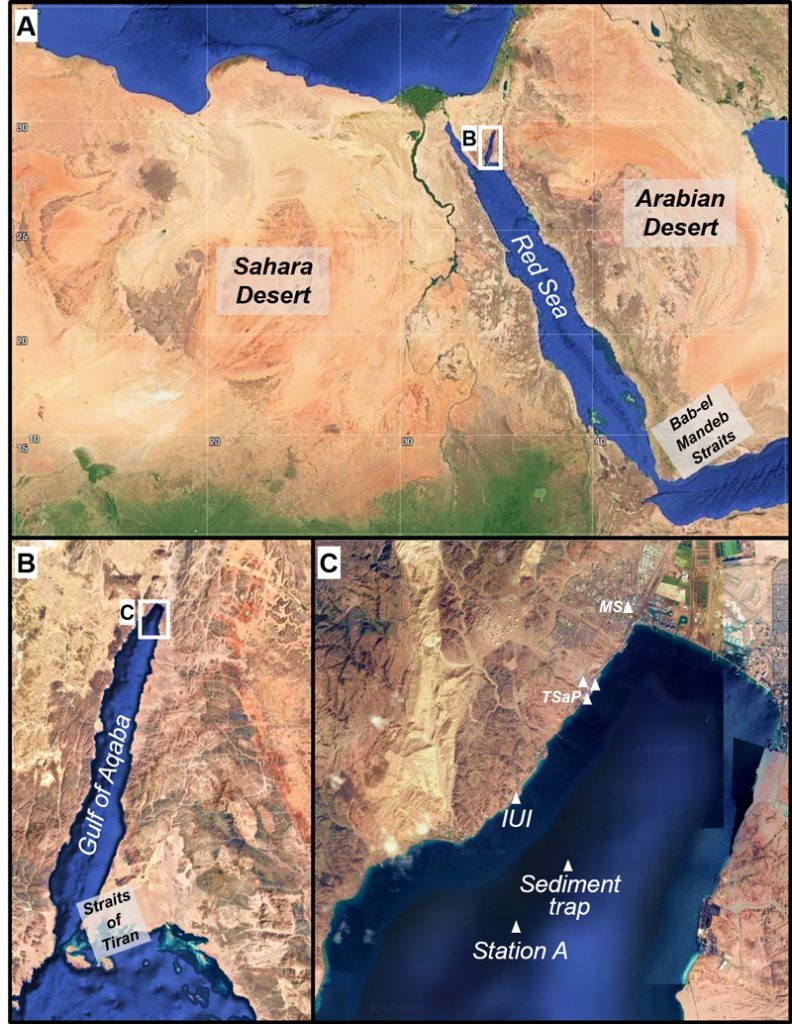
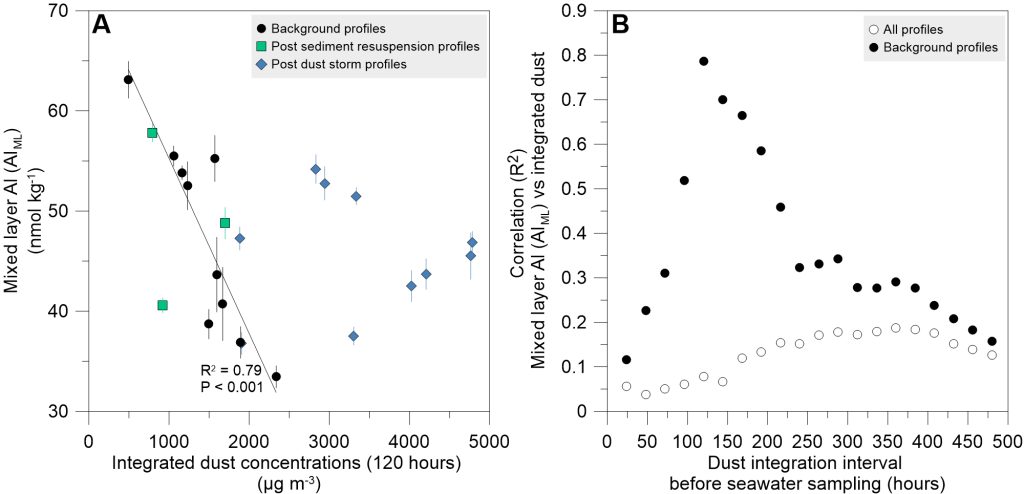
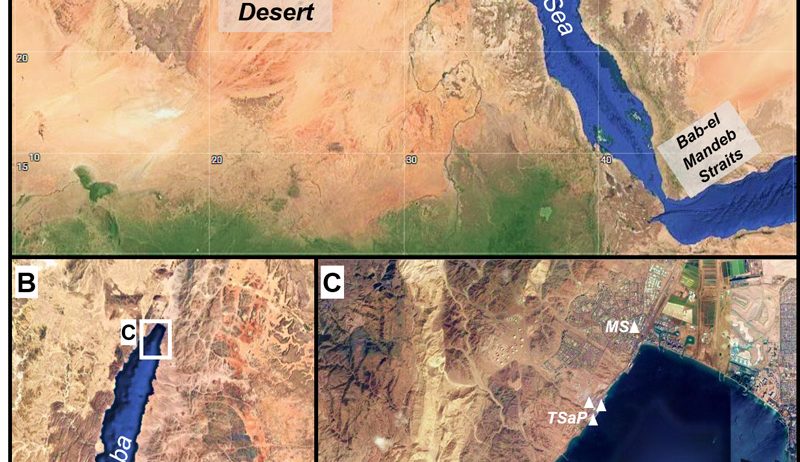
Figure 1: Map showing the location of the time series station, sediment trap mooring and aerosol monitoring stations in Gulf of Aqaba, northern Red Sea, between the major global dust exporters of the Sahara and Arabian deserts. 
Figure 2: (A) Dissolved Al concentrations in the upper water column of the GoA shown against integrated atmospheric dust particle loads. As dust is a major source of Al to seawater, an increase in dissolved Al concentrations with increasing dust concentrations is expected. However, the opposite trend is revealed since dust particles reaching seawater also adsorb (scavenge) dissolved Al, resulting in the observed lower Al concentrations. (B) The change in the correlation coefficient (R2) between dissolved Al and integrated dust loads, demonstrating how the effects of dust on dissolved Al peak 5 days after dust deposition. 

Reference:

Benaltabet, T., Lapid, G., & Torfstein, A. (2022). Dissolved aluminium dynamics in response to dust storms, wet deposition, and sediment resuspension in the Gulf of Aqaba, northern Red Sea. Geochimica et Cosmochimica Acta, 335, 137–154. Access the paper: 10.1016/j.gca.2022.08.029

Latest highlights

Mercury content and isotopes in bird’s guano: a window to reconstruct past climates

By analysing peat cores, Chuxian Li and her colleagues have shown how populations of nesting seabirds have fluctuated on a sub-Antarctic Island over the last 8,000 years.

Contraction of North Atlantic Deep Water during glacial times: a paradigm called into question

Blaser and co-authors propose a new distribution of deep-water masses in the Atlantic Ocean during the Last Glacial Maximum and the Heinrich Stadial..

Authigenic radiogenic neodymium isotope composition traces millennial-scale overturning circulation variability in the Arabian Sea

The neodymium isotopic signature of the sediment authigenic fraction is, a priori, a valuable proxy for reconstructing deep-water mass trajectories…

Magmatic activity at the Carlsberg Ridge in the Indian Ocean triggered by glacial sea-level variation

De and colleagues provide a high-resolution record of magmatic input and associated hydrothermal activity over the past 49 kyr from a core recovered from a magmatic segment of the slow-spreading Carlsberg Ridge in the Indian Ocean.

Rechercher