
Contraction of North Atlantic Deep Water during glacial times: a paradigm called into question
Blaser and co-authors (2025, see reference below) propose a new distribution of deep-water masses in the Atlantic Ocean during the Last Glacial Maximum (LGM) and the Heinrich Stadial 1 (HS1). Most importantly they establish that i) at least four distinct northern source deep waters co-existed in the Atlantic during the late glacial and ii) the contributions of glacial North Atlantic Deep Water (NADW) were significantly higher than recent estimates of 42% and 24% for the LGM and HS1, respectively. More particularly, their conclusions are clearly at odds with a strong volumetric reduction of NADW in the Atlantic during HS1.
These original results are based on an unprecedented compilation of five geochemical proxies (δ13C, δ18O, εNd, [CO32−] and radiocarbon (14C) reconstructions of deep waters integrated using a Bayesian mixing model. This multiproxy approach also reveals differences in the physical and chemical properties of the glacial-time deep water masses compared to today, presumably due to different formation processes.
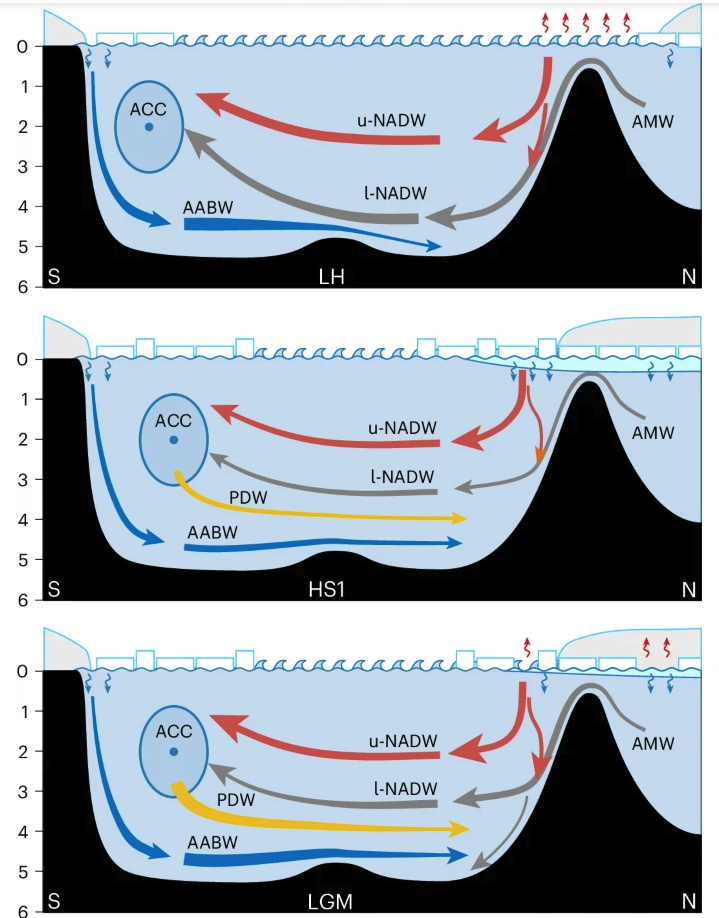
Figure: Illustrations showing source water mixing in the Atlantic Basin during the LH (top), HS1 (middle) and LGM (bottom). Arrows indicate the major deep ocean water mass flows, with thickness qualitatively indicating the flux. Sea ice and icebergs are indicated as white rectangles; continental ice is represented by the light grey caps on top; freshwater is denoted by the cyan-blue layer below. Heat release is shown as small red arrows, and salt injection from sea-ice formation is shown as small blue arrows. Numbers along the left edge indicate the approximate water depth in kilometres. The most notable differences between the LGM and HS1 are the supposed weaker deep overturning and less heat release combined with more brine rejection in the North Atlantic during HS1. ACC, Antarctic Circumpolar Current; N, north; S, south.
Reference:
Blaser, P., Waelbroeck, C., Thornalley, D. J. R., Lippold, J., Pöppelmeier, F., Kaboth-Bahr, S., Repschläger, J., & Jaccard, S. L. (2025). Prevalent North Atlantic Deep Water during the Last Glacial Maximum and Heinrich Stadial 1. Nature Geoscience, 18, 410–416. doi:10.1038/s41561-025-01685-5