
Mercury content and isotopes in bird’s guano: a window to reconstruct past climates
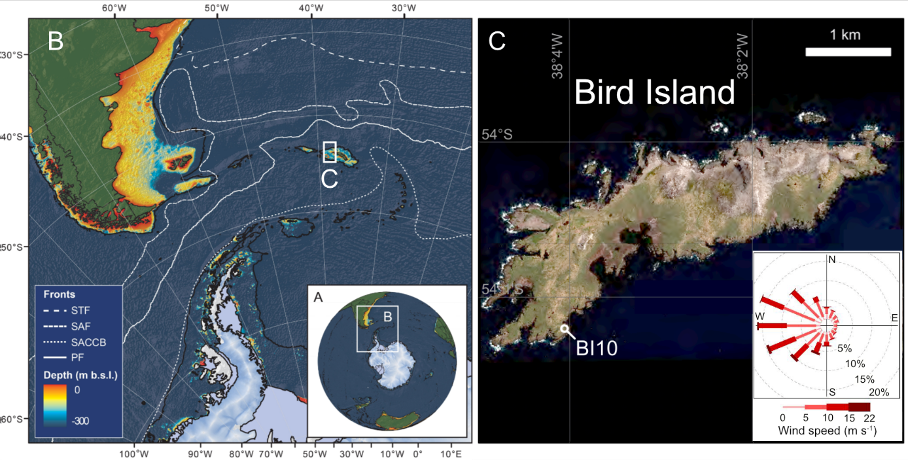
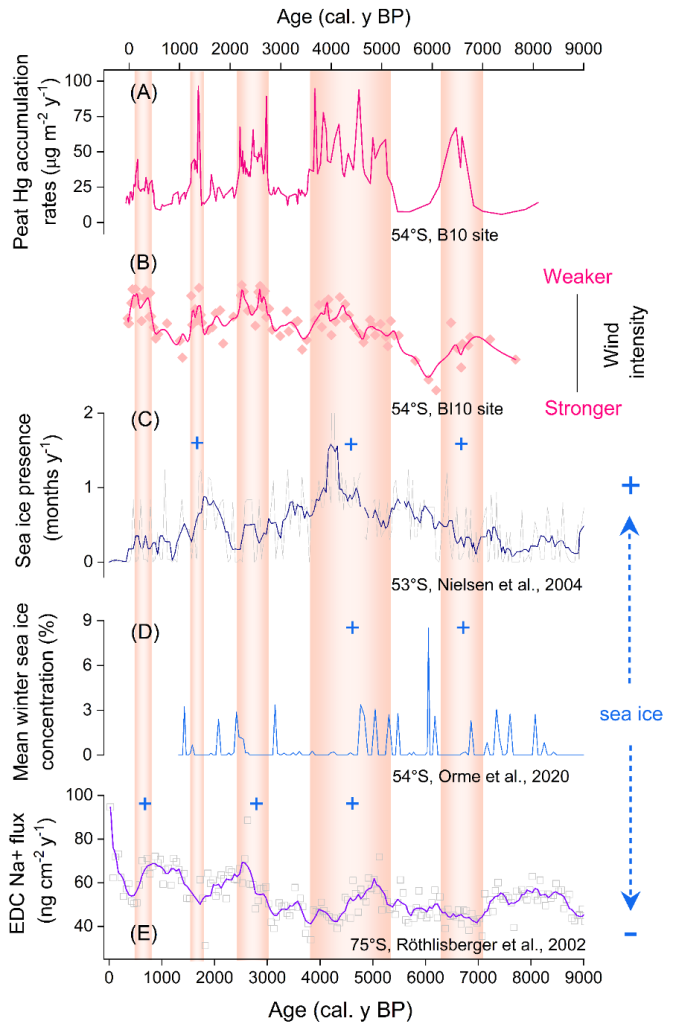
By analysing peat cores, Chuxian Li and her colleagues (2026, see reference below) have shown how populations of nesting seabirds have fluctuated on a sub-Antarctic Island over the last 8,000 years. They found that bird numbers rose and fell alongside shifts in climate, offering new clues about how future climate change could impact seabird populations.
This result was obtained based on an original and innovative idea: analysing the mercury content and mercury isotopes at different depths in a valley peatland below the slopes where the bird’s nest. Indeed, seabirds accumulate substantial amounts of mercury, and the mercury in their prey is also present in their guano. And guano is archived in successive layers of the peat. Applying this method to peat cores, from sub-Antarctic Bird Island, the researchers have provided a reliable, widely applicable, and high-resolution reconstruction of seabird population changes after the last ice age. The method can now be used to conduct similar studies at other locations around the world where there are suitable archives of peat layers or sediments.
Reference :
Li, C., Roberts, S. J., Grosjean, M., Mestrot, A., Wille, M., Phillips, R. A., Enrico, M., Bishop, K., Skyllberg, U., Mauquoy, D., von Scheffer, C., Theurer, T., Muirhead, D., Whittle, A., Gallego-Sala, A., Sonke, J. E., De Vleeschouwer, F., Van der Putten, N., Braconnot, P., Marti, O., Osterwalder, S., Buchmann, N., Frölicher, T., Anthamatten, E., Chiaia-Hernández, A. C., Zahajská, P., Jeandel, C., Saunders, K. M., Kwon, S. Y., Wang, D., Bindler, R., Sime, L., & Hodgson, D. A. (2026). Southern Ocean seabird population shifts over the Holocene revealed by peat sequestration of mercury from guano. Proceedings of the National Academy of Sciences, 123. doi:10.1073/pnas.2533681123