
What controls the barium distribution in the Arctic Ocean?
This overarching question guided the synthesis by Whitmore and her co-workers (2022, see reference below). Based on data collected as part of the Arctic 2015 GEOTRACES cruises (GN01, GN02/3 and GN04) in addition to historical data, they compiled an extensive set of parameters characterizing the marine barium (Ba) cycle: dissolved and particulate concentrations as well as more recent 138/134Ba dissolved isotopic ratios. They also characterized all the previously described sources of these tracers around the Arctic (rivers, atmosphere/sea ice, Pacific and Atlantic seawater). The strengths of this information gathering led them to compare the Arctic Ba distribution resulting from a pure mixing of source waters with the observations. This revealed that non-conservative sources/processes contributed 20 to 50% of the dBa budget. Using 3 different approaches (flux balance, coupling Ba transport with the 228Ra one (see highlight here), and statistical Ba anomaly representations) the authors clearly identify sediments deposited on the margins as sources of the excess dBa in the water column. Later, they debate the processes affecting the deep-water dBa and the Canadian Archipelago waters…exciting reading!
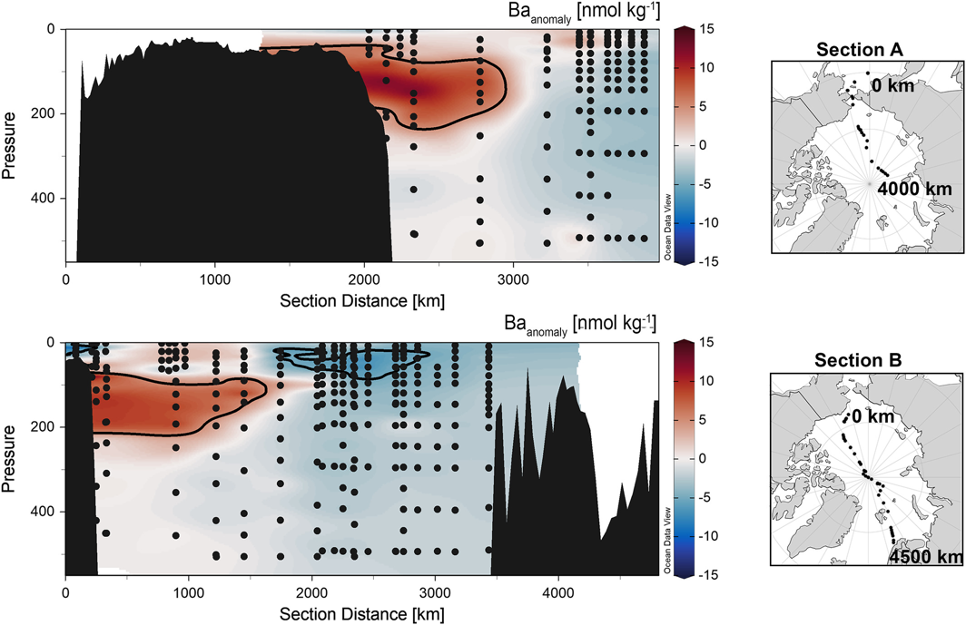
Figure: In this figure we show the barium anomaly (Baanomaly); this metric represents whether or not the distribution of dissolved Ba in the Arctic is set by mixing (values near zero; off-white) or if there are sources (red colors) or sinks (blue colors) of dissolved barium that can’t be accounted for by mixing. Values between -5 and +5 nmol kg-1 are effectively zero given the model uncertainties; the black contours indicate where the model determined significant sources or sinks. Where there is heightened red color, fluxes from margin sediments are likely the missing source.
Reference:
Whitmore, L. M., Shiller, A. M., Horner, T. J., Xiang, Y., Auro, M. E., Bauch, D., Dehairs, F., Lam, P. J., Li, J., Maldonado, M. T., Mears, C., Newton, R., Pasqualini, A., Planquette, H., Rember, R., & Thomas, H. (2022). Strong Margin Influence on the Arctic Ocean Barium Cycle Revealed by Pan‐Arctic Synthesis. Journal of Geophysical Research: Oceans, 127(4). doi:10.1029/2021jc017417