
Rare Earth and neodymium isotope cycles in the abyssal Pacific Ocean are shaking up the paradigm established for particle reactive tracers

Based on a comprehensive study of the Rare Earth Elements (REE) and neodymium (Nd) isotope cycles along a north-south section of the central North Pacific Ocean, Du and colleagues (2025, see reference below) demonstrate the importance of the abyssal sediment source in the control of the trace element and isotopes (TEI) marine distribution. Their findings are shaking up the paradigm – currently applied in most Ocean Biogeochemical Models (OBMs) – which assumes that TEI distributions are primarily controlled by surface sources, biological uptake or adsorption followed by reversible scavenging by dissolved-particulate exchange along the water column. Instead, they suggest that for elements with greater affinity for manganese oxide than biogenic particles:

  • scavenging acts as a net sink throughout the water column,
  • a benthic flux contributes to increasing elemental concentrations with water depth,
  • and the abyssal source consists of two components: one recycled from elements scavenged by water-column particles, and another newly introduced to the water column via marine silicate weathering within sediments.

This leads them to propose an original scheme of these TEI cycles, illustrated in the figure below.
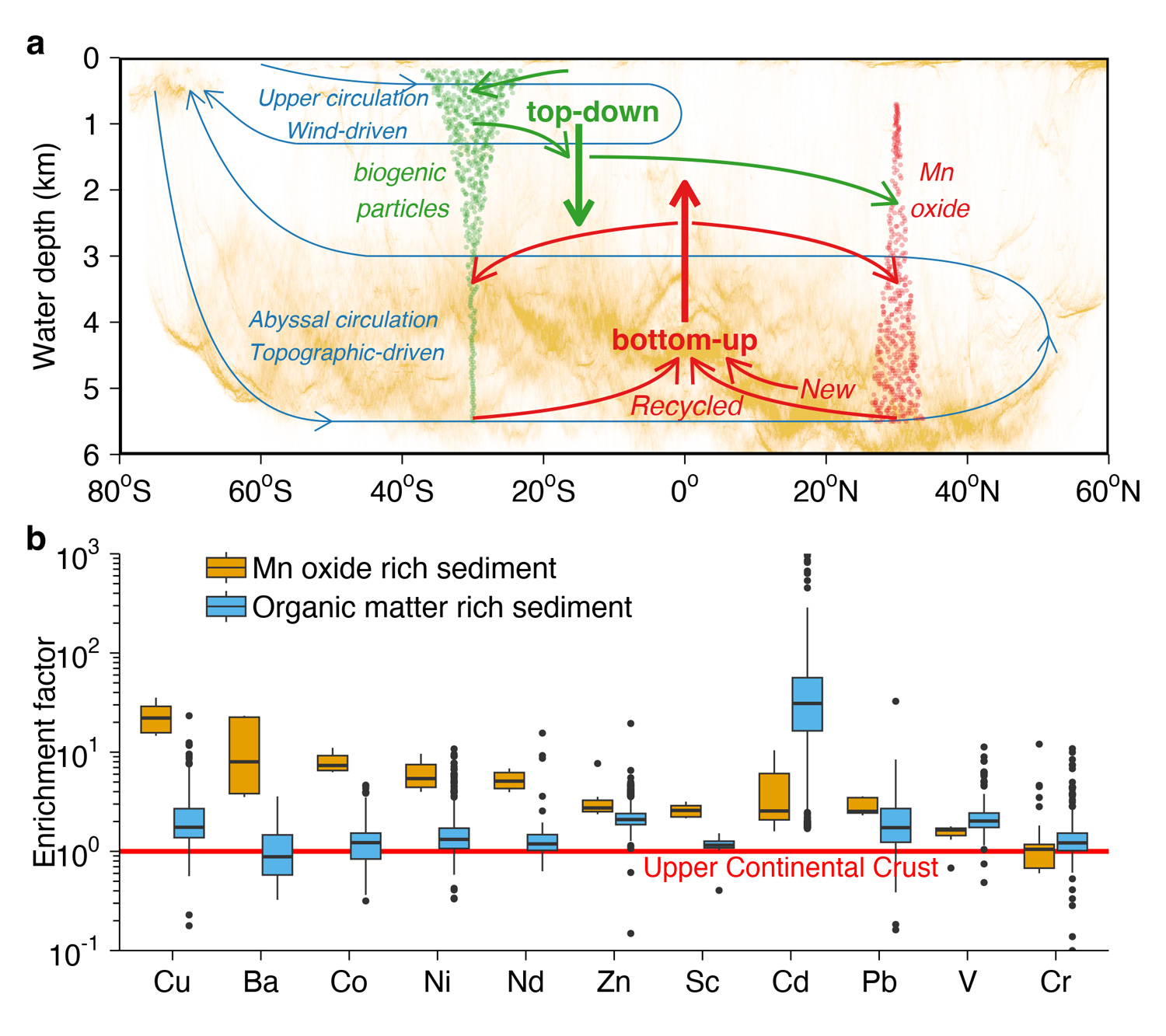
Figure: The bottom-up and top-down driven ocean biogeochemical cycles. (a) In the top-down driven cycle, marine elements are added to the surface ocean and removed by biogenic particles. As biogenic particles sink and remineralize, the surface sources are shuttled down the deep ocean. In the bottom-up driven cycle, elements are scavenged by oxide particles which prevent their direct regeneration in the water-column, instead, these elements are released from the abyssal seafloor, by recycling scavenged element and newly weathering marine silicate minerals during diagenesis. (b) The enrichment factors of trace metals in Mn-oxide-rich and organic-matter-rich sediments, revealing the relative affinity of metals to the two types of scavenging particles. This figure is modified based on Figure 5 from Du et al. (2025) under a Creative Commons Attribution 4.0 International License.

Reference:

Du, J., Haley, B. A., McManus, J., Blaser, P., Rickli, J., & Vance, D. (2025). Abyssal seafloor as a key driver of ocean trace-metal biogeochemical cycles. Nature, 642, 620–627. Access the paper: 10.1038/s41586-025-09038-3

Latest highlights

Do not mourn Nobias any longer: InertSep ME-2 is coming!

Thanks to the thorough development proposed by Alifia and co-workers, the community may have a solution to the shortage of Nobias Chelate PA-1…

Long-range transport of iron off the Antarctic Peninsula

Tian and co-authors investigate dissolved iron concentrations and isotope compositions in the western Weddell Sea…

Seasonal variation of the dissolved iron ligands in the South Atlantic sector of the Southern Ocean

In the ocean, up to 99% of the dissolved iron is strongly complexed with organic compounds known as iron-binding ligands…

Tracing the origin of iron in the equatorial Pacific: an isotopic study

The equatorial Pacific Ocean is a region of contrasts: in the west, rivers and sediments supply large amounts of iron, while in the east, iron deficiency limits the growth of phytoplankton…

Rechercher