
Trace metal effluxes from Peruvian shelf sediments

Shelf sediments are a major reservoir of labile trace metals. For dissolved redox sensitive elements such as iron (Fe), shelf sediments underneath oxygen minimum zones are typically a major source to the water column. However, quantifying the associated dissolved fluxes is methodologically challenging. Liu and colleagues (2025, see reference below), compare four different methods for estimating the Fe flux from Peruvian shelf sediments and show that the results are quite variable. Estimates of benthic Fe release suggest Fe residence times in the water column from 5 days to 7 years for the Peruvian shelf depending on exactly what spatial scale the benthic efflux is constrained over. This largely reflects the strong attenuation of dissolved Fe efflux from shelf sediments on spatial scales of 0.1-10 m from the seafloor.
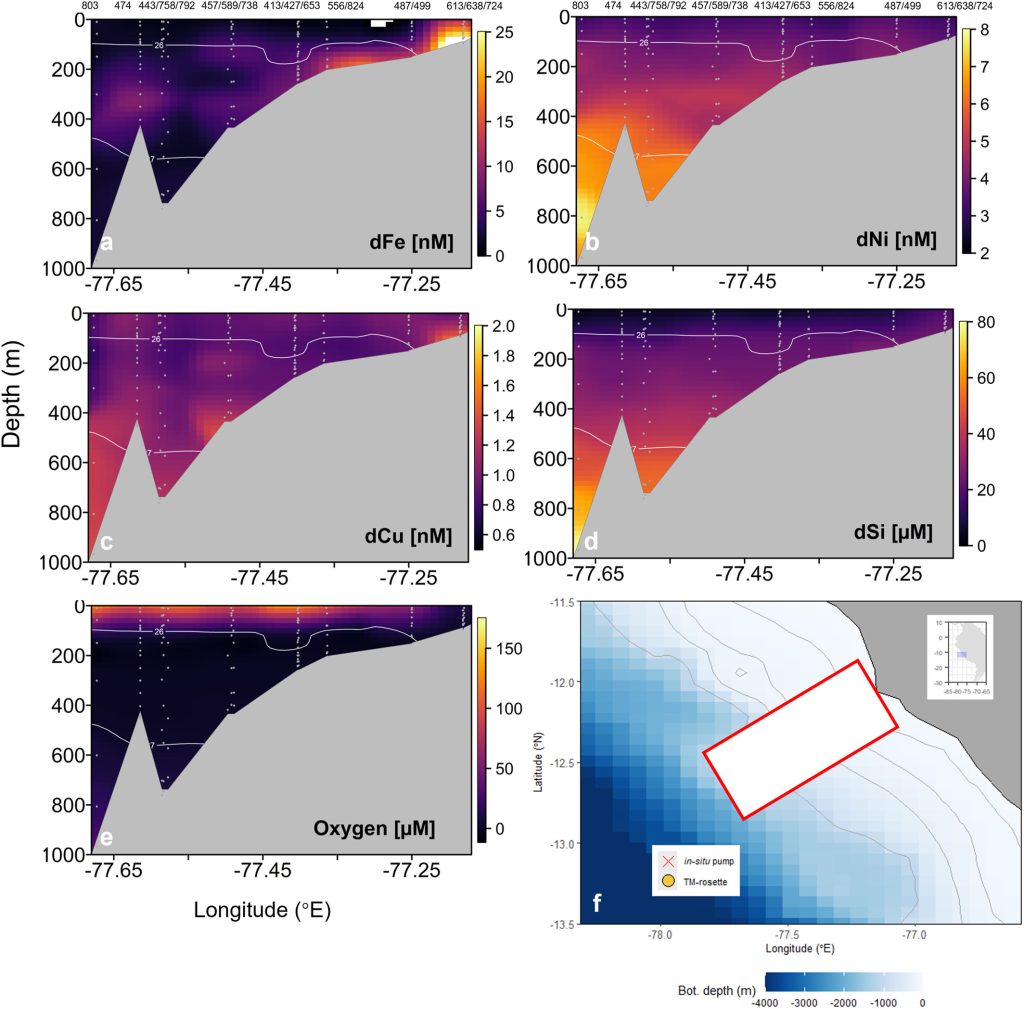
Figure: Dissolved iron, nickel, copper, silicon, and oxygen along a transect across the Peruvian shelf at 12°S. The data were collected using the TM-rosette system during two research cruises, M136 and M137.

Reference:

Liu, T., Plass, A., Gledhill, M., Scholz, F., Achterberg, E. P., & Hopwood, M. J. (2025). Trace Metal Effluxes From Peruvian Shelf Sediments Constrained in Parallel by Benthic Lander Mounted Pumps and Pelagic Rosette Sampling. Journal of Geophysical Research: Biogeosciences, 130. Access the paper: 10.1029/2024jg008583

Latest highlights

Continuous record of the Antarctic Circumpolar Current latitude over the last glacial-interglacial cycles

The meridional positions of the oceanic fronts separating subtropical and Antarctic waters are key to constraining the mechanisms that drive the degassing of deeply-stored CO2 at the end of the glacial periods…

Arctic outflows to Davis Strait and the Labrador Sea traced by radionuclide distributions

This study demonstrates that Arctic outflows through the Canadian Arctic Archipelago play a much more significant role than previously recognised.

Zinc and lead isotopes reveal human footprint on the most remote oceanic regions

Benaltabet and co-workers analysed suspended particles collected on GEOTRACES GP21 cruise tracked from Chile to New Caledonia.

Organic binding site heterogeneity controls amorphous ferric oxy-hydroxides oceanic sink

In oxygenated seawater iron binds to hydroxide ions, which results in authigenic Fe precipitation as amorphous ferric oxy-hydroxide…

Rechercher