
The biogeochemical ventures of dissolved iron and manganese across the Arctic Ocean

The spatial distributions and biogeochemical cycling of dissolved Fe (dFe) and dissolved manganese (dMn) across the Arctic Ocean were established during summer and fall 2015. The Canadian GEOTRACES transect extended from the Canada Basin (CB) to the Labrador Sea (LS) via the Canadian Arctic Archipelago (CAA).

The surface, subsurface and deep water distributions for both metals are controlled by i) a large variety of processes and ii) a complex balance between sources and sink (river inputs in surface, advective transports and particle remineralization at depth). For example, the highest concentrations are measured in surface waters of the CAA and the CB because these regions are strongly influenced by river inputs. Contrastingly, in the highly productive Baffin Bay and Labrador Sea, the surface waters are markedly depleted in dFe and dMn while organic matter remineralization likely acts as a notable source of these elements to deep waters.

The figure below summarizes the complexity of the processes governing the fate of these elements in the Canadian Arctic Ocean.
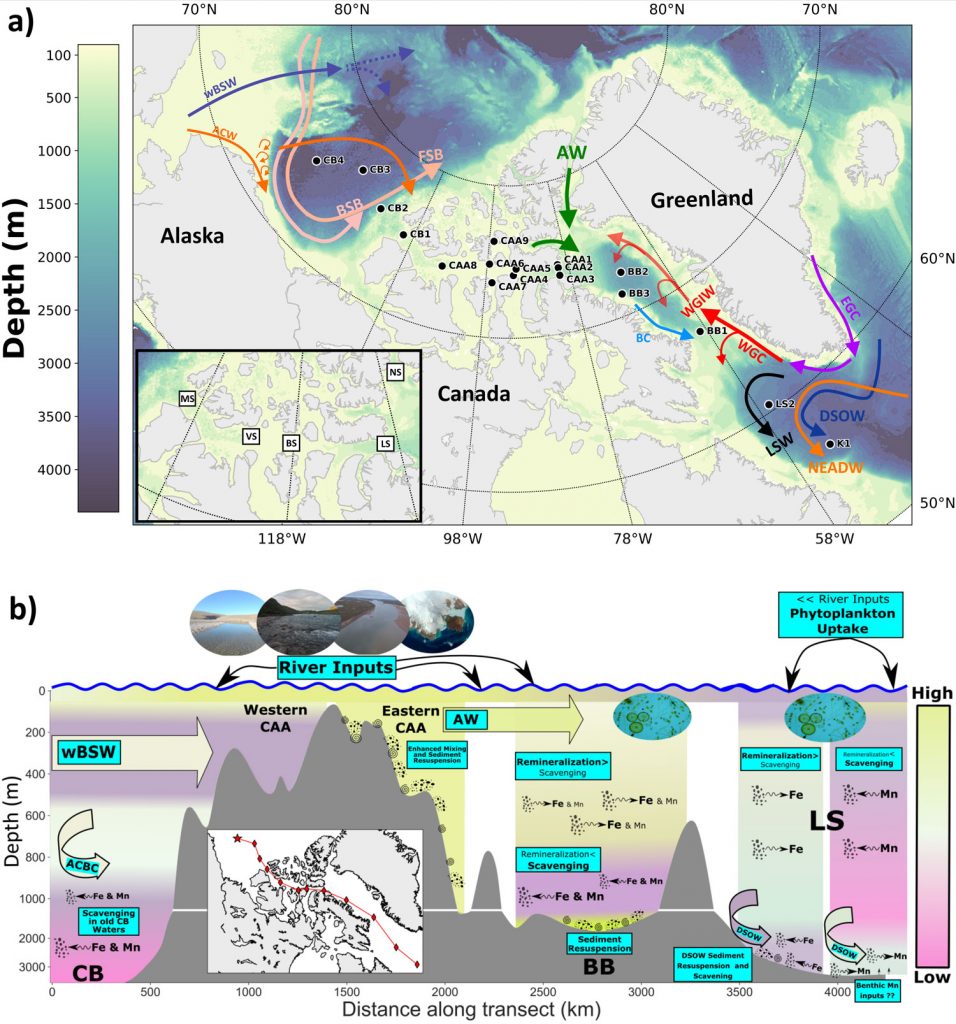
Figure: a) Sampled stations for Fe and Mn during the Canadian Arctic GEOTRACES cruises, bathymetry and schematic of water circulation. b) Conceptual scheme displaying the concentrations and key processes (e.g. freshwater and sedimentary inputs, remineralization and scavenging removal) controlling the distributions of dissolved Fe and Mn in the Canadian Arctic Ocean.

Reference:

Colombo, M., Jackson, S. L., Cullen, J. T., & Orians, K. J. (2020). Dissolved iron and manganese in the Canadian Arctic Ocean: On the biogeochemical processes controlling their distributions. Geochimica et Cosmochimica Acta, 277, 150–174. DOI : https://doi.org/10.1016/j.gca.2020.03.012

Latest highlights

Mercury content and isotopes in bird’s guano: a window to reconstruct past climates

By analysing peat cores, Chuxian Li and her colleagues have shown how populations of nesting seabirds have fluctuated on a sub-Antarctic Island over the last 8,000 years.

Contraction of North Atlantic Deep Water during glacial times: a paradigm called into question

Blaser and co-authors propose a new distribution of deep-water masses in the Atlantic Ocean during the Last Glacial Maximum and the Heinrich Stadial..

Authigenic radiogenic neodymium isotope composition traces millennial-scale overturning circulation variability in the Arabian Sea

The neodymium isotopic signature of the sediment authigenic fraction is, a priori, a valuable proxy for reconstructing deep-water mass trajectories…

Magmatic activity at the Carlsberg Ridge in the Indian Ocean triggered by glacial sea-level variation

De and colleagues provide a high-resolution record of magmatic input and associated hydrothermal activity over the past 49 kyr from a core recovered from a magmatic segment of the slow-spreading Carlsberg Ridge in the Indian Ocean.

Rechercher