
Long distance dissolved iron transport in the North-East Pacific revealed by multiple tracers and an ocean circulation model

GEOTRACES strategy is to combine the information provided by different geochemical tracers to identify and quantify oceanic processes. Sieber and co-authors (2024, see reference below) have made extensive use of this multi-tracer approach, coupled to an oceanic circulation model. By measuring sediment‐source tracers including dissolved iron isotope composition (δ56Fe), manganese (Mn), radium-228 (228Ra), and particulate iron (Fe), they revealed the dissolved Fe provenance of three dissolved iron plumes identified close to the Alaskan continental margin: surprisingly, while two originate from local shelf and abyss sedimentary sources, the intermediate depth dissolved Fe plume results not from the local margin but instead from long‐distance transport of dissolved iron from Asian marginal sediment sources. This finding extends work that already has shown the large eastward transport of Fe from Asian marginal seas into the North Pacific.
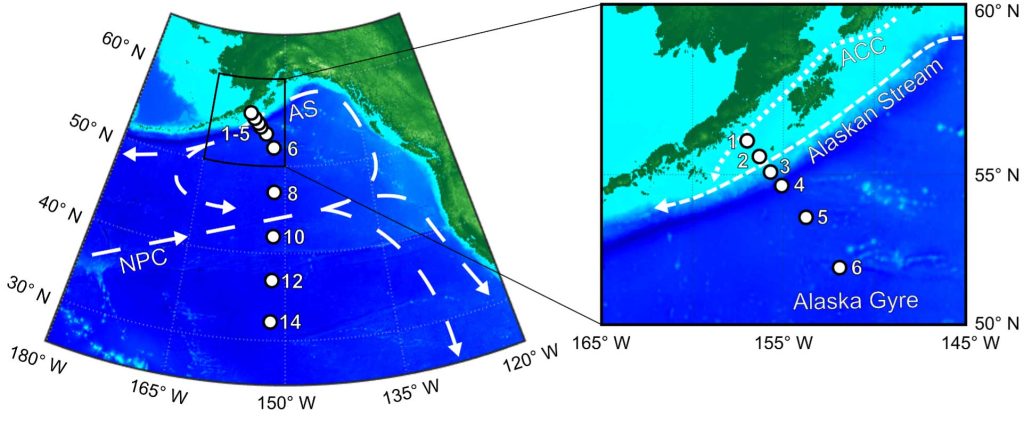
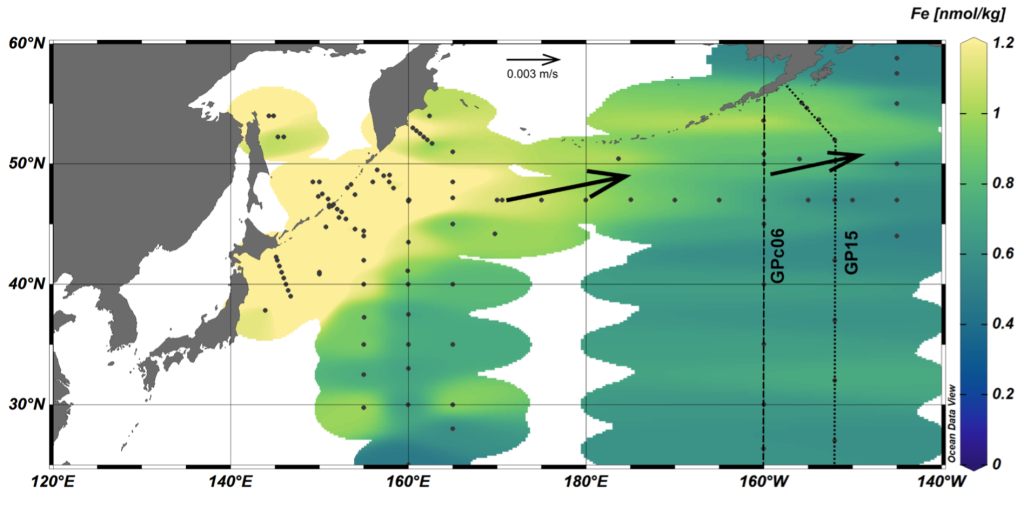
Figure 1. Cruise track and stations of the 2018 US GEOTRACES GP15 Meridional Transect off Alaska, as well as major surface currents in the region. AS = Alaskan Stream, ACC = Alaskan Coastal Current, NPC = North Pacific Current.
Figure 2. Iron concentrations at ~1300 m depth across the North Pacific Ocean, compiled from various cruises, and arrows showing the direction of flow and how Fe from Asian marginal seas is transported to Alaska. GPc06 and GP15 show the location of Japanese and US GEOTRACES cruises.

Reference:

Sieber, M., Lanning, N. T., Steffen, J. M., Bian, X., Yang, S.-C., Lee, J. M., Weiss, G., Hunt, H. R., Charette, M. A., Moore, W. S., Hautala, S. L., Hatta, M., Lam, P. J., John, S. G., Fitzsimmons, J. N., & Conway, T. M. (2024). Long Distance Transport of Subsurface Sediment‐Derived Iron From Asian to Alaskan Margins in the North Pacific Ocean. Geophysical Research Letters, 51. Access the paper: 10.1029/2024gl110836

Latest highlights

Mercury content and isotopes in bird’s guano: a window to reconstruct past climates

By analysing peat cores, Chuxian Li and her colleagues have shown how populations of nesting seabirds have fluctuated on a sub-Antarctic Island over the last 8,000 years.

Contraction of North Atlantic Deep Water during glacial times: a paradigm called into question

Blaser and co-authors propose a new distribution of deep-water masses in the Atlantic Ocean during the Last Glacial Maximum and the Heinrich Stadial..

Authigenic radiogenic neodymium isotope composition traces millennial-scale overturning circulation variability in the Arabian Sea

The neodymium isotopic signature of the sediment authigenic fraction is, a priori, a valuable proxy for reconstructing deep-water mass trajectories…

Magmatic activity at the Carlsberg Ridge in the Indian Ocean triggered by glacial sea-level variation

De and colleagues provide a high-resolution record of magmatic input and associated hydrothermal activity over the past 49 kyr from a core recovered from a magmatic segment of the slow-spreading Carlsberg Ridge in the Indian Ocean.

Rechercher