
Silicon isotopes reveal significant lithogenic input to dissolved silicon on the Kerguelen Plateau
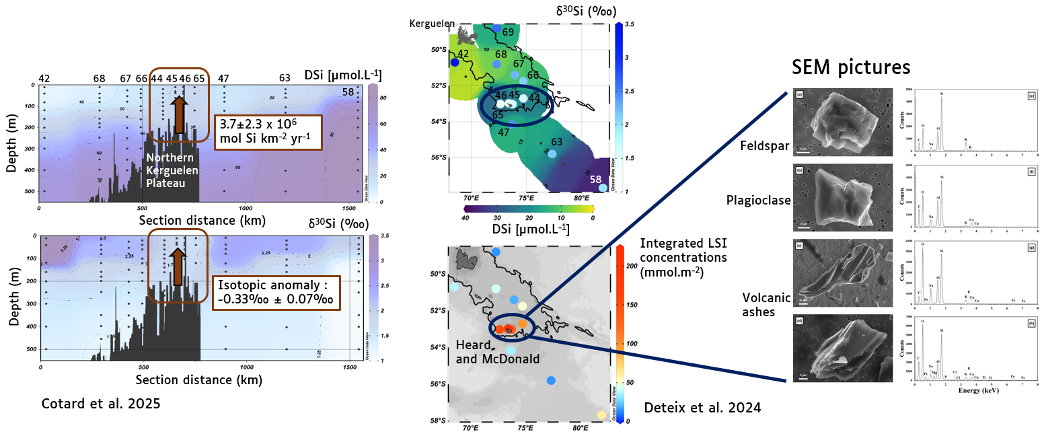
The South West Indian GEOTRACES Section (SWINGS, GS02) allowed detailed studies of the sub-Antarctic island effect on the chemical species distributions. Establishing sources, transformations and sinks of dissolved silicon (DSi), a major nutrient in the Southern Ocean (SO), is thus of primary importance. Two studies conducted at LOCEAN (Sorbonne Université, Paris, France) are highlighted here. Deteix and co-workers (2024, see reference below) established the biogenic and lithogenic silicon distribution along the full section. Cotard and co-authors (2025, see reference below) focused on the DSi and Si isotopes on the Kerguelen Plateau. Based on the previous microscopic observations and Si concentration measurements of Deteix and co-authors (2024) highlighting a lithogenic Si source (including volcanic ashes) around the Heard and McDonald Islands, Cotard and co-authors (2025) revealed i) that the DSi isotopic signature is lighter compared to the surrounding SO so that ii) this lighter isotopic signature can be explained by the dissolution of lithogenic Si, likely of volcanic origin. The authors estimate the lithogenic Si contribution to 10% of dissolved Si (corresponding to 2.9 ± 1.8 μmol L−1), leading to a Si dissolution flux per surface area among the highest identified in the ocean so far. Without the measurement of Si isotopes this lithogenic Si contribution to the Si nutrient pool would have not been detected nor quantified.
References:
Cotard E., V. Deteix, F. Vivier, A. Dapoigny, S. Caquineau, D. Cardinal (2025). Significant impact of lithogenic dissolution from subantarctic volcanic islands on the regional marine silicon cycle. Limnology & Oceanography, Access the paper: 10.1002/lno.70243
Deteix, V., Cotard, E., Caquineau, S., Landing, W. M., Planchon, F., Ryan-Keogh, T., & Cardinal, D. (2024). Biogenic and lithogenic silicon along the GEOTRACES south West Indian Ocean section (SWINGS-GS02) and the islands mass effect on regional Si biogeochemical cycle. Marine Chemistry, 104412. Access the paper: 10.1016/j.marchem.2024.104412