
Shelf sediments in the Benguela Upwelling System as a major source of trace metals to the shelf and eastern South Atlantic Ocean

Trace metals including iron (Fe), cobalt (Co), manganese (Mn), cadmium (Cd), nickel (Ni) and copper (Cu) can regulate phytoplankton growth, marine primary productivity, ultimately carbon export in the ocean. Sources and fluxes of trace metals are therefore crucial to identify the ocean state and how ocean reacts to climate change.

Liu and her colleagues (2022, reference below) investigated dissolved trace metals distributions within the Benguela Upwelling System sampled from GEOTRACES GA08 cruise. Results reveal shelf sediments are a major redox-sensitive trace metals (Fe, Co and Mn) to the shelf and eastern South Atlantic Ocean, whereas distributions of nutrient-type trace metals (Cd, Ni and Cu) are shaped by regeneration and water masses on the shelf and in the open ocean, respectively. Estimated off-shelf fluxes of Fe and Co from 200-500m are larger than those from upper 200m, indicating an important role of shelf edge as a source of trace metals. These findings demonstrate that supplies of Fe, Co and Mn from the shelf could increase and potentially result in a more extensive regional limitation of primary production by fixed nitrogen availability in the future of ocean deoxygenation.
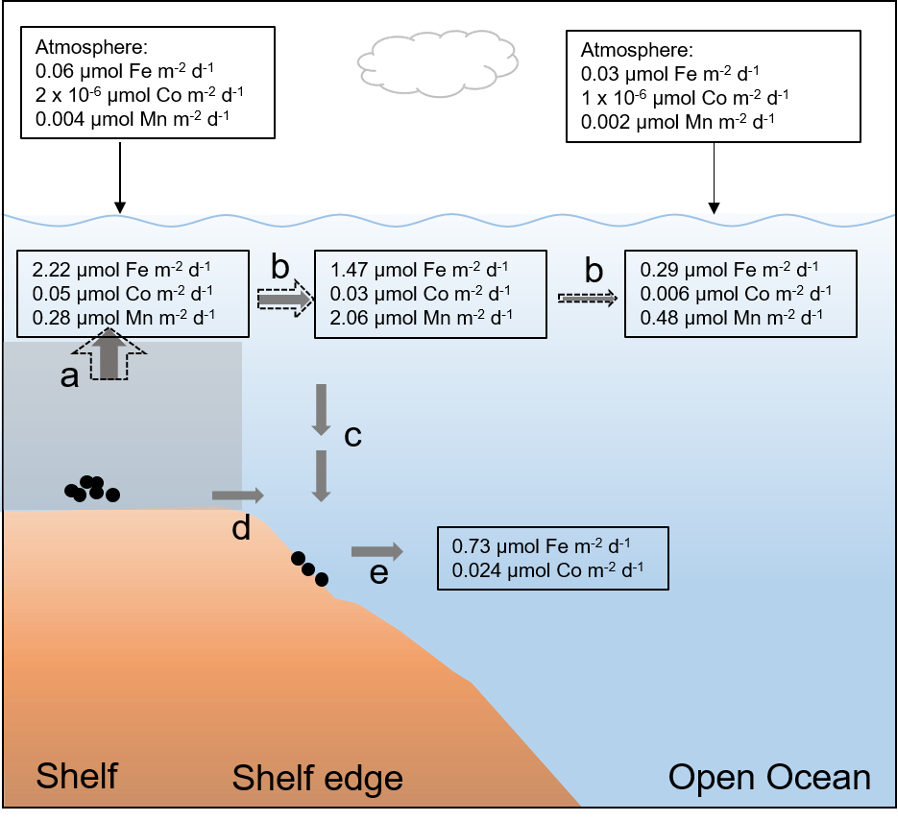
Figure. Schematic of different trace metal (TM) fluxes in the Benguela Upwelling System. Grey shading indicates OMZ over the Namibian shelf. Arrows (a – e) indicate different processes, a. upward transfer, b. lateral off-shelf transfer within the surface layer, c. precipitation/scavenging to the shelf edge, d. lateral transfer within the bottom shelf layer, e. off-shelf transfer from the shelf edge. The thickness of arrows (a, b, c and e) are scaled up to the magnitude of the associated flux. The dashed arrows indicate changes of different TM fluxes following ocean deoxygenation.   

Reference:

Liu, T., Krisch, S., Xie, R. C., Hopwood, M. J., Dengler, M., & Achterberg, E. P. Sediment release in the Benguela Upwelling System dominates trace metal input to the shelf and eastern South Atlantic Ocean. Global Biogeochemical Cycles, e2022GB007466. Access the paper: https://doi.org/10.1029/2022GB007466

Latest highlights

Mercury content and isotopes in bird’s guano: a window to reconstruct past climates

By analysing peat cores, Chuxian Li and her colleagues have shown how populations of nesting seabirds have fluctuated on a sub-Antarctic Island over the last 8,000 years.

Contraction of North Atlantic Deep Water during glacial times: a paradigm called into question

Blaser and co-authors propose a new distribution of deep-water masses in the Atlantic Ocean during the Last Glacial Maximum and the Heinrich Stadial..

Authigenic radiogenic neodymium isotope composition traces millennial-scale overturning circulation variability in the Arabian Sea

The neodymium isotopic signature of the sediment authigenic fraction is, a priori, a valuable proxy for reconstructing deep-water mass trajectories…

Magmatic activity at the Carlsberg Ridge in the Indian Ocean triggered by glacial sea-level variation

De and colleagues provide a high-resolution record of magmatic input and associated hydrothermal activity over the past 49 kyr from a core recovered from a magmatic segment of the slow-spreading Carlsberg Ridge in the Indian Ocean.

Rechercher