
High levels of anthropogenic lead in the Indian Ocean

Yadav and her colleagues (2025, see reference below) provide comprehensive insights into the distribution and sources of dissolved lead (dPb) in the Indian Ocean, based on 510 samples collected during winter monsoon GI10 (2020) and spring inter-monsoon GI09 (2021) cruises, to which they add results from published works. The surface dPb concentrations are elevated compared to other ocean basins, characterised by a strong north-south gradient (114 to 23 pM). Although most of the lead is of atmospheric origin, the study reveals relatively high dPb contribution from continental shelf sediments in the Bay of Bengal. This likely reflects the impact of enhanced sediment loading, primarily driven by the Ganga-Brahmaputra River system. The authors also propose an assessment of the atmospheric lead sources, which shows that China and India have increased their lead inputs by approximately 4.3 to 4.8 times over 33-year period, 12.5 and 82.8 thousand tons annually for India and China respectively in 2023, due to coal burning. In addition, climatic events such as the Indian Ocean Dipole play an important role in supplying dPb over the southern Indian Ocean through dust storms and bushfires from southern Africa and Australia.
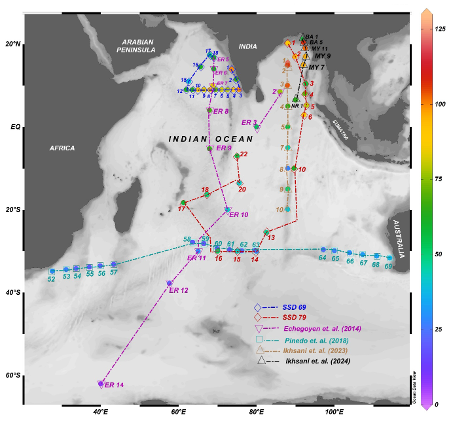
Figure : The map illustrates the surface dissolved lead (dPb) concentration in the Indian Ocean, with coloured circles representing dPb levels (in pM) ranging from low (violet) to high (red), as indicated by the colour scale bar on the right. The map displays surface dPb concentrations from six cruise tracks. The cruise transects GI10 (blue diamonds) and GI09 (red diamonds) represent data from this study. Pb concentrations reported by Echegoyen et al. (2014) are shown as pink inverted triangles. Cross-over stations include ER 5, ER 7, and ER 11 Echegoyen et al. (2014). Additional data from previous studies include Pinedo et al. (2018) (cyan squares) and Ikhsani et al. (2023, 2024) (brown and black triangles). The labels for each transect are based on previous publications, which can be referred to in their respective references. Figure indicates elevated concentrations of Pb in the surface water of the Northern Indian Ocean, suggesting atmospheric deposition is the primary source of lead. Increased concentration of dPb along 30 ºS transect during this study compared to that observed a decade ago underscores the importance of Indian Ocean Dipole in controlling the aridity and hence the dust input and forest fire supplying lead in these regions.

Reference:

Yadav, C., Singh, S. K., & Chinni, V. (2025). Persistent elevated levels of dissolved lead in the Indian Ocean post-leaded gasoline ban: The impact of anthropogenic activities, sediment desorption, and dust storms. Marine Pollution Bulletin, 215, 117874. Access the paper: 10.1016/j.marpolbul.2025.117874

Latest highlights

Continuous record of the Antarctic Circumpolar Current latitude over the last glacial-interglacial cycles

The meridional positions of the oceanic fronts separating subtropical and Antarctic waters are key to constraining the mechanisms that drive the degassing of deeply-stored CO2 at the end of the glacial periods…

23 Million Years of iron sources reconstructed in the Northwest Pacific Ocean using iron isotopes in a ferromanganese crust

Using iron isotopes and elemental records, Chu and co-workers analysed an iron-manganese crust recovered from the Hongyan Seamount, and reconstructed the sources of dissolved Fe to the Northwest Pacific Ocean…

Variability of the past deep-water masses in the Arabian Sea over the last 41ka

Shukla and colleagues propose a high-resolution authigenic ƐNd record measured from a sediment core located in the eastern Arabian Sea…

Arctic outflows to Davis Strait and the Labrador Sea traced by radionuclide distributions

This study demonstrates that Arctic outflows through the Canadian Arctic Archipelago play a much more significant role than previously recognised.

Rechercher