Scavenging differentiates the distribution of cadmium, nickel, zinc and copper in the North Pacific Ocean
The North Pacific Ocean is located at an end point of thermohaline circulation, where the Pacific Deep Water (PDW) is formed internally with contributions of the Lower Circumpolar Water and the North Pacific Intermediate Water. Zheng and co-authors (2021, see reference below) observed sectional distributions of cadmium (Cd), nickel (Ni), zinc (Zn), and copper (Cu) in the North Pacific Ocean during three GEOTRACES related cruises. Although Cd shows a high correlation with PO4 throughout the distributions, Ni, Zn, and Cu show considerable deviations from the correlation with PO4. Based on the analysis of the mole ratios of dissolved metal (dM) to phosphate (dM/PO4) and the enrichment factor of dM:
EF(dM) = (dM/dAl)seawater/(M/Al)upper crust
They propose that scavenging influences the distribution of these recycled-type metals in the stagnant PDW. They conclude that, among the four metals, Cu is the most affected by scavenging, while Cd is the least affected, and scavenging plays a significant role on Ni and Zn.
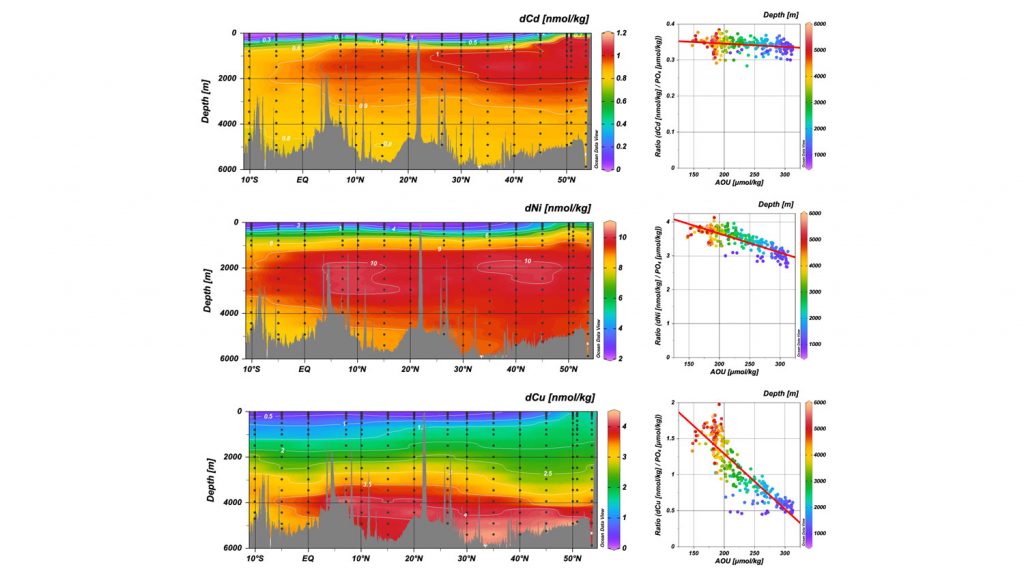
Figure: Left panels: full-depth sectional distributions of dCd, dNi, and dCu from KH-05-2 (along 160°W, 10°S–54°N). Right panels: plots of dM/PO4 vs. apparent oxygen utilization (AOU) at depths > 800 m of the three cruises. AOU is a measure of the age of deep water. The point color indicates depth. Click here to view the image larger.
Reference:
Zheng, L., Minami, T., Takano, S., Ho, T.-Y., & Sohrin, Y. (2021). Sectional distribution patterns of Cd, Ni, Zn, and Cu in the North Pacific Ocean: Relationships to nutrients and importance of scavenging. Global Biogeochemical Cycles, 35, e2020GB006558. https://doi.org/10.1029/2020GB006558