
Regional zinc cycling in the Indian Ocean

Using an extensive database of dissolved Zn (dZn) from multiple GEOTRACES-India section cruises, Chinni and his colleagues (2025, see reference below) has presented the dZn distribution in the Arabian Sea (AS), Bay of Bengal (BoB) and southern tropical Indian Ocean (STIO). Continental shelf inputs are the major Zn sources for the photic waters of the northern Indian Ocean, while soluble atmospheric dust input areis negligible. Thanks to a multiparametric analysis of the water masses, they demonstrated that water mass mixing and scavenging are the primary mechanisms controlling dZn distribution in the region. A strong linear relationship between dZn and silicate is observed everywhere but shows variable slopes, steeper in the STIO than in the BoB and AS. These variations reflect dominant Zn scavenging in the low-oxygen  waters of the Indian Ocean.
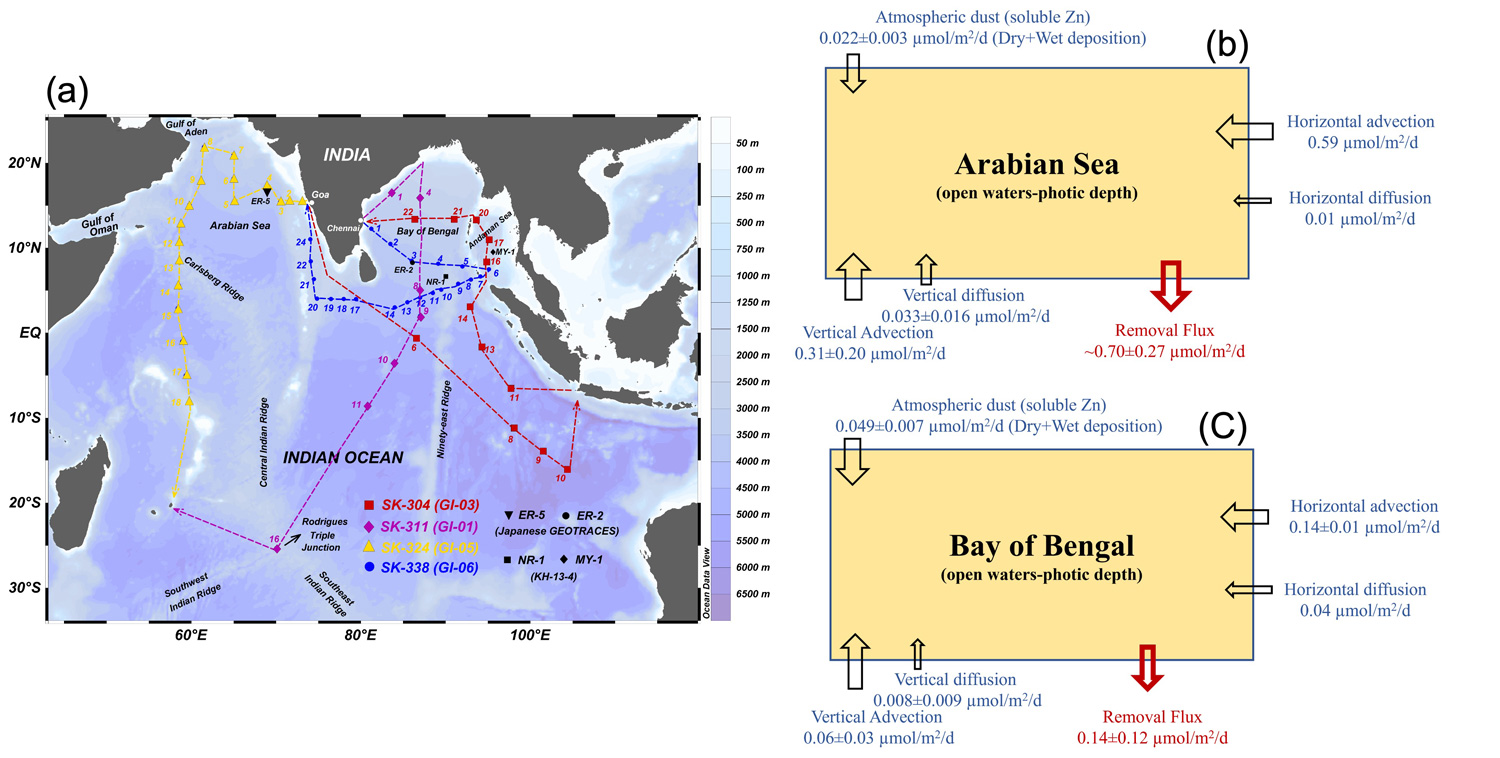
Figure: Left panel: (a) Map showing the sampling locations of dissolved zinc data presented in this study along the GEOTRACES-India section cruises GI03 (March to May 2013), GI01 (March to April 2014), GI05 (September to October 2015), and GI06 (January to March 2017) in the Indian Ocean.
Right panel: Approximated geochemical budget of dissolved zinc in photic waters (top 100 m) of northern Indian Ocean: (b) the Arabian Sea and (c) the Bay of Bengal. The removal flux mentioned in the figure represents the total removal fluxes (both biotic and abiotic).

Reference:

Chinni, V., Singh, N. D., Singh, S. K., & Goswami, V. (2025). Biogeochemical cycling of dissolved zinc in the Indian Ocean. Limnology and Oceanography. Access the paper:10.1002/lno.70286

Latest highlights

Authigenic radiogenic neodymium isotope composition traces millennial-scale overturning circulation variability in the Arabian Sea

The neodymium isotopic signature of the sediment authigenic fraction is, a priori, a valuable proxy for reconstructing deep-water mass trajectories…

Magmatic activity at the Carlsberg Ridge in the Indian Ocean triggered by glacial sea-level variation

De and colleagues provide a high-resolution record of magmatic input and associated hydrothermal activity over the past 49 kyr from a core recovered from a magmatic segment of the slow-spreading Carlsberg Ridge in the Indian Ocean.

Zinc and lead isotopes reveal human footprint on the most remote oceanic regions

Benaltabet and co-workers analysed suspended particles collected on GEOTRACES GP21 cruise tracked from Chile to New Caledonia.

Organic binding site heterogeneity controls amorphous ferric oxy-hydroxides oceanic sink

In oxygenated seawater iron binds to hydroxide ions, which results in authigenic Fe precipitation as amorphous ferric oxy-hydroxide…

Rechercher