
Nutrient-OMICS coupling approach reveals unexpected actors for atmospheric carbon sequestration

While the stimulation of the primary production by atmospheric dust deposits is known for years, interaction between minerals and marine microorganisms is still not well understood. Sharma and colleagues (2024, see reference below) investigated the role of clay minerals in strengthening the marine biological pump.

Using microcosm devices, unfiltered and filtered seawater were sprayed with clay (20 mg L− 1 and 60 mg L− 1) and incubated. All clay treatments led to a tenfold increase in TEP (Transparent Exopolymer Particles) concentration. Associating OMIC tools with the analysis of nutrients and micronutrients released from clays during their experiments, the authors further demonstrate that deposition of continental mineral dust associated clay minerals at the sea surface recruits the heterotrophic bacteria to produce more TEP and trigger a pathway that strengthens the biological carbon pump by (a) converting buoyant dissolved organic matter into settling organoclay flocs, (b) forming and sinking of phytoplankton aggregates in bloom, and (c) mineral ballasting, thereby increasing the mean depth of respiration of particulate organic matter. Moreover, ingestion of organoclay flocs by microzooplankton repackages clay with carbon resulting in fecal pellets with enhanced settling rates.

As there is strong attenuation of particulate organic carbon in the euphotic zone, these results suggest that it is clay minerals (not a solution of iron sulfate, as done in iron fertilization experiments!) whose deposition on sea surface likely increased the carbon export efficiency.
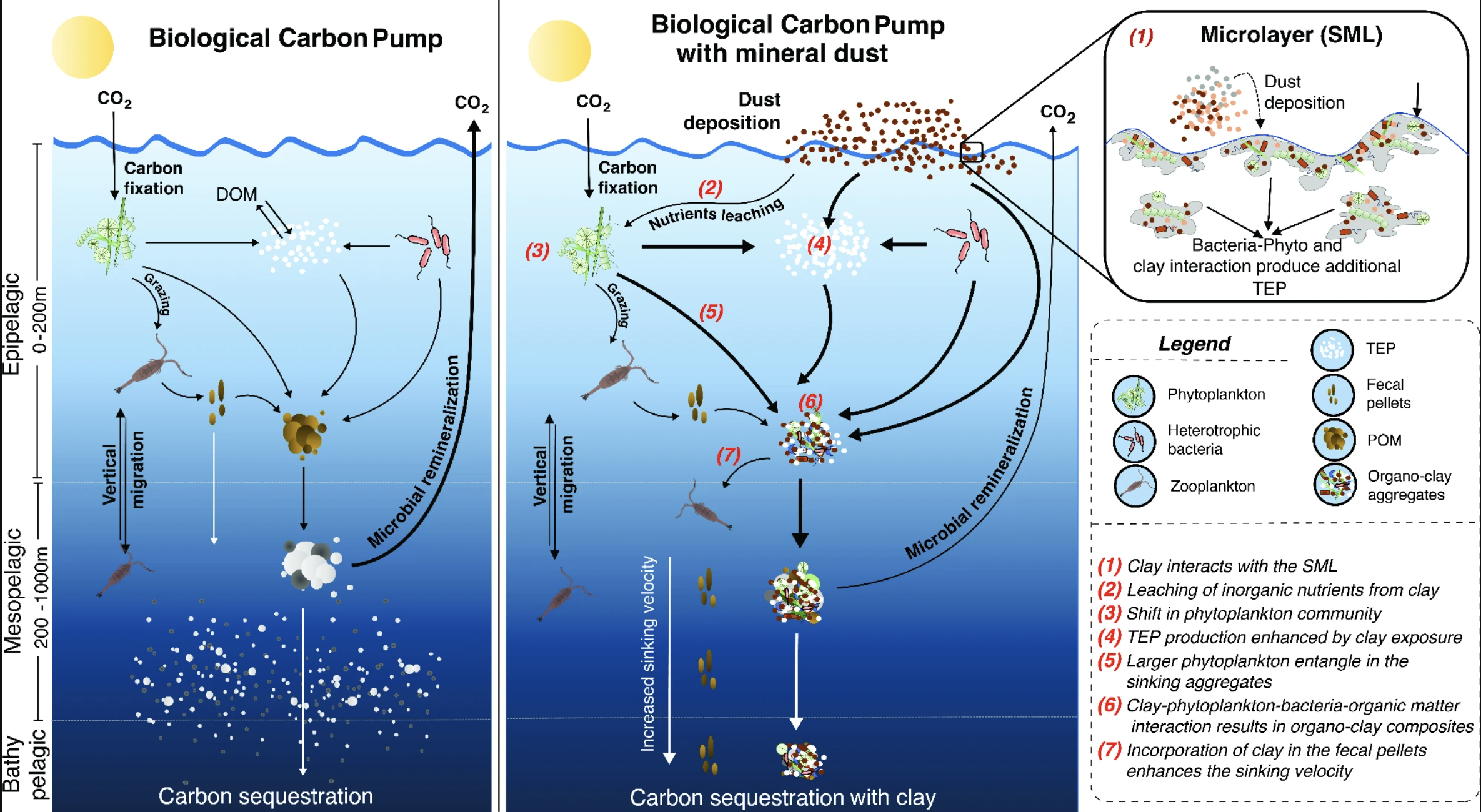
Figure: Scheme comparing the Biological Carbon Pump (BCP, left box) with the BCP augmented by deposition of continental mineral dust at the sea surface (right box). The thickness of the arrows is indicative of the strength of the respective pathways. The BCP exports photosynthetically produced organic carbon in the form of sinking particulate organic matter (POM). The POM aggregation is facilitated by acidic polysaccharides exuded from phytoplankton and heterotrophic bacteria that form transparent exopolymer particles (TEPs)/microgels. The BCP is inefficient in removing atmospheric carbon permanently to the ocean sediment as the bulk inventory of POM is remineralized by marine biota during transport through the epipelagic and mesopelagic. This study suggests that deposition of continental mineral dust associated clay minerals at the sea surface recruits the heterotrophic bacteria to produce more TEP and trigger a pathway that strengthens the BCP by (a) converting buoyant dissolved organic matter into settling organoclay flocs, (b) forming and sinking of phytoplankton aggregates in bloom, and (c) mineral ballasting, thereby increasing the mean depth of respiration of POM. Moreover, ingestion of organoclay flocs by microzooplankton repackages clay with carbon resulting in fecal pellets with enhanced settling rates. They posit that high fecal pellet sinking rates combined with diel migration of microzooplankton further boost the sequestration of atmospheric carbon. The above processes can occur in combination with the changes in productivity and organismal community structure resulting from the deposition of mineral dust.

Reference:

Sharma, D., Menon, V. G., Desai, M., Niu, D., Bates, E., Kandel, A., Zinser, E. R., Fields, D. M., O’Toole, G. A., & Sharma, M. (2024). Organoclay flocculation as a pathway to export carbon from the sea surface. Scientific Reports, 14. Access the paper: 10.1038/s41598-024-79912-z

Latest highlights

Mercury content and isotopes in bird’s guano: a window to reconstruct past climates

By analysing peat cores, Chuxian Li and her colleagues have shown how populations of nesting seabirds have fluctuated on a sub-Antarctic Island over the last 8,000 years.

Contraction of North Atlantic Deep Water during glacial times: a paradigm called into question

Blaser and co-authors propose a new distribution of deep-water masses in the Atlantic Ocean during the Last Glacial Maximum and the Heinrich Stadial..

Authigenic radiogenic neodymium isotope composition traces millennial-scale overturning circulation variability in the Arabian Sea

The neodymium isotopic signature of the sediment authigenic fraction is, a priori, a valuable proxy for reconstructing deep-water mass trajectories…

Magmatic activity at the Carlsberg Ridge in the Indian Ocean triggered by glacial sea-level variation

De and colleagues provide a high-resolution record of magmatic input and associated hydrothermal activity over the past 49 kyr from a core recovered from a magmatic segment of the slow-spreading Carlsberg Ridge in the Indian Ocean.

Rechercher