
North – South contrasting behavior of dissolved cobalt in the Indian Ocean

Cobalt (Co) plays an important role as a rare bioactive trace metal vital to phytoplankton in the global ocean. Malla and Singh (2024, see reference below) have studied the complex biogeochemical processes of total dissolved cobalt (dCo) in the Indian Ocean and highlight the crucial sources of dCo as fluvial inputs, atmospheric dust, the continental shelf and submarine groundwater discharges to surface waters, while the Java-Sumatra subduction zone acts as a supplier of dCo to deep waters. Although the waters of the Arabian Sea oxygen minimum zone (OMZ) have a dCo cycle similar to that of the World Ocean OMZ, the BoB has a peculiar dCo distribution with surface maxima that are attributed to its large input of fluvial, atmospheric and shelf sediments into surface waters. Authors alert that due to the complex internal cycling of dCo with dissolved oxygen, the global climate change and ocean deoxygenation will severely affect the dCo reservoir in the water column.
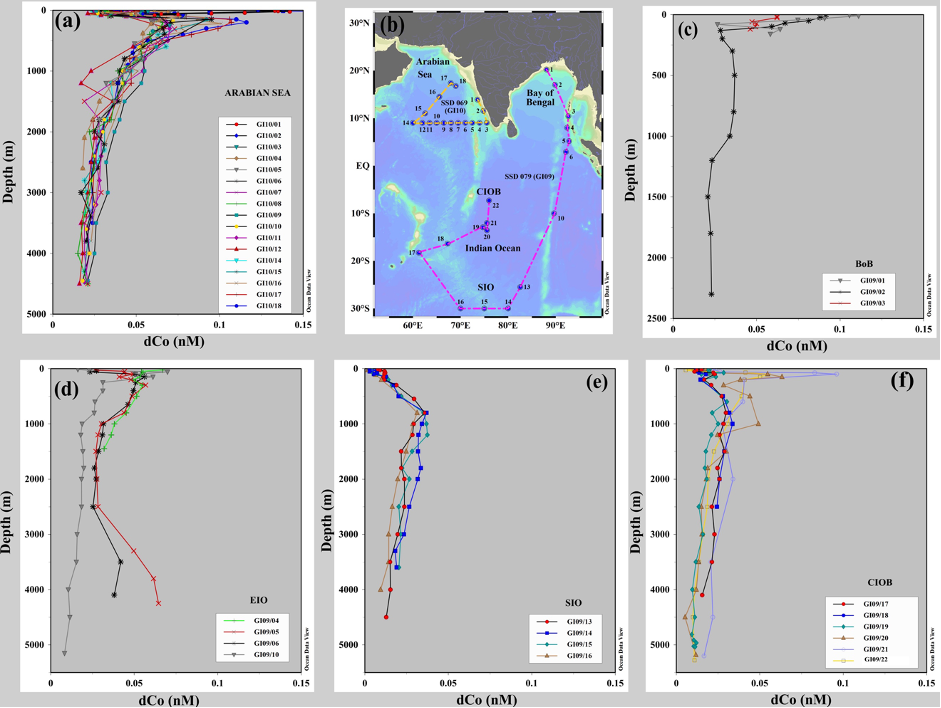
Figure: Vertical profiles of dissolved cobalt (dCo) in the Indian Ocean. The dCo distribution over the Bay of Bengal, the Arabian Sea, the central Indian Ocean basin and the southern sector of the Indian Ocean displays contrasting behaviour: nutrient-type in the southern sector, hybrid-type in the Arabian Sea, whereas scavenged type in the Bay of Bengal. Higher surface concentration in the Bay of Bengal could be attributed to the combined effect of high riverine input, atmospheric dust, shelf supply, and SGD. The scavenging type of profile of dCo in the Bay of Bengal is also associated with low biological productivity, thereby lower utilisation of Co through biological uptake.

Reference:

Malla, N., & Singh, S. K. (2024). Spatial Variability of Dissolved Cobalt in the Indian Ocean Waters: Contrasting Behavior in the Arabian Sea, the Bay of Bengal and the Southern Sector of the Indian Ocean. Global Biogeochemical Cycles, 38. Access the paper: 10.1029/2024gb008291

Latest highlights

Do not mourn Nobias any longer: InertSep ME-2 is coming!

Thanks to the thorough development proposed by Alifia and co-workers, the community may have a solution to the shortage of Nobias Chelate PA-1.

Tracing the origin of iron in the equatorial Pacific: an isotopic study

The equatorial Pacific Ocean is a region of contrasts: in the west, rivers and sediments supply large amounts of iron, while in the east, iron deficiency limits the growth of phytoplankton…

Comprehensive inverse model constrains the application of beryllium-7 as a deposition tracer

Measurements of beryllium-7 activity in surface waters provide a promising approach for quantifying the deposition of aerosol-bound elements at the ocean surface…

Long-range transport of iron off the Antarctic Peninsula

Tian and co-authors investigate dissolved iron concentrations and isotope compositions in the western Weddell Sea…

Rechercher