
Neodymium isotopes trace past Antarctic Intermediate Water circulation in the Arabian Sea

In paleoclimatology, Younger Dryas (YD, 12ka BP) and Heinrich Stadials (HS1, 16 ka BP and HS2, 25 ka BP) are identified as very cold events at the end of the Last Glacial Maximum (LGM).  The potential shutdown of the North Atlantic Deep Water (NADW or its glacial equivalent) during these events might have impacted the dynamics of the Antarctic Intermediate Water (AAIW), which is one of the main actors ventilating the Arabian Sea. Reconstructing this ventilation in the North West Indian Ocean was the goal of Shukla and co-authors (2026, see reference below). To tackle this issue, the authors measured at high resolution the neodymium (Nd) isotopic composition (over the last ~29 ka, expressed as eNd) on the authigenic and silicate phases of sediments from a core collected off Goa. They revealed a pronounced temporal variation (-9.5 to -6.1) throughout the core, marked by an enhanced radiogenic Nd signature during the YD, HS1, and HS2. The more radiogenic Nd signatures reflect an increase in the northward penetration of AAIW into the Northern Indian Ocean. Their interpretation is that when the Atlantic Meridional Overturning Circulation (AMOC) was decelerating, the formation of AAIW in the Southern Ocean increased. Last but not least, their data are consistent with Atlantic and Pacific past circulation reconstructions.
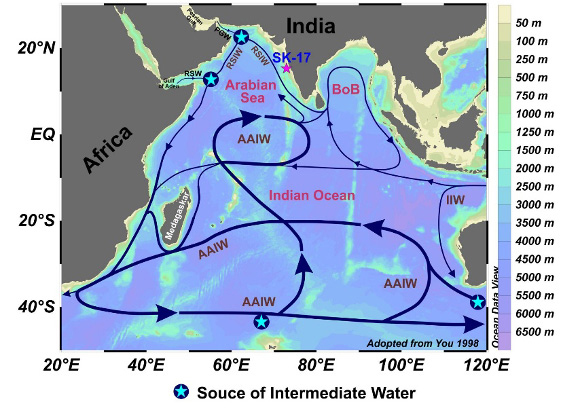
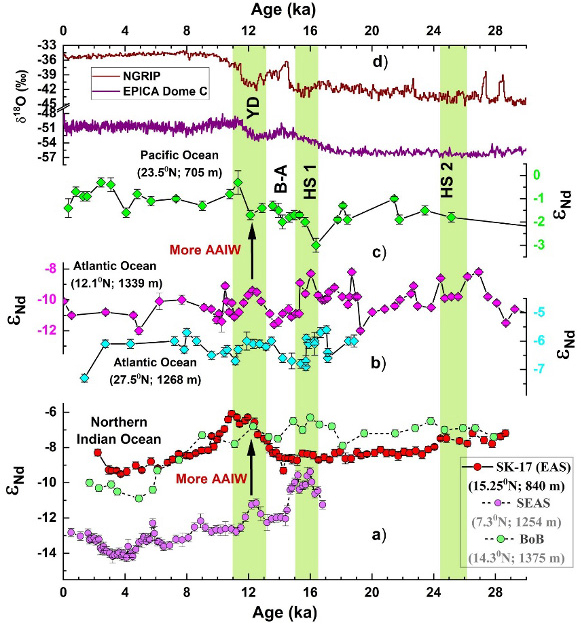
Figure: Schematic of major intermediate water masses and circulation pathways in the Indian Ocean, adopted from You (1998), overlaid on bathymetry. Arrows indicate the advection of Antarctic Intermediate Water (AAIW), Red Sea Water (RSW), Persian Gulf Water (PGW), and Indonesian Intermediate Water (IIW) into the Arabian Sea (AS) and Bay of Bengal (BoB). Blue stars mark major source regions of intermediate waters, while the pink star indicates the location of core SK-17 in the eastern Arabian Sea (15.25°N, 72.96°E; 840 m water depth). The ƐNd record of the studied core (SK-17) is compared with published intermediate-water ƐNd records from different regions of the global oceans and with ice-core δ¹⁸O records, together with major climatic events. (a) ƐNd records from the Northern Indian Ocean, including the present study from the eastern Arabian Sea (SK-17) (b) ƐNd records from Atlantic intermediate-depth cores KNR159-5-36GGC and MD99-2198 (Pahnke et al., 2008); and (c) ƐNd record from the Pacific intermediate-depth core MV99-GC31/PC08 (Basak et al., 2010). More radiogenic ƐNd values during the Younger Dryas and Heinrich Stadials in the northern Indian Ocean suggest enhanced influence of southern-sourced Antarctic Intermediate Water linked to large-scale reorganization of intermediate-water circulation during periods of weakened AMOC.

Reference:

Shukla, A., Mishra, T. K., Singh, S. K., & Singh, A. D. (2025). Substantial invasion of Antarctic Intermediate Water into the Arabian Sea during Younger Dryas and Heinrich Stadials. Quaternary Science Reviews, 349, 109115. Access the paper: 10.1016/j.quascirev.2024.109115

Latest highlights

Do not mourn Nobias any longer: InertSep ME-2 is coming!

Thanks to the thorough development proposed by Alifia and co-workers, the community may have a solution to the shortage of Nobias Chelate PA-1.

Tracing the origin of iron in the equatorial Pacific: an isotopic study

The equatorial Pacific Ocean is a region of contrasts: in the west, rivers and sediments supply large amounts of iron, while in the east, iron deficiency limits the growth of phytoplankton…

Comprehensive inverse model constrains the application of beryllium-7 as a deposition tracer

Measurements of beryllium-7 activity in surface waters provide a promising approach for quantifying the deposition of aerosol-bound elements at the ocean surface…

Long-range transport of iron off the Antarctic Peninsula

Tian and co-authors investigate dissolved iron concentrations and isotope compositions in the western Weddell Sea…

Rechercher