
Long-range transport of iron via the Agulhas Current and counter-current: a boon for the phytoplankton
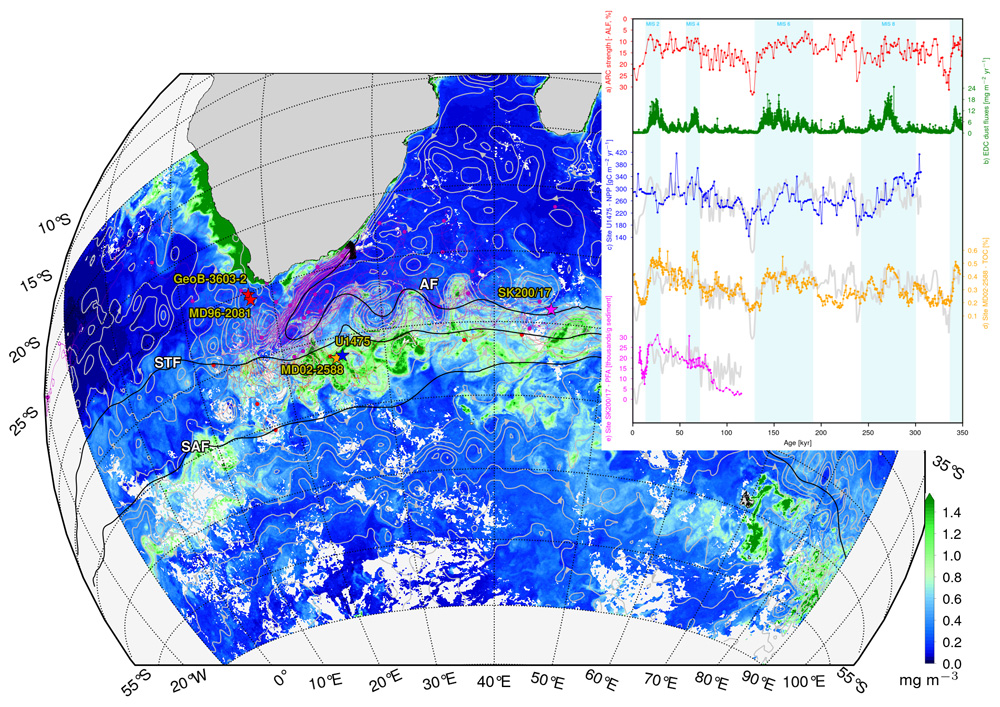
Bucciarelli, Penven et al. (2025, see reference below) combined float trajectories with high-resolution model diagnostics, thus could establish that a significant iron fertilisation was explaining the huge phytoplankton bloom recurrently observed in the western Indian Subantarctic Zone. They show that the energetic Agulhas current is leaching sedimented iron over the African margin, crossing the Subtropical Front via the region’s intense mesoscale eddy variability with the Agulhas Return Current (ARC), eventually transporting iron through the Sub Tropical Front (STF) and extending into the Sub Antarctic Zone (SAZ). So far, it was established that aeolian inputs to this area support only about half of the biological iron demand in the SAZ. The results of Bucciarelli, Penven et al. contribute to balance the dissolved iron budget for this region, which productivity represents 20–40% of Southern Ocean carbon export to the deep ocean. Beyond the present fertilisation, the authors also hypothesised that the past ARC variability could have influenced past productivity across much of the western Indian SAZ, providing a convincing reconstruction over the past 350 ka.
Reference:
Bucciarelli, E., Penven, P., Pous, S., & Tagliabue, A. (2025). Western Indian subantarctic phytoplankton blooms fertilized by iron-enriched Agulhas water. Nature Geoscience, 18, 1152–1158. Access the paper:10.1038/s41561-025-01823-z
Read also the “Behind the paper” post: https://communities.springernature.com/posts/the-southern-agulhas-leakage-a-source-of-iron-for-the-southern-ocean?channel_id=behind-the-paper