
Lead isotopes, reversible scavenging and ventilation processes in the South Atlantic Ocean

Olivelli and co-authors (see reference below) present seawater lead concentrations and lead isotopes for 10 depth profiles collected in the South Atlantic Ocean as part of the GA02 and GA10 GEOTRACES cruises. Using an extended optimum multiparameter (eOMP) analysis, allowing them to deconvolute the horizontal (advected) from the vertical (scavenged) lead transport, they 1) confirm that anthropogenic lead is transported to the deepest part of the ocean by reversible scavenging, 2) show that this reversible scavenging is intensified in areas characterised by high particle loads as for example the Brazil-Malvinas confluence area, and 3) warn us to use isotope lead ratios to trace water mass movements and/or ocean ventilation in areas rich in particles, where reversible scavenging is expected to be strong.
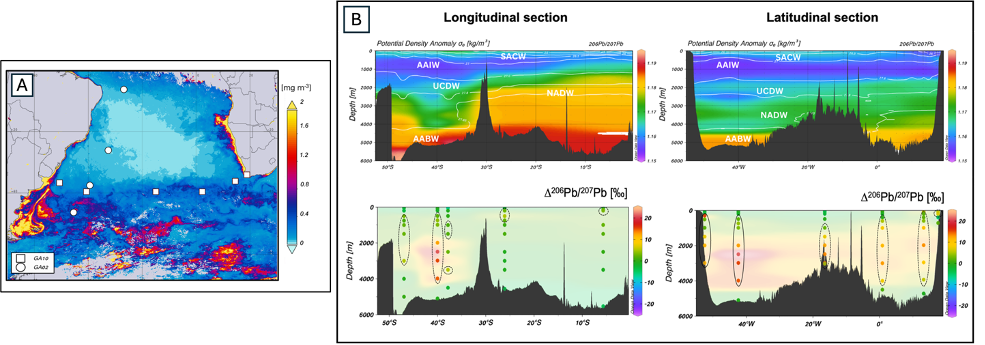
Figure: A) Sampling locations for Pb on GEOTRACES cruises GA02 Leg 3 (circles) and GA10 (squares). Background: monthly averaged surface chlorophyll-a concentrations in January 2012. B) Top: 206Pb/207Pb distribution on the longitudinal (GA02 + near-crossover station from GA10) and the latitudinal (GA10) sections. Bottom: Relative differences in modelled versus observed 206Pb/207Pb. Modelled values are obtained by the output of the eOMP analysis. Samples enclosed within black ellipses have a model-observation offset larger than the model’s uncertainty, therefore suggesting that reversible scavenging is altering the advected Pb isotope composition at those locations.

Reference:

Olivelli, A., Paul, M., Xu, H., Kreissig, K., Coles, B. J., Moore, R. E. T., Bridgestock, L., Rijkenberg, M., Middag, R., Lohan, M. C., Weiss, D. J., Rehkämper, M., & van de Flierdt, T. (2024). Vertical transport of anthropogenic lead by reversible scavenging in the South Atlantic Ocean. Earth and Planetary Science Letters646, 118980. Access the paper: 10.1016/j.epsl.2024.118980

Latest highlights

Mercury content and isotopes in bird’s guano: a window to reconstruct past climates

By analysing peat cores, Chuxian Li and her colleagues have shown how populations of nesting seabirds have fluctuated on a sub-Antarctic Island over the last 8,000 years.

Contraction of North Atlantic Deep Water during glacial times: a paradigm called into question

Blaser and co-authors propose a new distribution of deep-water masses in the Atlantic Ocean during the Last Glacial Maximum and the Heinrich Stadial..

Authigenic radiogenic neodymium isotope composition traces millennial-scale overturning circulation variability in the Arabian Sea

The neodymium isotopic signature of the sediment authigenic fraction is, a priori, a valuable proxy for reconstructing deep-water mass trajectories…

Magmatic activity at the Carlsberg Ridge in the Indian Ocean triggered by glacial sea-level variation

De and colleagues provide a high-resolution record of magmatic input and associated hydrothermal activity over the past 49 kyr from a core recovered from a magmatic segment of the slow-spreading Carlsberg Ridge in the Indian Ocean.

Rechercher