
Iron and zinc isotopes disentangle the anthropogenic, natural and wildfire sources of aerosols over the North and Equatorial Pacific Ocean
Bunnell and co-authors (2025, see reference below) analysed total, size-fractionated, and water-soluble aerosol iron (Fe) and zinc (Zn) isotopic compositions as well as presenting aerosol enrichment factors for some trace metals such as vanadium (V), aluminium (Al), cadmium (Cd) and lead (Pb) along the North Pacific GEOTRACES GP15 section (Alaska-Tahiti). The iron isotopic signatures clearly identify that North Pacific aerosols are sourced from Asian dust mixed with a fraction of anthropogenic Fe, the latter being identified by the light isotopic signature of the soluble aerosol Fe. Contrastingly, Equatorial Pacific aerosols also include a wildfire contribution originating from the American continent: the isotopically heavy end member of the wildfire Fe is attributed to a pyroconvective entrainment of soil. Bulk and soluble aerosol Zn are isotopically light throughout the transect, indicating pervasive anthropogenic Zn sources.
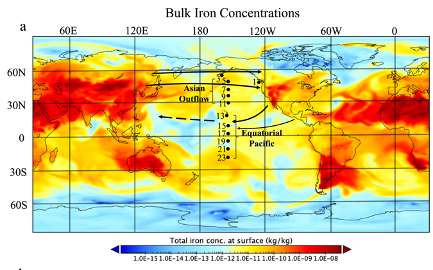
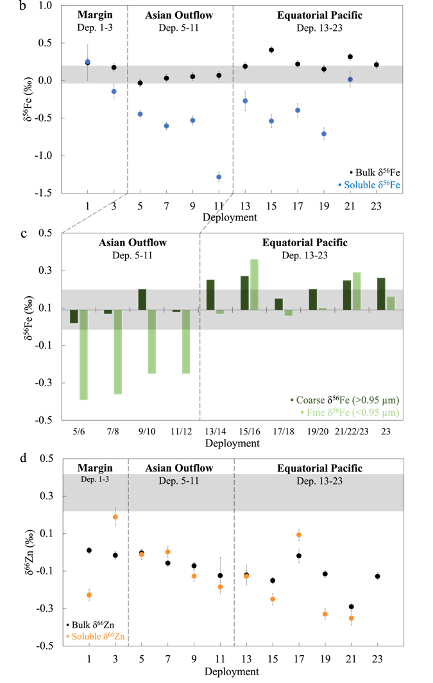
Figure: (a) GP15 aerosol deployment map overlaid on a daily (3 October 2018) Fe aerosol model output map showing concentrations (CAM6-MIMI). (b) Bulk (black) and water-soluble (blue) δ56Fe from Asian Outflow and Equatorial Pacific deployments. (c) Coarse (dark green) and fine (light green) size-fractionated δ56Fe from Asian Outflow and Equatorial Pacific deployments. (d) Bulk (black) and water-soluble (orange) δ66Zn from Asian Outflow and Equatorial Pacific deployments. Grey boxes in (a) and (b) represent the natural range of Fe aerosols (Gong et al., 2017) and the grey box of (c) is the natural range of Zn aerosols (Little et al., 2014).
References:
Bunnell, Z. B., Sieber, M., Hamilton, D. S., Marsay, C. M., Buck, C. S., Landing, W. M., John, S. G., & Conway, T. M. (2025). The Influence of Natural, Anthropogenic, and Wildfire Sources on Iron and Zinc Aerosols Delivered to the North Pacific Ocean. Geophysical Research Letters, 52. Access the paper:10.1029/2024gl113877
Gong, Y., Xia, Y., Huang, F., & Yu, H. (2017). Average iron isotopic compositions of the upper continental crust: constrained by loess from the Chinese Loess Plateau. Acta Geochimica, 36, 125-131.
Little, S. H., Vance, D., Walker-Brown, C., & Landing, W. M. (2014). The oceanic mass balance of copper and zinc isotopes, investigated by analysis of their inputs, and outputs to ferromanganese oxide sediments. Geochimica et Cosmochimica Acta, 125, 673-693.