
Glacial erosion processes suspected to enhance the lability of particulate iron, with a strong influence on the biological demand in the subantarctic waters

As part of the GEOTRACES process study HEOBI (GIpr05) van der Merwe and co-workers (2019, see reference below) conducted a thorough characterization of the labile and refractory iron phases of the particles discharged to the local seawater by the glacial erosion and rivers of Heard and Mc Donald islands (Southern Indian Ocean). They demonstrate that, together with their specific lithology, the fraction of labile iron is significantly larger for particles that experienced glacial weathering processes than for particles of submarine hydrothermal origin. Moreover, they estimate that this labile particulate iron supplied from Heard and to a lesser extent, McDonald Island, is likely the missing iron required meeting biological demand over the plateau, downstream of the islands where traditionally an intense seasonal bloom develops.
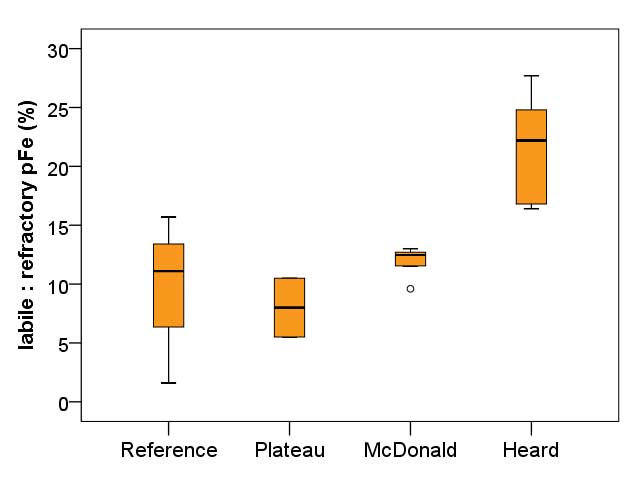
Figure: Mixed layer, mean labile fraction of pFe (ratio of labile to refractory pFe) at each of the contrasting regions within the study. Heard Island displayed a significantly higher mean labile fraction compared to all other sites, including the reference station (one-way ANOVA, Games-Howell post hoc, p < 0.01). Furthermore, in addition to the ratio of labile to refractory Fe being higher at Heard Island, the absolute concentration of labile particulate Fe (pFelab) was also significantly higher at Heard Island (115 ± 34 nM, n = 9) compared to McDonald Island (79 ± 20 nM, n = 12) (one-way ANOVA, Games-Howell post hoc, p < 0.01). Standard boxplot median (centre black line), 25th and 75th percentiles (upper and lower box limits) and 95% confidence intervals (inner fences) are indicated. Outliers are shown as open circles and defined as less than 1.5 times the interquartile range. The number of independent data points for the reference, plateau, McDonald and Heard regions were 3, 2, 8 and 9 respectively. Click here to view the figure larger.

Reference :

van der Merwe, P., Wuttig, K., Holmes, T., Trull, T. W., Chase, Z., Townsend, A. T., Goemann, K., Bowie, A. R. (2019). High Lability Fe Particles Sourced From Glacial Erosion Can Meet Previously Unaccounted Biological Demand: Heard Island, Southern Ocean. Frontiers in Marine Science, 6, 332. DOI: https://doi.org/10.3389/fmars.2019.00332

Latest highlights

Zinc and lead isotopes reveal human footprint on the most remote oceanic regions

Benaltabet and co-workers analysed suspended particles collected on GEOTRACES GP21 cruise tracked from Chile to New Caledonia.

Organic binding site heterogeneity controls amorphous ferric oxy-hydroxides oceanic sink

In oxygenated seawater iron binds to hydroxide ions, which results in authigenic Fe precipitation as amorphous ferric oxy-hydroxide…

Microbial trace metal transport in distinct water masses of the Southern Indian Ocean

Zhang and colleagues used genes coding for membrane transporters as proxies to map the distribution of the uptake and efflux of the trace metals…

Contraction of North Atlantic Deep Water during glacial times: a paradigm called into question

Blaser and co-authors propose a new distribution of deep-water masses in the Atlantic Ocean during the Last Glacial Maximum and the Heinrich Stadial 1…

Rechercher