
Constraining Oceanic Copper Cycling through Artificial Intelligence and Ocean Circulation Inverse Model

Using available observations of dissolved copper (Cu), artificial neural networks, and an ocean circulation inverse model, Roshan and collaborators (2020, see references below) calculated a global estimate of the 3-dimensional distribution and cycling of dissolved Cu in the ocean (see Figure). Among the most striking features, they reveal that: (1) the highest surface dissolved Cu concentrations and the highest rates of dissolved Cu export occur in the Southern Ocean and, and (2) Cu is removed predominantly in the ocean interior but a near-sediment source sustains its vertical accumulation.
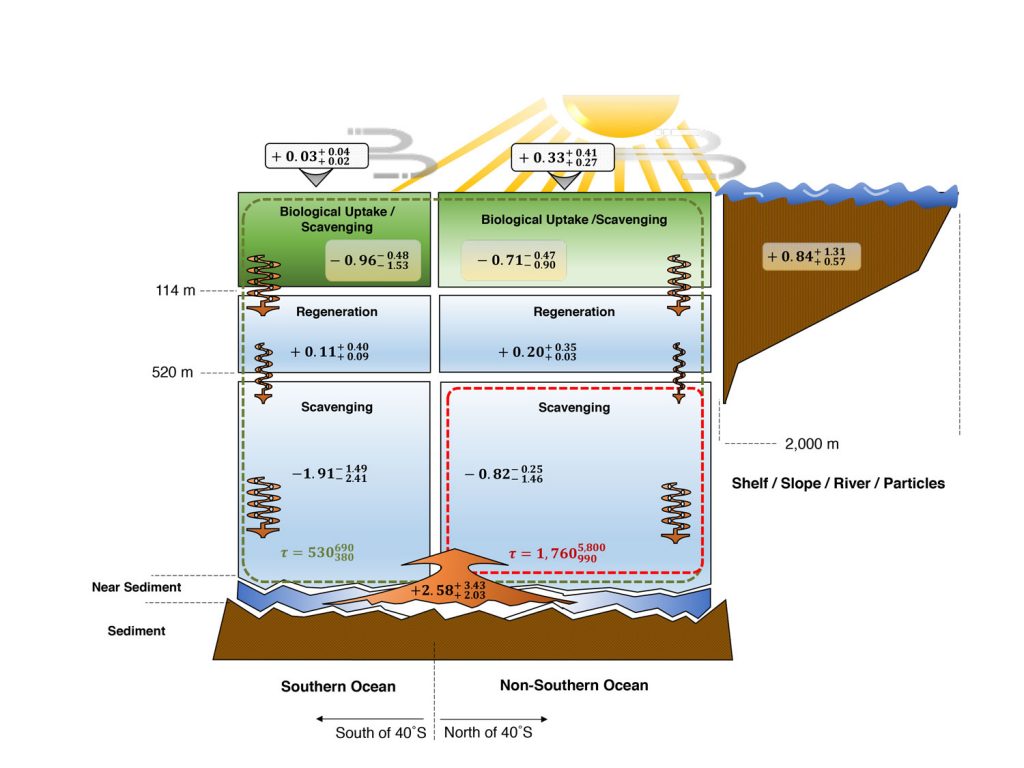
Figure: Estimates of dissolved copper rates (in Gmol yr-1; positive = added, negative = removed) and its water column residence times (τ; in years). Modified from Roshan et al., 2020.

References:

Roshan, S., DeVries, T., & Wu, J. (2020). Constraining the Global Ocean Cu Cycle With a Data‐Assimilated Diagnostic Model. Global Biogeochemical Cycles, 34. DOI: https://doi.org/10.1029/2020GB006741

Roshan, S., DeVries, T. & Wu, J. (2020). Dissolved Copper Climatology. figshare. DOI: https://doi.org/10.6084/m9.figshare.11827908.v2 

Latest highlights

Tracing the origin of iron in the equatorial Pacific: an isotopic study

The equatorial Pacific Ocean is a region of contrasts: in the west, rivers and sediments supply large amounts of iron, while in the east, iron deficiency limits the growth of phytoplankton…

Comprehensive inverse model constrains the application of beryllium-7 as a deposition tracer

Measurements of beryllium-7 activity in surface waters provide a promising approach for quantifying the deposition of aerosol-bound elements at the ocean surface…

Long-range transport of iron off the Antarctic Peninsula

Tian and co-authors investigate dissolved iron concentrations and isotope compositions in the western Weddell Sea…

When cadmium faces the Black Sea contrasting environment

Dickson and his colleagues investigated the fate of cadmium in the Black Sea using its concentration and isotopic composition.

Rechercher