
A refined neodymium parameter modelling study reveals differing controls on neodymium cycling in the Atlantic and Pacific Oceans
Since neodymium (Nd) isotopes are used as proxies for past ocean circulation and, more rarely, past weathering, constraining the modern Nd cycle is a major challenge for marine geochemists. In particular, there has been an ongoing debate within the community regarding where most Nd enters the ocean. Does it originate from surface inputs (the “top-down” hypothesis) or from bottom inputs (the “bottom-up” hypothesis)?
Wise and colleagues address this question using a refined Global Neodymium Ocean Model (GNOM) embedded within the data-constrained inverse model OCIM2. Their simulations test the relative importance of the main potential Nd sources: dust, sediments, and rivers. For sedimentary sources, they further distinguish between shallow-only and deep-only sediment inputs. Reversible scavenging is implemented as the main driver of the internal Nd cycle using four particle types: biogenic silica, mineral dust, particulate organic carbon, and Fe-Mn oxide precipitates.
Their results show that, on a global scale, the best fit is obtained with a top-down sedimentary source, Nd being sourced from surface inputs, i.e., rivers and dust combined with shallow sediments (above 2000 m depth). They also confirm that the manganese (Mn) oxides are the most important particle type for reversible scavenging of Nd in the water column.
Moreover, Wise’s work highlights an original result, underlining how the Nd cycle differs between the Atlantic and the Pacific. In short, top-down processes are dominant in the Atlantic Ocean while the sedimentary sources explain the Pacific Nd isotopic distribution. While shallow and reactive sediments are essential for setting the Pacific Nd isotopic distribution, deep sediments also play an important role.
These findings are an important step forward in the understanding of the modern Nd oceanic cycle, with important consequences for its paleo applications, which are discussed in the last section of the paper… let’s read it!
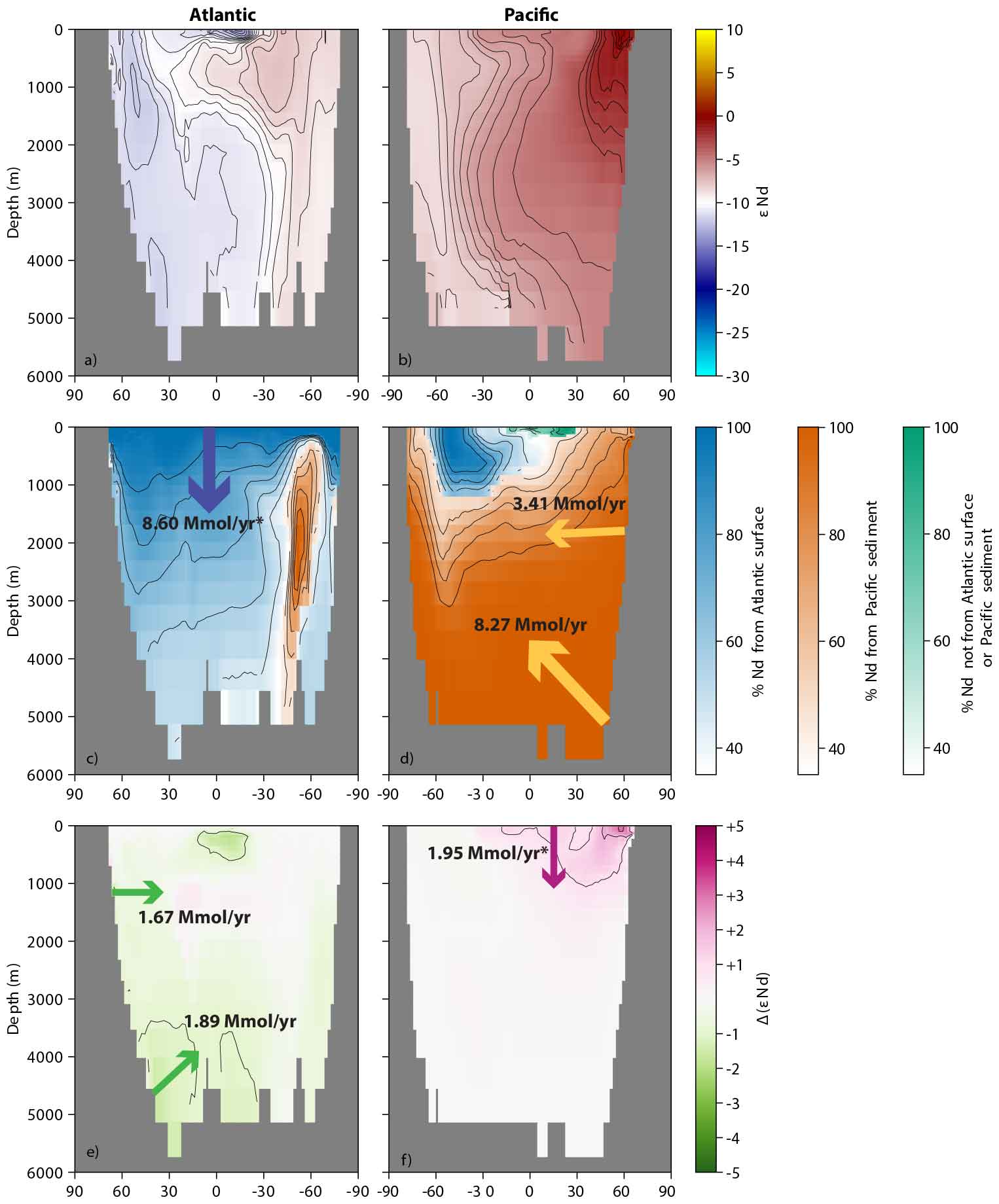
Meridional depth sections of modelled seawater εNd and Nd source attribution for the Atlantic (left column) and Pacific (right column) from the optimized GNOM model. Panels (a–b) show the modelled εNd distribution, with the Atlantic exhibiting strongly negative values throughout (reaching −25 to −30 εNd units in the deep North Atlantic) reflecting unradiogenic riverine and dust inputs, while the Pacific is uniformly more radiogenic (approaching 0 to +10 εNd units) due to influence from volcanic island arcs and reactive seafloor sediments. Panels (c–d) quantify the fraction of the Nd inventory derived from Atlantic surface sources (blue; panel c) versus Pacific sedimentary sources (orange; panel d), with annotated arrows indicating the magnitude of the dominant flux pathways (Mmol/yr); Atlantic Nd is overwhelmingly supplied from the surface (8.60 Mmol/yr), whereas Pacific Nd is dominated by large benthic sedimentary fluxes (8.27 and 3.41 Mmol/yr). Panels (e–f) show perturbation experiments in which specific source fluxes are removed, with the resulting change in εNd (Δ(εNd), ±5 units) revealing that Atlantic isotope compositions are insensitive to sedimentary inputs while Pacific compositions shift dramatically basin-wide without sedimentary sources, confirming a top-down (surface-driven) regime in the Atlantic and a bottom-up (sediment-driven) regime in the Pacific.
Reference:
Wise, P. M., Pasquier, B., John, S. G., & Hines, S. K. V. (2026). Differing Controls on the Cycling of Neodymium in the Atlantic and the Pacific. Geophysical Research Letters, 53. Access the paper:10.1029/2025gl117334